The Empathy Trap With a Narcissist
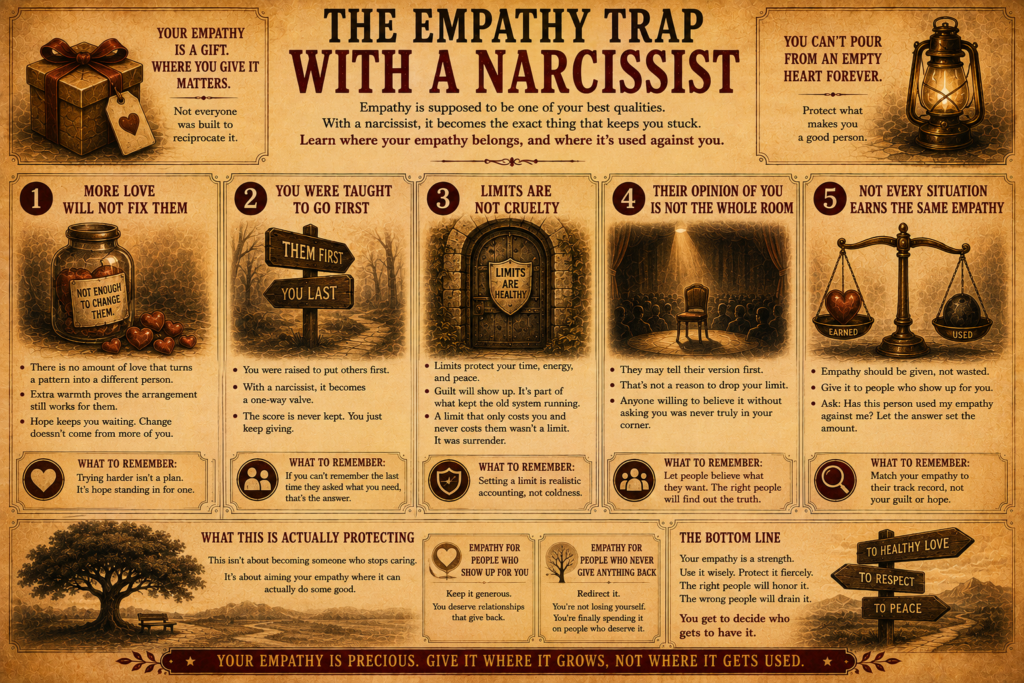
Empathy is supposed to be one of your best qualities, and with almost everyone in your life, it is. The trouble starts with a narcissist, because empathy assumes the other person will eventually give something back, and this specific kind of person is built not to. So the very trait that makes you a good partner, friend, or parent becomes the exact thing that keeps you stuck, still trying to reach someone who was never going to meet you halfway. This is not a case for becoming a colder person. It is about learning where your empathy actually belongs, and where it is just fuel for someone using it against you. Here are five ways that trap sets itself, and how to close it.
More love will not fix them
Staying and giving more, certain that enough warmth will finally reach the good version of them underneath, is a decent instinct aimed at the wrong lock. There is no amount of love that turns a pattern into a person who was not already running that pattern before you arrived. Every bit of extra warmth mostly proves one thing to them: the current arrangement still works, so there is no reason to change it.
Notice if “I just need to try harder” has been the plan for months or years with nothing to show for it but more of the same. Waiting for someone to become who you need them to be is not a strategy. It is hope standing in for one, and hope does not need your empathy to keep running. It just needs you to stop checking whether the plan is actually working.
You were taught to go first
A lot of us were raised to believe that putting other people first is simply what a good person does, quietly, without keeping score. That is a fine rule for people who eventually reciprocate. With a narcissist it turns into a one-way valve: you keep going first, they keep receiving, and the score never gets kept, because keeping it would mean noticing how lopsided things have become.
Notice how long it has been since anyone asked what you needed first, not as an afterthought tacked onto the end of a conversation about them. If the honest answer is you cannot remember, the rule that used to serve you has quietly turned into a toll you keep paying alone.
Limits are not cruelty
This is the actual fix, and it feels wrong at first because it runs against the instinct. Deciding in advance how much patience, energy, and how many second chances a specific person gets is not coldness. It is realistic accounting, once you already know the investment does not come back.
Guilt shows up right on schedule the first time you actually hold a limit, because guilt was always part of what kept the old arrangement running smoothly. Treat it as background noise, not proof you did something wrong. A limit that only ever costs you and never costs them was never a limit to begin with. It was just a description of what you would silently keep tolerating.
Their opinion of you is not the whole room
Hold a limit and there is a decent chance they tell people their version first, before you have said a word. That is not a reason to drop the limit. Usually it is proof the limit landed somewhere real. You cannot control what gets said about you once you stop being available on demand, and trying to control it by staying available anyway just hands the leverage right back.
Let people believe what they are going to believe. Anyone willing to hand their opinion of you entirely over to someone else’s account, without ever once asking you directly, was not actually in your corner to begin with, whatever they call themselves. The ones who matter will come find out for themselves, on their own time, and the rest were never yours to manage.
Not every situation earns the same empathy
Empathy is not one universal setting you leave on or off for the whole world. It is supposed to move: warm and patient with people who show up for you, careful and limited with people who treat every ounce you hand over as an opening. Giving a narcissist the exact same unguarded empathy you would give someone who has actually earned it is not generosity. It is handing your one real resource to whoever asks the loudest, regardless of what they have done with it before.
Before you extend the usual amount, ask one plain question: has this person, historically, done anything with my empathy except use it against me later. Let the honest answer set the amount. Not the guilt, and not the hope that this time will finally be different.
What this is actually protecting
None of this is about becoming someone who stops caring, and it never was. It is about aiming the caring somewhere it can actually do some good. The empathy that goes to people who show up for you gets to stay exactly as generous as it has always been.
The empathy that keeps getting fed to someone who never gives anything back was not making that person better anyway. It was only ever making it easier for you to stay. Redirect it, and you are not losing the best part of who you are. You are finally spending it on people who deserve to have it.