The Small Habits That Wear You Down
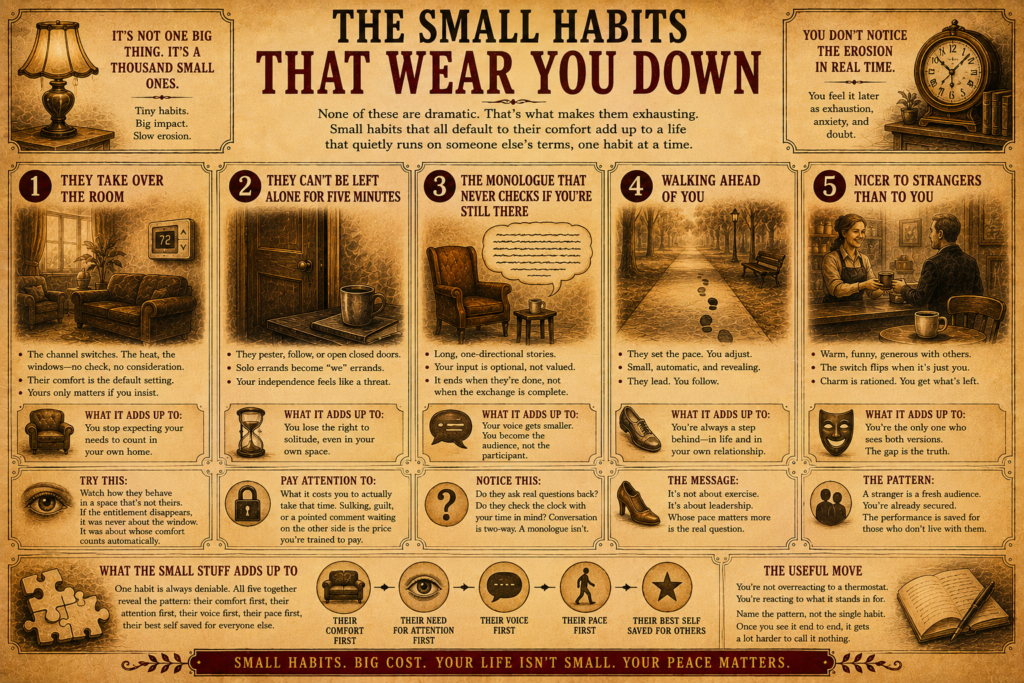
None of what follows is dramatic. That is precisely what makes it exhausting. Nobody leaves a relationship over a thermostat, or a long story, or a closed door that keeps getting opened. Each one, on its own, is too small to even bring up without sounding petty. But small habits that all default to the same thing, their comfort, their attention, their voice, their pace, add up over months and years into a life that quietly runs on someone else’s terms, one unremarkable habit at a time. This is not a list about danger. It is a list about the low, constant static that wears a person down long before anything dramatic ever happens, the kind you laugh off at dinner with friends because saying it out loud makes it sound smaller than it feels to actually live inside. Here are five, and what they add up to once you stop excusing them one at a time.
They take over the room
Watch what happens when a narcissist walks into a shared space. The channel switches. The heat goes up. The windows close, or open, without a word to whoever else is sitting right there. It is not usually meant as hostile. It simply does not occur to them to check, because on some level their comfort reads as the room’s default setting, and everyone else’s is an afterthought that only gets addressed if someone insists on it out loud.
Notice whether shared space actually functions as shared, or whether it quietly runs on their preferences unless you speak up every single time. A room that belongs to two people should not require one of them to constantly assert that fact.
Try a simple comparison. Watch how they behave in a space that is clearly not theirs, a friend’s living room, a hotel lobby, somewhere their comfort is obviously not the default setting. If the entitlement disappears the moment it might cost them something socially, that tells you it was never really about needing the window closed. It was about whose comfort counts automatically, and yours was never going to be the answer at home either.
They can’t be left alone for five minutes
Some narcissists cannot tolerate you existing independently, even briefly. They pester, they follow you from room to room, your closed door becomes something to open rather than respect, and a short solo errand turns into a production about why they should come too. It rarely reads as suffocating at first. It can even feel like devotion for a while, before you notice it is really a low-grade inability to sit with your independence for more than a few minutes at a stretch.
Notice whether uninterrupted time to yourself is simply a normal part of your day, or something you have to actively defend, over and over, like a request rather than a basic feature of anyone’s life. You should not need a good excuse to be alone in your own house for twenty minutes.
Pay attention to what it costs you to actually take that time when you do manage it. A sulk waiting on the other side of the door, a pointed comment about how long you were gone, a mood that has to be managed the moment you come back, all of it teaches the same lesson without ever having to say it out loud: solitude has a price, and the price is paid by you.
The monologue that never checks if you’re still there
Some narcissists talk in long, one-directional stretches with no real read on whether you are still following, or whether you have somewhere to be. Your half of the conversation is optional, background noise the story does not actually need, and the talking ends when they are finished, not when the exchange has run its natural course for both people in it.
Notice whether they ever ask a real question back, the kind that requires listening to the answer, or check the clock with your schedule in mind rather than only their own. A conversation is supposed to run in two directions. A monologue with a listener attached is not the same thing, no matter how it is dressed up.
Walking ahead of you
This one is common enough, and says enough on its own, that it earned its own full look elsewhere. The short version: the pace someone keeps beside you is a small, automatic habit, which is exactly why it is worth paying attention to.
Nicer to strangers than to you
Watch how they treat the barista, the neighbor, a stranger at a party, warm, funny, generous with their attention, and then watch the switch flip the second it is just the two of you again. The charm was never fake exactly. It was simply rationed, spent on people who only ever see the performance, while you get whatever is left over after the good version has already been handed out to everyone else first.
That is why hearing you’re so lucky to have them stings in a way that is hard to explain to the person saying it. They are grading a performance. You are the only audience who has ever actually seen both versions, and the gap between them is the whole story nobody else gets to witness.
The pattern makes a kind of sense once you notice what each audience is actually worth to them. A stranger is a fresh chance to be admired, and admiration from someone new never gets old. You are already secured, already staying, already there tomorrow whether the good version shows up tonight or not, and that certainty is exactly what makes you the one they stop performing for. It runs on a similar clock to why the charm wears off everyone eventually. You simply got there first.
If what you are mostly feeling is the tiredness rather than the individual habits, the mechanism behind that is covered in Why Being Around a Narcissist Is So Exhausting.
What the small stuff actually adds up to
Not one of these five is big enough to build a case around, and that is not an accident, it is the design of it. A single habit is always deniable, always small enough to swallow, always your fault for making an issue out of nothing. But habits are not supposed to be graded one at a time. Line them up and what you get is a pattern: their comfort first, their need for attention first, their voice first, their pace first, their best self saved for people who do not have to live with them.
You are not overreacting to a thermostat. You are reacting, finally, to what the thermostat has always actually been standing in for. Naming the pattern, not any single habit inside it, is what makes the whole thing visible, and once you can see it laid out end to end, it gets a lot harder to talk yourself back into believing it was nothing.