What Happens After You Leave a Narcissist
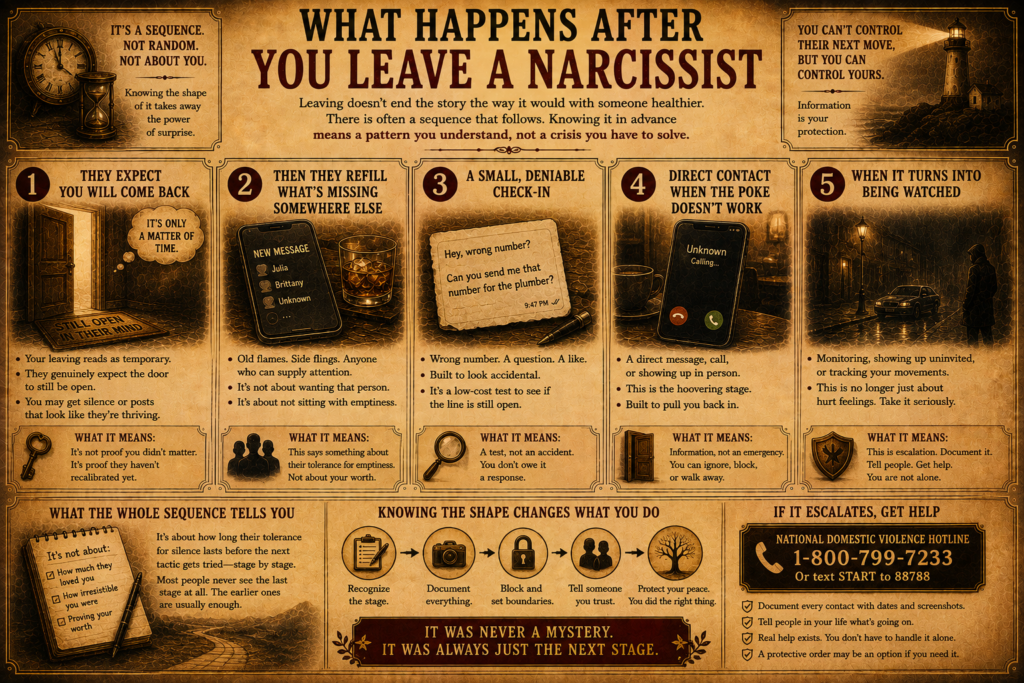
Leaving does not end the story the way it would with someone healthier. There is often a sequence that follows, predictable enough that knowing it in advance can save you from a lot of confusion later. It does not always run the whole way through, and most people who leave never see the far end of it. But knowing the shape of it means that when a stage shows up, it reads as a pattern you already understood, not a personal crisis you have to solve in the moment. Here is what tends to happen, one stage at a time, and what each one actually means.
First comes the certainty that you will come back
Your leaving rarely gets received as real at first. To someone who never separated your worth from what you supplied them, walking away calmly reads as temporary, a mood to wait out rather than a decision that already happened. The confidence is not an act. They genuinely expect the door to still be open, because in every version of this that has worked before, it was.
If you are waiting for a reaction big enough to confirm that you mattered, notice that its absence is not proof you did not. It is proof they have not recalibrated yet. That has nothing to do with what you were actually worth.
This stage can look like nothing at all from the outside, sometimes total silence, sometimes a breezy post about how great life is. Do not mistake either one for peace on their end. It is usually just the confidence stage running quietly, waiting for the part where you are supposed to reach back out first.
Then they refill what is missing somewhere else
While they wait you out, the tank does not stay empty. Old flames, people who were already flirting on the side, anyone who can supply attention on short notice, tend to hear from them during this stretch. It is rarely about wanting that person specifically. It is about not sitting with the silence you left behind for even a day.
Do not read this as proof you were replaceable in some way that should sting less than it does. It says something about their tolerance for an empty tank. It says nothing about what you actually were to be with.
A small, deniable check-in
When you still have not come back, a message or a call tends to arrive that looks accidental: wrong number, a question about something practical, a like on an old photo. It is built to look like nothing, because looking needy would cost them something, but it is not nothing. It is a low-cost test to see whether the line is still open on your end.
You do not owe an accidental-looking message a response, and not responding is not rude. It is simply declining to run the test for them.
Watch the timing of these too, not just the content. A wrong-number text at the exact hour you used to talk every night, or a like on a photo from right around an anniversary, is not a coincidence worth agonizing over. It is a small, deniable knock on a door they are hoping you left unlocked.
Direct contact when the poke does not work
If the quiet test gets nothing back, the approach usually gets louder: a direct message, a phone call, sometimes showing up somewhere you are likely to be. This is the hoovering stage, and it is built to pull you back into contact by any door that is still unlocked, not to actually repair anything.
Treat an unexpected appearance or a sudden direct message as information, not an emergency to manage on their terms. You are allowed to leave a message unanswered, block a number, or simply walk the other way. None of that requires an explanation.
When it turns into being watched
For a smaller number of people, none of the above works, and the escalation continues. Losing control entirely can push some narcissists toward monitoring, showing up uninvited, or tracking your movements through people you both know. This is the point where the situation is no longer just about hurt feelings, and it deserves to be treated with real seriousness, not minimized as an ex who cannot let go.
If this is happening to you, document every contact with dates and screenshots, tell people in your life what is going on so you are not carrying it alone, and know that real help exists specifically for this. In the US, the National Domestic Violence Hotline is 1-800-799-7233, or text START to 88788, and they can help you think through safety planning and legal options, including a protective order if you need one.
What the whole sequence actually tells you
None of this is about how irresistible you were or how much they loved you, whatever the version of events in their head might say. It is about how long their tolerance for silence lasts before the next tactic gets tried, stage by stage, in a fairly predictable order. Most people who leave never see the last stage at all, because the earlier ones are usually enough.
Knowing the shape of it ahead of time changes what you do with each stage when it shows up. Instead of being surprised into a decision, you can document, block, and tell someone, calmly, because you already know what this is and you already know it is not about your worth. It was never a mystery. It was always just the next stage.