Are All Narcissists Dangerous?
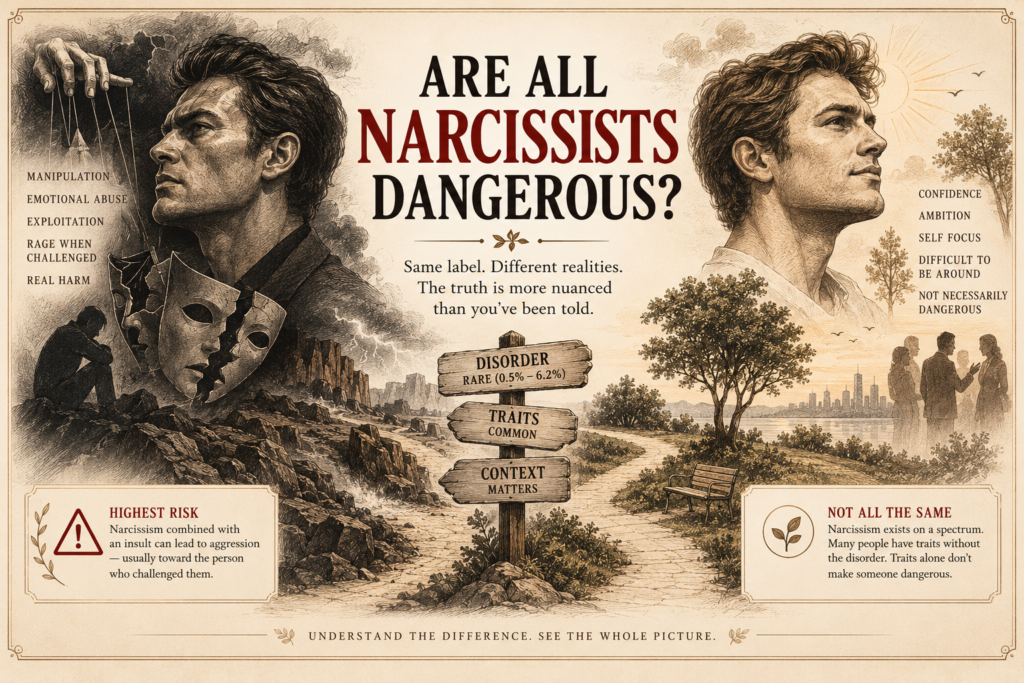
My stepfather was one. I’ve been married to three of them, and the list doesn’t stop there. I’m one of the extreme cases, close enough to the far end that I’ve written about it separately in How Abuse Kills.
I also have some good friends I believe are true narcissists. But are they killers?
That question isn’t academic for me, and nothing below is me going soft on any of it. It’s about people I still take calls from, carrying the same label as the people who did the worst damage of my life. Is every narcissist dangerous? Is every one of them a manipulator, an abuser, somebody capable of the worst thing you can picture? The word gets attached to presidents and billionaires and the guy who cut somebody off in traffic. So what does the research actually say when you go and look?
It says something more specific than either side of this argument wants to hear.
Plenty of people reading this are going to disagree with me, and some are going to be angry that I wrote it at all. I understand why. When you’ve lived through the worst version, any sentence that starts with “not all of them” sounds like the beginning of an excuse, and you’ve probably heard that sentence from somebody who was covering for the person who hurt you. I’m not doing that here, and I’d rather have this argument in the open than publish the version everybody nods along to.
Start With How Rare the Actual Disorder Is
Narcissistic personality disorder is a real diagnosis with real criteria, and it’s uncommon. A systematic review of community studies found an average prevalence of about 1%, although estimates vary widely. One large U.S. epidemiological study found a lifetime prevalence of 6.2%. Depending on the study and methodology, estimates have ranged from near zero to about 6.2%. The DSM has also reported that roughly 50% to 75% of people diagnosed are men.
Sit with that number for a second. If the honest figure is somewhere between one and six people in a hundred, then the great majority of people being called narcissists right now don’t have the disorder. Some of them have elevated traits. Some of them are selfish, or arrogant, or going through something. Some of them are just difficult to be around and some of them are just plain assholes. That’s a different category, and I’ve written about how the word got stretched to cover all of it in Is “Narcissist” Just an Overused Insult Now?
Traits and Disorders Aren’t the Same Thing
Narcissism is measured by researchers as a trait everybody has some amount of, the way everybody has some amount of extraversion. Being somewhat high on it doesn’t mean you have a disorder any more than being somewhat tall makes you a basketball player. Narcissistic traits exist on a continuum, but having more of those traits isn’t by itself the same thing as having NPD. The disorder involves a persistent and pervasive pattern of narcissistic functioning severe enough to cause significant problems in relationships, work, or other areas of life.
It also isn’t one thing. There’s a grandiose version and a vulnerable version, and they behave differently enough that lumping them together produces bad predictions. And narcissism itself is only one member of a small family of traits, which I covered in What Are Dark Personalities? The other members, Machiavellianism and psychopathy, are the ones more consistently tied to genuine exploitation.
What the Violence Research Actually Found
This is the question people really mean when they ask if all narcissists are bad. Are they dangerous. Are they going to hurt somebody.
The most useful study on this is Bushman and Baumeister’s work from 1998, and the finding surprised the field. They measured self-esteem and narcissism separately, then gave people a chance to aggress against someone who had insulted them, or against an innocent third person. Self-esteem turned out to be irrelevant to aggression. The popular idea that low self-esteem causes violence didn’t hold up. What produced exceptionally high aggression was the combination of narcissism and an insult.
The second half of that finding matters just as much. The aggression went at the person who delivered the insult. Displaced aggression, taking it out on an uninvolved third party, was low across the board. So what the research describes isn’t a person who is randomly dangerous to everybody. It’s a person who becomes aggressive when their image of themselves gets challenged, aimed at whoever challenged it.
If you’ve lived with one, that will sound exactly right, and it explains why the danger in your house was so tied to specific moments. It wasn’t weather. It was a response to something, and the something was usually you failing to confirm the story they tell about themselves.
Where the Dark Triad Actually Comes In
People bring up the triad whenever this conversation gets serious. Researchers Delroy Paulhus and Kevin Williams grouped three traits together in 2002 and called them the Dark Triad: narcissism, Machiavellianism, and psychopathy. A fourth, everyday sadism, got added later to make the Dark Tetrad.
The grouping exists because the three overlap and travel together, not because they’re the same. The three overlap, but they’re not interchangeable. Narcissism, particularly its grandiose aspects, has produced some findings that aren’t uniformly negative, while psychopathy and Machiavellianism are more consistently associated with socially aversive outcomes. Machiavellianism is patient and calculating and doesn’t need anyone’s approval. Psychopathy brings callousness plus impulsivity and a weak grip on consequences.
That ordering runs against how the word gets used, because narcissist became the popular name for the entire family. When somebody describes a cold, strategic, patient manipulator who never seemed to need to be liked, they’ll almost always say narcissist, and they’ll almost always be describing Machiavellianism instead. The label that gets attached is often narcissism, even when the behavior being described looks more like the callousness of psychopathy or the calculated manipulation associated with Machiavellianism.
So when people ask whether narcissists are part of the triad, the answer is yes, and the follow-up is the useful part. Being in that group doesn’t make somebody the dangerous member of it.
When It Does Turn Genuinely Dangerous
None of that means the fear is imaginary. There is a version of this that hurts people badly, and the research is reasonably clear about what it looks like.
The risk climbs when narcissistic traits show up alongside other things: antisocial personality traits, psychopathy, substance abuse. Reviews of clinical and forensic populations find narcissistic traits related to threatening and violent behavior primarily in combination with antisocial features rather than on their own. Somebody who is grandiose and entitled and also callous, impulsive, and drinking heavily is a different proposition from somebody who is merely insufferable at dinner.
Clinicians have a name for the worst combination. Otto Kernberg described malignant narcissism, meaning narcissism combined with antisocial behavior, aggression, and paranoia. It isn’t a separate DSM diagnosis, it’s a clinical description, and it’s the thing people are usually picturing when they use the word as an accusation. It’s also a subset of a subset.
One of the strongest predictors of future violence is a history of past violence. Not a label. What the person has actually done.
The two presentations can also look very different. Grandiose narcissism is often easier to recognize because it presents through overt confidence, dominance, and self-importance. Vulnerable narcissism can present through insecurity, hypersensitivity, and withdrawal, and research has linked it with reactive aggression as well. Neither presentation, by itself, tells you whether a particular person will become violent.
None of this tells you whether the specific person in your life is safe. That’s the honest limit of any research on populations. What it does tell you is that the label alone was never going to answer that question, and the things that actually predict it are observable without a diagnosis: what he’s done before, whether there’s substance abuse in the mix, whether callousness shows up in places that have nothing to do with you, and whether consequences ever seem to reach him.
Narcissistic Traits Come With Documented Upsides
Narcissistic traits have documented upsides. Grandiose narcissism has been linked to mental toughness and psychological resilience, and in some research to lower reported depression, anxiety and stress. Self-confidence, ambitious goal setting, willingness to step into leadership, none of that is a disorder. It’s part of why some of these people end up running things.
But those benefits aren’t spread evenly across narcissistic traits. Entitlement and exploitativeness, in particular, have been associated with psychological maladjustment and interpersonal problems. The traits that reach out and cost other people something are where the picture changes considerably.
So the confidence can genuinely help somebody. The certainty can carry a team through something hard. The using of people never turns into an advantage for anybody except the user. That’s not a compromise position, it’s what the evidence actually shows, and it’s a much more useful way to think about the person in front of you than a yes or no verdict on whether they’re a narcissist.
Having the Trait and Using It Are Two Different Things
Bad is a moral word, not a clinical one, and that’s the part the research can’t settle for you. A diagnosis describes how somebody is built. It doesn’t tell you what they decided to do with it, and those aren’t the same question.
There are people carrying these traits who know it, who can name it, and who spend real effort keeping it off the people around them. They apologize badly but they apologize. They notice they’ve made it about themselves again and they hand the conversation back. That person is still hard work and probably always will be. Treating the presence of the traits as proof that they are irredeemably bad flattens the effort some of them put into limiting the damage. The traits remain costly. The difference is in how much they try to contain them.
And there are people with the same traits who found out early that the entitlement gets them things, that the charm opens doors, that the other person will fold if you push hard enough, and who made a hundred small decisions to keep doing it because it kept working. The traits didn’t make those decisions. They made those decisions.
That’s the line, and it’s not a clinical line, it’s a conduct one. What I watch is whether somebody ever chooses the harder thing when the easier thing would cost somebody else. Most people with these traits have made that choice at least once. Whether they keep making it is the whole of what I’d call a person good or bad, and it has almost nothing to do with what a manual would say about them.
What About the President, or Elon Musk
Public figures get this label thrown at them constantly, from both directions, depending on who’s talking. There’s an actual professional rule about it.
In 1964, a magazine surveyed 12,356 psychiatrists about whether Barry Goldwater was psychologically fit to be president, and a large number of them answered. The fallout produced what’s now called the Goldwater Rule, adopted by the American Psychiatric Association in 1973. It says it’s unethical for a psychiatrist to offer a professional opinion about someone they haven’t personally examined and don’t have authorization to discuss. The APA expanded it in 2017 to cover essentially all psychiatric opinion about public figures.
Plenty of psychiatrists have argued with that rule, particularly in recent years, on the grounds that they have a duty to warn. That argument is live, and settling it isn’t the point here. What’s harder to dispute is narrower: you cannot diagnose somebody from television. Neither can I. Neither can the people confidently doing it on both sides of every political argument. Watching hours of somebody’s public performance tells you about their public performance.
That should land close to home for regular people too. If trained professionals aren’t supposed to diagnose a man they’ve watched for a decade, the confident diagnosis of your sister’s boyfriend after one Thanksgiving is worth about what you’d expect.
The Strongest Argument Against Everything I Just Wrote
I’m not the first person to raise this. The National Domestic Violence Hotline has published on narcissism and abuse. Psychology Today has run pieces asking whether narcissists are more likely to be abusive. Therapists write about it regularly, usually landing where I’ve landed, that the traits and the abuse are separate things that sometimes overlap.
The one worth taking seriously goes considerably further. Lundy Bancroft wrote Why Does He Do That?, which is probably the most important book on abusive men anybody has written, and he argues that calling abusers narcissists is a mistake with consequences. His position is that abuse is learned behavior, absorbed from attitudes and role models, while narcissism comes from psychological injury. Different origins entirely. He points out that most abusers don’t have the disorder.
Then he makes the argument that actually bothers me. If abuse comes from attitudes a society teaches, the community is responsible for changing them. Reframe it as a personality disorder and it shrinks to one man’s damaged psychology, the messed-up family he came from, and everyone else gets to stop looking. He’s saying the diagnosis can function as an exit, and that the word I’ve built a lot of writing around might be part of the problem.
He’s right about a good deal of that. The label does get used as an explanation that explains nothing. It does let people stop at “he’s a narcissist” instead of asking what he believes he’s entitled to and who taught him that. And most abusers genuinely don’t meet criteria, which is the same point I made about prevalence near the top of this piece.
Where I part company is narrower, and it comes from my own house rather than from a study. Bancroft’s account is built around men who learned contempt for women from other men, and it explains a great deal. It doesn’t explain the three women I married, or the others I’ve watched do this to men, which I’ve written about in Signs Your Wife Is a Narcissist. A framework that’s mostly about male socialization has a hole in it exactly where half my inbox lives.
So I’d put it this way. He’s right that the word gets used as a substitute for thinking, and right that it can let a community off the hook. He’s wrong, I think, that it’s therefore the wrong word. Applied precisely to the pattern it was built to name, it still describes something real that people need language for. Applied to everybody who ever hurt somebody, it becomes the excuse he’s warning about. Both of those can be true, and the difference between them is whether you’re using the word to understand a person or to stop understanding them.
Why This Isn’t a Defense of Anyone
I know how this can read to somebody who’s still in it, or just got out, and I want to close that gap directly.
Nothing above says your experience was smaller than you think. It says the opposite, and here’s the logic. If the actual disorder is uncommon, that alone tells us something important: severe abuse cannot simply be explained by how common NPD is. People without NPD can be severely abusive, and people with NPD are not automatically dangerous. Whatever happened in your house should be judged by what the person actually did, not by whether they fit a diagnostic label. You didn’t overreact to an ordinary difficult person. You lived with something most people never encounter, which is exactly why so few people around you understood what you were describing.
And the practical answer to “was he really a narcissist” is that the label is secondary to the harm. You don’t need a diagnosis to leave. Whether he met criteria changes nothing about whether the relationship was livable or safe. I’ve written about that separately in Can Narcissists Be Good Partners?, and it holds here too. The diagnosis is their business. What it cost you is yours.
So Is Every Narcissist a Bad Person
No, and the honest version of that answer is more useful than either the slogan or the denial.
Most people carrying the label don’t have the disorder at all. Among those who do, the traits run on a spectrum, and some of what sits at the milder end genuinely functions in the world, right up until it touches entitlement and exploitation. The version that frightens people, the one capable of real harm, exists and is real, and it generally involves narcissism sitting alongside callousness, impulsivity, or antisocial traits rather than narcissism by itself.
What the research doesn’t support is the idea that the word by itself tells you somebody is dangerous. It doesn’t. Behavior tells you that, over time, and the best single indicator of what a person will do is what they’ve already done.
So the friends I mentioned at the top. I don’t treat them as dangerous, and I can tell you what that judgment is based on. There’s no history of violence. There’s no callousness showing up in the parts of their lives that have nothing to do with me. Consequences reach them. They can be told something and it lands, sometimes badly and late, but it lands. They’re exhausting in specific ways and I’ve had to hold a line with each of them. That is still a serious relational cost. It is not the same as the fear and damage that come with the high-harm end of this spectrum, and I know the difference from the inside.
If any of those things changed, my answer would change with it. That’s the part worth keeping. It isn’t loyalty and it isn’t a diagnosis, it’s a running read on behavior that I’d revise the moment the behavior did.
That’s a less satisfying answer than a villain. It’s also the one that holds up when somebody checks, and it’s the one that actually helps a person work out what they’re dealing with instead of handing them a label and calling it understanding.