Is It Abuse If They Never Hit You?
You’re probably reading this late, and you probably didn’t tell anybody you were looking. That’s how this search usually happens. Something went wrong again tonight, you’re lying there running it back, and somewhere in the middle of it a word showed up that you’d never say out loud. Then you threw it out, because they’ve never hit you.
So here’s the answer, up front, before all the rest of it. Yes. It can be abuse when nobody ever hits you. Most of it is.
The reason that’s hard to accept is that you’ve got nothing to point at. No bruise, no police report, no night that would sound bad if you described it to a friend. Every single thing that happened, taken by itself, sounds like a couple having a rough patch. And that’s exactly what makes it so hard to name and so easy to stay inside of.
There is a name for it
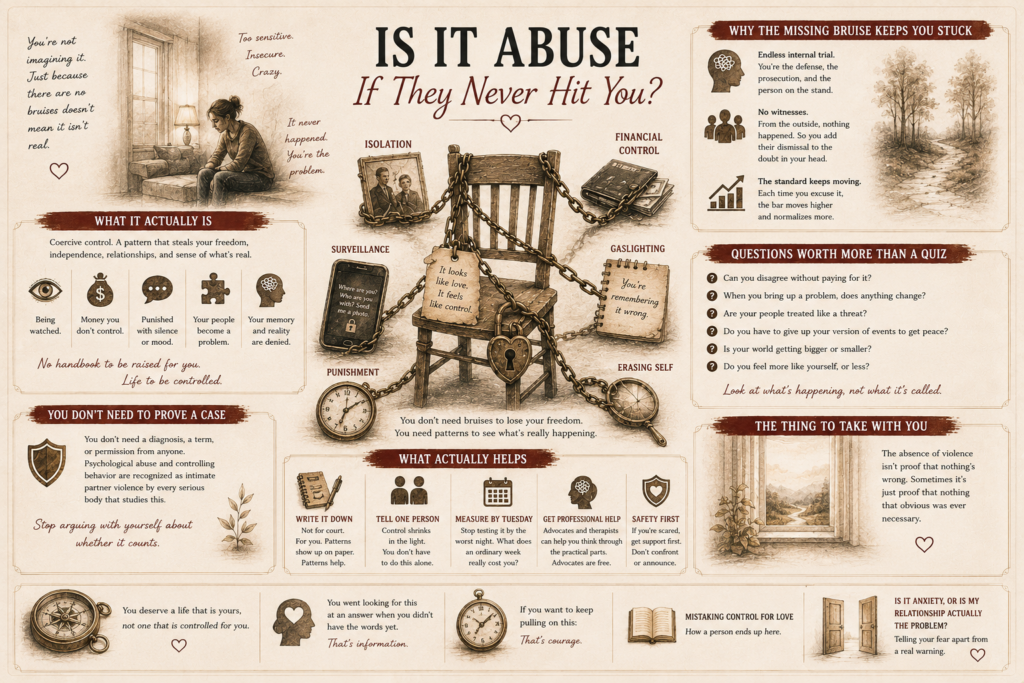
The term people use now is coercive control. It means a pattern where one person steadily takes another person’s freedom, independence, relationships, and sense of what’s real. Not one blowup. A pattern, running long enough that it becomes the shape of your life.
It can look like being checked on. Money you don’t have a say in. Getting punished with silence or a mood every time you disagree. Being told a conversation didn’t happen the way you remember, until you quit trusting your own memory. Your friends becoming a problem. Every plan you make on your own turning into evidence that you don’t care.
Nobody has to raise a hand for any of that to run a person’s life. Physical violence can be part of it, and it often shows up eventually, but it isn’t required for the damage to be real.
Why the missing bruise keeps you stuck
Here’s the part I want you to sit with, because I think it’s the thing doing the most work against you.
When there’s no violence, there’s nothing to interrupt the argument you’re having with yourself. You can’t say “he hit me” and be done with it. So instead you get an endless internal trial where you’re the defense, the prosecution, and the person on the stand. Was that bad enough? Am I making too much of it? Other people have it worse. He was stressed. She apologized. I probably pushed it.
And every time you decide it wasn’t bad enough, the standard moves. Next time has to be worse to count. Then that becomes normal too, and the bar moves again. That’s how people end up years in, exhausted, still not sure whether they’re allowed to be upset.
The other thing the missing bruise does is take away your witnesses. From outside, nothing happened. There’s no black eye at Thanksgiving. So when you finally do say something, you get “well, every relationship has problems,” and you go home and add that to the pile of evidence that it’s you.
Why the people who study this take it so seriously
I want to put one number in front of you, and then straight away tell you what it does and doesn’t mean, because it gets misused in both directions.
The Domestic Violence Death Review Team in New South Wales, Australia went back over every intimate partner domestic violence homicide in that state between 2000 and 2022. In roughly 97% of them, the killing had been preceded by the perpetrator using emotional and psychological abuse to control the victim.
Not most of them. Nearly all of them.
Now the part that matters just as much, and that I’m not going to skip past. That does not mean a controlling relationship usually ends with somebody dead. It doesn’t. The overwhelming majority of people living with this will not be killed, and I’m not interested in frightening you with a statistic that doesn’t say what it looks like it says.
What it does say is this. When these deaths get reviewed afterward, the thing that was there first, almost every single time, is the thing you are currently trying to decide whether you’re allowed to call abuse.
That’s why advocates and police and researchers treat coercive control as a risk marker in its own right rather than a milder version of the real thing. Not because it always escalates. Because when the worst does happen, it was nearly always there beforehand, and it was nearly always visible to somebody.
Work out of Britain points the same direction. A study of 372 intimate partner killings mapped a repeating eight-stage progression, and control sits early in it. The first stage is the perpetrator arriving with a history of abuse or stalking from before you met. By the third, the relationship itself has become dominated by coercive control.
So when somebody tells you it can’t be that serious because nobody has hit you, understand that the people whose entire job is studying how these things end do not see it that way at all.
Questions worth more than a quiz
Nearly everything you’ll find searching this is a quiz. Fifteen boxes, a score at the end. I understand the appeal, because you want somebody official to tell you. But a score isn’t going to settle it, and you’ll just take another one.
These are better, because they’re about what happens rather than what it’s called.
Can you disagree without paying for it? Not whether you win. Whether you can say “I don’t want to” and the rest of the night doesn’t turn into weather you have to wait out.
When you bring up a problem, does anything change? Apologies are easy and they’re often sincere in the moment. What matters is whether the same thing happens again in three weeks. A cycle tells you more than an apology does.
Are your people treated like a threat? Watch what happens around your friends, your family, your time alone. Not whether they’re forbidden. Whether they cost you something.
Do you have to give up your own version of events to get peace back? If ending a fight requires you to agree that you remembered it wrong, and that keeps happening, that’s not a communication problem.
Is your world getting bigger or smaller? This one’s the tell. Over a few years, are you doing more things, seeing more people, saying more of what you think? Or has it all been quietly shrinking while their say in it keeps growing?
Do you feel more like yourself, or less? Most people know this answer immediately and don’t like it.
You don’t need to prove a case
A lot of people stall out here, waiting to be certain enough to say the word. Like there’s a threshold, and until you hit it you have to keep going.
There isn’t one. You don’t need a diagnosis for the other person, you don’t need a term you can defend in an argument, and you don’t need permission from a friend who wasn’t there. Psychological abuse and controlling behavior are already recognized as intimate partner violence by every serious body that studies this. You’re not inventing a category to excuse yourself.
And you don’t have to decide tonight whether to stay or go. That’s a different question and it’s a bigger one. All you have to do right now is stop arguing with yourself about whether it counts.
Where to start
Write it down. Not for a court case. For you. What was said, what was agreed to, what changed, what happened when you brought it up. The reason this matters so much is that the confusion is doing half the damage. When it’s on paper you stop having to re-litigate reality every night, and patterns show up that feelings hide.
Tell one person. Control gets stronger as your world gets smaller, and this stuff cannot survive daylight very well. One friend, one relative, one counselor. Somebody who knew you before.
Stop testing it by the worst night. People measure by the biggest incident, decide it wasn’t that bad, and reset. Measure by the ordinary Tuesday instead. What does a normal week cost you.
Get somebody who does this for a living. An advocate can help you think through the practical parts, money, housing, kids, phones, without you having to prove anything to them first. Advocates are free, and you don’t have to be leaving to talk to one.
One more thing on safety. If any part of you is scared of how this person reacts, don’t hand them this article and don’t announce a conclusion to them. Naming it out loud to someone who’s controlling you raises the temperature and rarely produces the moment of clarity people hope for. Talk to somebody else first.
One last thing
The absence of violence isn’t proof that nothing’s wrong. Sometimes it’s just proof that nothing that obvious was ever necessary.
You went looking for this at an hour when you didn’t want anybody to know. That’s information. People in relationships that are basically fine don’t spend their nights building a case for why they’re allowed to be unhappy.
How a person ends up here is in Mistaking Control for Love. If some of it is happening through your phone, the car, or the house, that is Is My Partner Tracking My Phone? Telling your own fear apart from a real warning is in Is It Anxiety, or Is My Relationship Actually the Problem?
You don’t need a bruise, a witness, or anybody’s permission to call this what it is. What you need is to quit waiting for it to get bad enough to qualify.
It also turns up in specific shapes worth naming: money in Financial Abuse: When You Have to Ask for Your Own Money, scripture in Spiritual Abuse: You Can’t Win an Argument With God, and the household jobs nobody counts in Weaponized Incompetence.
Where control leads when it runs long enough, both of the ways it can end and how little of either gets counted, is in How Abuse Kills
The same machine runs in the bedroom, where almost nobody is willing to look at it, and that is Is It Coercion If You Said Yes?.
And the reason nobody around you saw any of it, which is rarely what people assume, is in Nobody Took Your Friends.
And the reason you cannot produce a single incident to prove any of it has its own piece, in You Don’t Need Them to Lie to You Anymore.
Why the people around you had already been given a version of this is in They Told Everyone First.
Because that’s the part nobody warns you about. The bar moves. Whatever you decide isn’t bad enough tonight becomes the new normal by spring, and the next thing has to be worse to count. That’s not you being tough. That’s the standard sliding while you stand still.
This reflects personal experience and research. It isn’t therapy, and it isn’t a diagnosis of anyone. If you’re worried about control or abuse in a relationship, the National Domestic Violence Hotline offers free, confidential support 24 hours a day to people of all genders. Call 800-799-SAFE (7233), text START to 88788, or chat at TheHotline.org. If you’re in immediate danger, call 911 or your local emergency service.