Why Is Everyone Suddenly Calling People Narcissists?
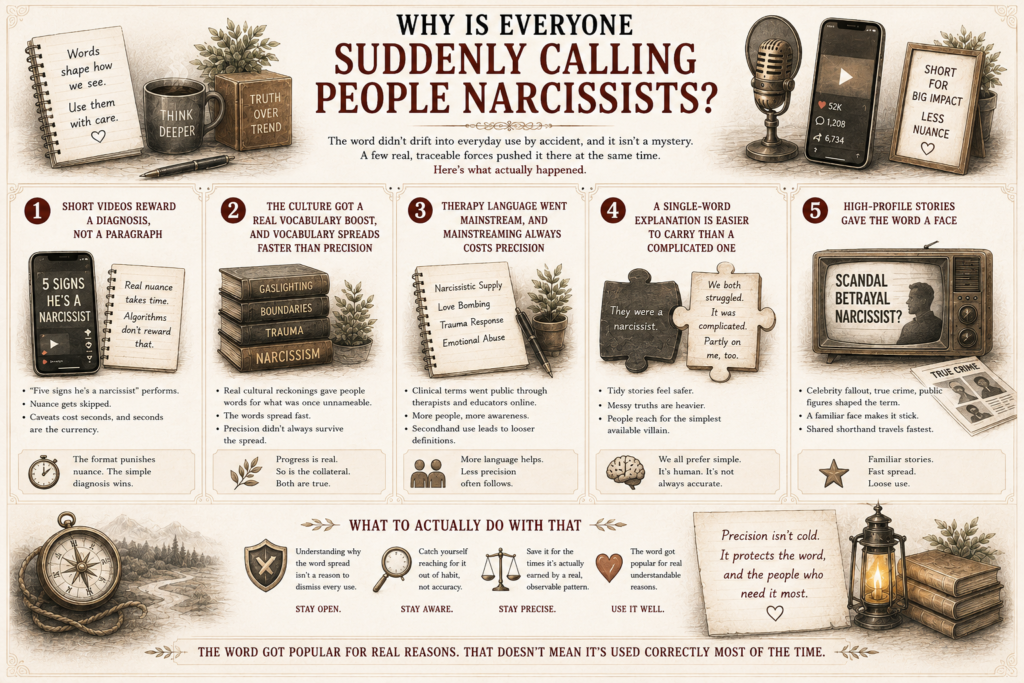
The word didn’t drift into everyday use by accident, and it isn’t a mystery either. A few real, traceable forces pushed it there at the same time, covered from the definitional side in Is “Narcissist” Just an Overused Insult Now? This is the other half: not what the word means now, but why it took over so fast in the first place.
Short Videos Reward a Diagnosis, Not a Paragraph
A huge amount of relationship content now lives in fifteen to sixty seconds, and that format has a built-in bias. “Five signs he’s a narcissist” performs. “This might be a few different things, and here’s how to think it through” does not, no matter how much truer it is. The platforms didn’t invent the word. They rewarded whichever version of it was fastest to say and hardest to scroll past, and a sharp diagnosis beats a careful paragraph every time on those terms.
Nuance doesn’t disappear because creators are careless. It disappears because the format punishes it. A caveat costs seconds, and seconds are the entire currency the algorithm is measuring. Strip the caveats out of thousands of videos a day for a few years running, and the word that survives is the confident, simple one, not because it’s more accurate, but because it’s the one that kept getting watched to the end.
The Culture Got a Real Vocabulary Boost, and Vocabulary Spreads Faster Than Precision
The last decade brought a genuine, overdue expansion in language for control, manipulation, and abuse, driven by real cultural reckonings that gave people words for things that used to go completely unnamed. That’s real progress, not something to be cynical about. The side effect is what always happens when specialized vocabulary spreads fast: the words got out ahead of the fine distinctions between them, so gaslighting, trauma, and narcissist all started covering a wider range of experiences than they used to, sometimes accurately and sometimes not.
This is worth holding as two true things at once rather than picking a side. The expanded vocabulary genuinely helped people recognize patterns they’d been living inside for years without a name for them. The same expansion also handed that vocabulary to people describing something much smaller. Both of those are real outcomes of the same shift, not a story where one side is the good version and the other is the corruption of it.
Therapy Language Went Mainstream, and Mainstreaming Always Costs Precision
Terms that used to live almost entirely inside clinical training, narcissistic supply, love bombing, trauma response, are now just how people talk, largely through therapists and educators building real audiences online. More people having real language for real patterns is a genuine good. It also comes with the same tradeoff any specialized vocabulary faces once it goes public: it gets used more often and more loosely, by people who picked it up secondhand rather than through years of training, and some of the original precision doesn’t survive the trip.
A Single-Word Explanation Is Easier to Carry Than a Complicated One
This part isn’t about platforms or culture. It’s just how people are built. “They were a narcissist” is a complete, satisfying story. “We were both struggling and it fell apart in a complicated way that was partly on me too” is a true story a lot of the time, and it’s a much heavier one to carry. Given the choice between a tidy explanation and an accurate but messier one, most people reach for tidy, and the word was sitting right there, ready to supply it.
This isn’t unique to this word, or to this decade. People have always reached for the simplest available villain when a painful story needs somewhere to land. What’s new is that this particular villain now comes pre-loaded with credibility, a clinical-sounding word doing the work a vaguer one like difficult or selfish never quite managed on its own.
High-Profile Stories Gave the Word a Face
Celebrity relationship fallout, true crime coverage of controlling partners, and public figures getting discussed in these exact terms all did what high visibility always does to a clinical word. It stops sounding like something from a textbook and starts sounding like something you already understand, the same way casual, imprecise use of other clinical terms tends to follow whenever one gets enough public attention. A word with a famous face attached spreads faster than one that doesn’t.
It also gives everyone a shared shorthand nobody has to explain from scratch. Once a public example exists, saying the word doesn’t require walking someone through what you mean by it. They already have a picture in their head. That convenience is part of why the word travels so easily now, even into conversations about people who look nothing like the public example it’s borrowing its weight from.
What to Actually Do With That
None of these five forces are villains, and understanding them isn’t a reason to distrust every single use of the word from now on. It’s the opposite, actually useful move: now that you know why it’s so tempting to reach for, you can catch yourself reaching for it out of habit instead of accuracy, and save it for the times it’s actually earned. The word got popular for real, understandable reasons. That doesn’t mean it’s being used correctly most of the time it gets said.