Why Narcissists Criticize Everything You Do
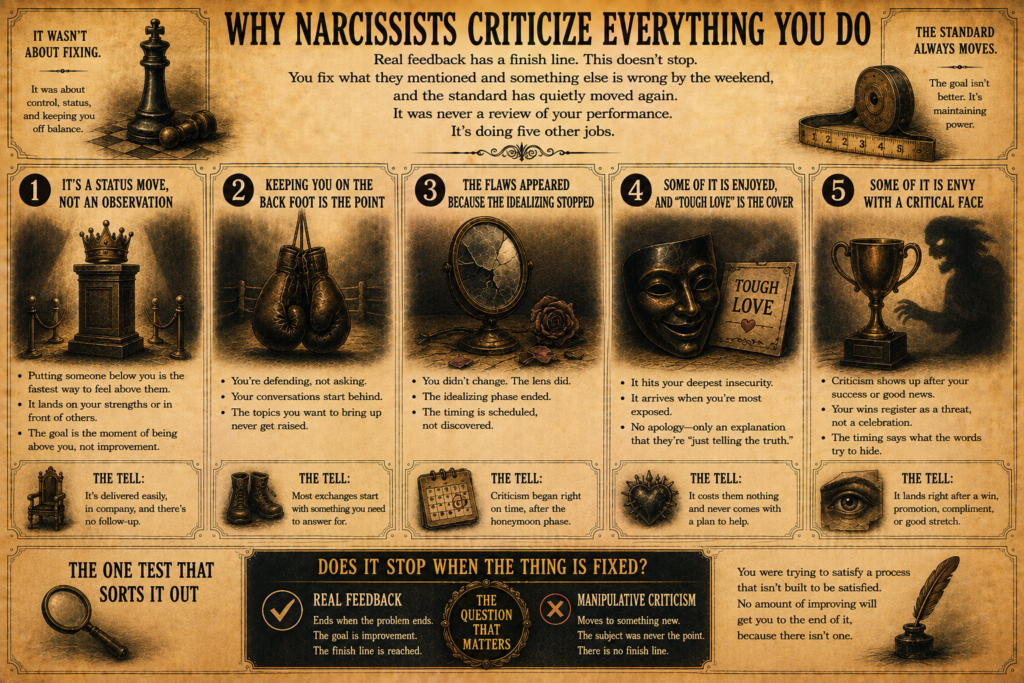
Real feedback has a finish line. Someone tells you the thing, you sort it out, and it stops, because the point was the improvement. This doesn’t stop. You fix what they mentioned and something else is wrong by the weekend, and the standard has quietly moved again. That’s the difference that matters, and once you see it, the constant correction reads completely differently. It was never a review of your performance. It’s doing five other jobs.
It’s a Status Move, Not an Observation
Putting someone below you is the fastest way to feel above them, and it doesn’t require achieving anything. Criticism does that work instantly and for free. Note where it tends to land: not on things that genuinely need fixing, but on the areas where you’re doing well, or where other people can hear it.
You can spot this version by what it costs them. Genuine feedback is a little uncomfortable to give, because the person giving it risks the friction. Status criticism is comfortable, sometimes visibly enjoyable, delivered easily and often in company. Comfort is the tell.
It also tends to arrive without any interest in the outcome. Someone who actually wants the thing fixed asks about it later, or notices when it changes. Here the comment gets made, the ground gets taken, and nobody follows up, because the point was the moment of being above you rather than anything that happens afterward.
Keeping You on the Back Foot Is the Whole Point
This is the one that does the most damage and gets noticed the least. A person who is defending is not asking. While you’re explaining why you did the thing, you’re not raising what they did, not making a request, not questioning anything about how the relationship runs.
Criticism arriving steadily keeps you in that position permanently. You start every conversation slightly behind, already justifying, and the topics you meant to bring up never get raised because you’re busy answering for something else. This is why the relationship can feel unbalanced without a single dramatic incident you could point at. The imbalance is procedural. One person is always the examiner and the other is always the examined, and that arrangement never gets voted on.
Try counting, over a week, how many exchanges started with something you wanted to discuss versus something you needed to answer for. If the second number is much larger, that’s the mechanism working, not a coincidence about what happened to come up.
The Flaws Appeared Because the Idealizing Stopped
Early on you may have been described as perfect. Then the criticism started, and the natural conclusion is that they finally saw the real you and were disappointed. That isn’t what happened. The idealizing phase ended, which is a scheduled event rather than a discovery, and we’ve covered that timing in full in Why a Narcissist’s Charm Always Wears Off. You didn’t change. The lens did.
Some of It Is Enjoyed, and “Tough Love” Is the Cover
At the harsher end, the reaction itself is part of the appeal, and the criticism gets aimed with enough precision that it’s hard to call it accidental. It arrives on the thing you’re most insecure about, at the moment you’re most exposed, and afterward there’s no apology, just an explanation that they’re the only one who’ll tell you the truth.
That framing is doing real work, which is why it belongs alongside the other stock justifications in Common Excuses Narcissists Use. Genuine tough love is uncomfortable for the person delivering it and it’s oriented around you getting somewhere. This version costs them nothing, lands hardest where you’re weakest, and never seems to produce a plan for anything getting better.
Worth saying plainly, because people twist themselves in knots over it: you don’t need to prove intent to act on this. Whether they mean to wound you or genuinely believe they’re helping, the effect on you is identical, and the effect is the part you actually live with. Trying to settle the question of what’s in their head is a trap, partly because you can’t answer it and partly because the answer wouldn’t change what to do next.
Some of It Is Envy With a Critical Face
Criticism that shows up right after something goes well for you is usually about the going well. The mechanism, and why your success registers as a threat rather than good news, is covered in Why a Narcissist Sabotages Your Dreams and Why a Narcissist Suddenly Goes Silent.
The practical version for spotting it: watch the timing rather than the content. A flaw discovered in the hours after a promotion, a compliment from someone else, or a good stretch you were pleased about is rarely a coincidence of scheduling.
The One Test That Sorts It Out
You do not need to work out their motive in the moment. There’s a simpler question, and it works whatever the reason underneath: does it stop when the thing is fixed?
Real feedback ends when the problem ends. If you sort out the thing they raised and the criticism moves to something new, then something new again, the subject was never the point, and no amount of improving will get you to the end of it, because there isn’t one. That’s worth knowing mostly for what it takes off your shoulders. If you’ve been treating this like a series of solvable complaints and quietly wondering why you never seem to catch up, this is why. You were trying to satisfy a process that isn’t built to be satisfied.