Common Excuses Narcissists Use
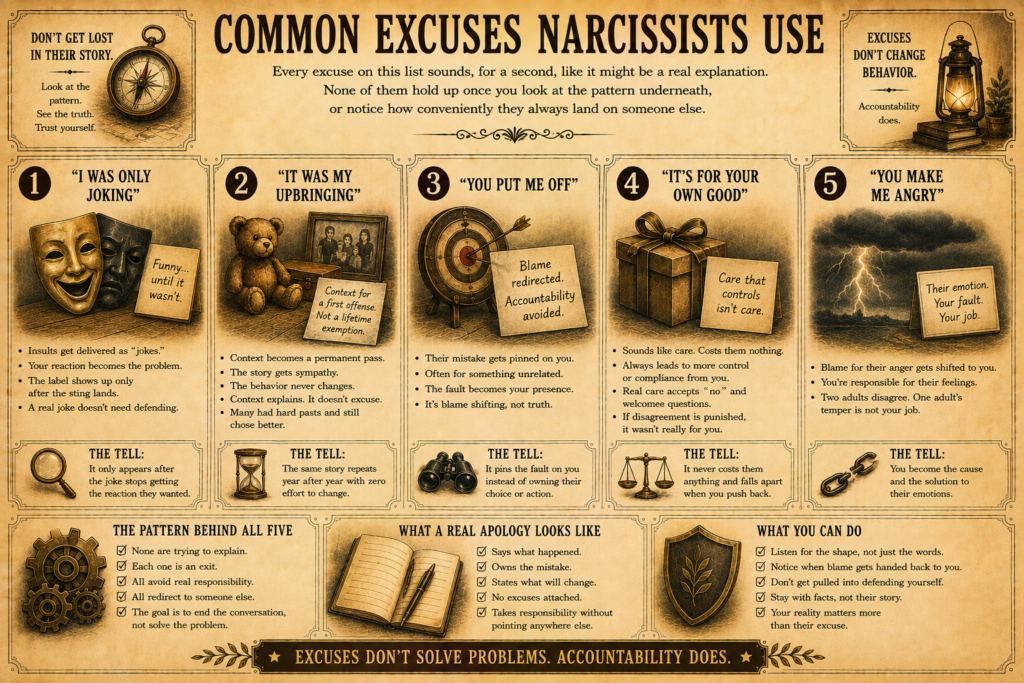
Every excuse on this list sounds, for a second, like it might be a real explanation. None of them hold up once you look at the pattern underneath, or notice how conveniently they always land on someone else. Some of these have deep mechanisms worth their own full read, linked below where that’s the case. Here, the point is the phrase itself, and how to hear it the moment it shows up.
“I Was Only Joking”
An insult gets delivered dressed as a joke, and the instant you react to it, the joke label gets used to make your reaction the actual problem instead of what was actually said. We’ve covered exactly this move, and the specific tell that separates it from a real accidental joke, in full in Why a Narcissist Can’t Take a Joke. Worth naming here specifically as a stock excuse: it only ever shows up after the sting has already landed, never before. A real joke doesn’t need defending once someone flinches. This one needs a label attached the instant it stops working as intended.
“It Was My Upbringing”
How someone was raised can be real, honest context for understanding a pattern. Here it gets used as something else entirely: a permanent exemption from ever having to change it. The upbringing gets mentioned, everyone nods sympathetically, and the actual behavior continues exactly as before, now with a built-in reason nobody’s supposed to bring it up again.
Context explains a first offense. It doesn’t get to explain the hundredth. Watch whether the same upbringing excuse gets repeated year after year with zero visible effort to do anything differently in between. A real reckoning with the past usually produces some change eventually. An excuse just produces the same story on a loop.
Plenty of people had genuinely hard childhoods and never once use it as a reason to treat someone else badly today. That’s not a coincidence, and it’s worth holding onto when this excuse gets deployed. The past can explain where a pattern came from. It was never going to be the thing that makes the pattern acceptable to keep living inside of, and the difference between the two is whether anything at all changes after the story gets told.
“You Put Me Off”
Blame for their own mistake gets redirected onto you, often for something you did nowhere near them or had no real connection to what actually happened. We’ve covered this exact mechanism, blame shifting, in full in How Narcissists Make You the Problem. Worth naming here as its own specific phrase: it pins the fault on your presence rather than any action you actually took, which makes it almost impossible to defend against on the merits, since there’s no real claim to argue with in the first place. Simply being in the room becomes the offense.
“It’s For Your Own Good”
Real tough love is rare, and it’s genuinely uncomfortable to give. It costs the person giving it something, an awkward conversation, the risk of the relationship itself, to say a hard truth that’s actually oriented around the other person’s growth.
The narcissist’s version costs them nothing, and it conveniently always points toward more control or more compliance from you, never toward anything that would require sacrifice or discomfort on their end. Ask what this “for your own good” behavior would actually look like if it really were about you. Does it ever cost them anything, or does it only ever ask something of you?
Real care can survive being questioned. It welcomes a second opinion, tolerates you saying no, and stays intact even when you decide not to take the advice. If the “help” turns hostile the moment you push back on it, or if disagreeing with it gets treated as proof you needed it more than you realized, that reaction is the actual information here, more than anything said in the original pitch. Care that can only survive total agreement was never really offering you a choice.
“You Make Me Angry”
The same move as “you put me off,” aimed specifically at their anger this time, covered in the same blame-shifting mechanism in How Narcissists Make You the Problem. Worth naming separately here because it comes with an extra cost on top of the blame: it also puts you in charge of managing their emotional state, since if you caused the anger, you’re implicitly the one responsible for preventing or soothing it too. Two adults having a disagreement is normal. One adult’s temper becoming the other one’s job to prevent is not.
These Are Exits, Not Explanations
None of these five are really trying to explain anything. Each one is functioning as an exit, a way out of the one thing that would actually require something from them: taking responsibility without immediately handing it back to you or excusing it away.
Notice that a genuine apology doesn’t need any of these five riding along with it. It just says what happened and what will be different. The moment an explanation shows up attached to someone else’s fault, or someone else’s past, or someone else’s supposed benefit, it has already stopped being an apology.
Listen for the shape of it, not the specific words used in the moment. Every real version of these five ends in the same place: whatever went wrong, it’s already being handed back to you before you’ve even finished reacting to it.