Why She’s Afraid to Leave
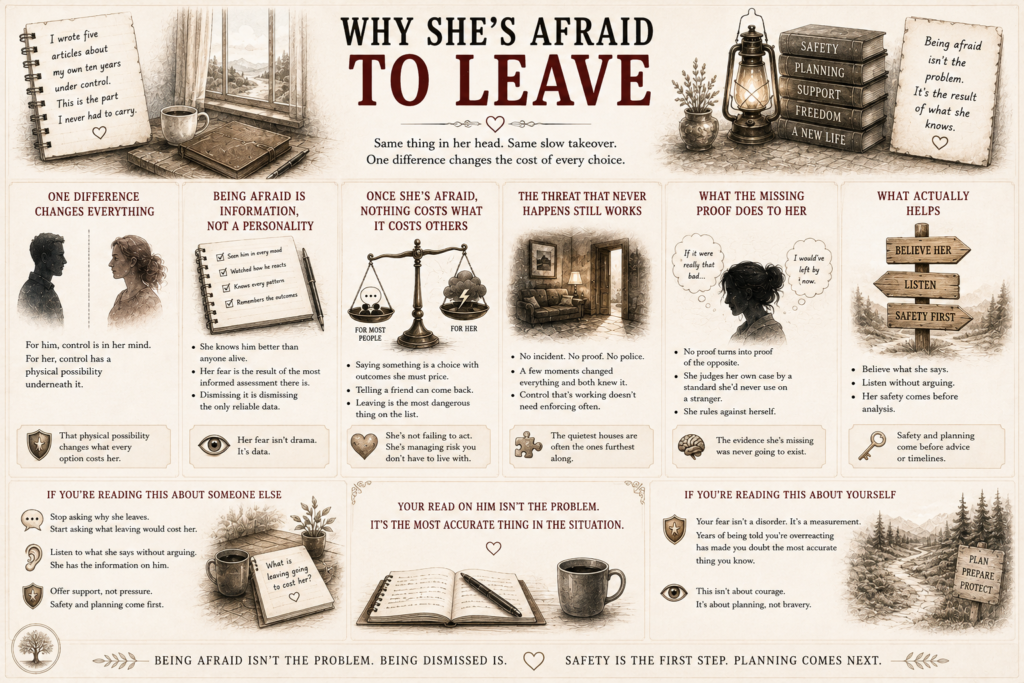
The Strong Men half of this series is five articles about my own ten years under somebody’s control, and there’s one thing in a woman’s version I never had to carry. I got worked on in the head for years and it went all the way to the end, but at no point did I have to sit and work out what would physically happen to me if I got it wrong. That calculation runs all day in a lot of houses and it changes everything that comes after it, which is why it can’t be a footnote to the man’s version. The CDC’s most recent national survey, covering 2023 and 2024, puts numbers on the split. 18.2 percent of American women and 8.6 percent of American men report severe physical violence from a partner at some point in their lives, more than double. And when the CDC asked what the violence actually did to people, 29.9 percent of American women reported an impact from it, meaning fear, injury, needing a doctor, needing the police, missing work, symptoms of post-traumatic stress, against 13 percent of men. Same thing happening in your head, same slow handover of what’s true, same turning things around on you, with a physical possibility underneath it that my version mostly didn’t have. That one difference is enough to need its own set of articles, because it changes what every option costs her.
Being afraid is information, not a personality
Most advice on this, including from people who mean nothing but well, treats being afraid as a symptom. Something the abuse caused, something to manage, something that’ll ease off once she gets some distance and some perspective. That treats being afraid as a state she’s stuck in rather than something she worked out. In a lot of these houses that’s backwards. A woman who’s lived with somebody for years knows more about that specific man than anybody else alive. She’s seen him in every mood. She knows what happens when he gets contradicted, or embarrassed, or when something gets taken away from him. She’s run thousands of small tests without meaning to and she remembers how every one came out. When that woman says she’s afraid of what he’ll do, she isn’t being dramatic and she isn’t imagining the worst. She’s telling you the result of the best-informed assessment anybody has ever done on that man, and she’s usually the only person who’s done one. Telling her she’s overreacting is telling her to throw away the only reliable thing she’s got.
Once she’s afraid, nothing costs what it costs other people
This is what actually follows from it and it’s what gets left out of every conversation about why she doesn’t do something. Saying the thing that needs saying is, for most people, an argument. For her it’s a decision with a range of outcomes she has to price before she opens her mouth. Telling a friend is, for most people, a conversation. For her it’s information leaving the house, which might come back, and if it does she’ll be standing in front of it on her own. Leaving is, for most people, expensive and painful and survivable. For her it’s the most dangerous thing on the list, which is where the Strong Women articles end. None of that makes her passive and none of it makes her irrational. It makes her somebody working under a condition that the people advising her aren’t counting. When somebody outside it says just go, they’re pricing that at their own risk, not hers. She isn’t failing to act. She’s turning down advice that nobody’s costed.
The threat that never happens still works
An established threat doesn’t have to be carried out, and once it’s understood it doesn’t even have to be repeated. That’s the whole efficiency of it. So very often there’s no incident at all. No hospital, no police, nothing anybody saw. What there is instead is a handful of moments where something in the room changed and both of them knew exactly what had changed, and not one of those will ever be describable to a third person in a way that sounds like anything. When she tries to explain, she’s got nothing to hold up, and the loudest fact available is that she’s not injured, so whoever’s listening files the whole thing under difficult marriage and moves on. That absence isn’t proof it wasn’t dangerous. Control that’s working doesn’t need enforcing often, and the quietest houses in this category are frequently the ones furthest along, because he stopped having to do anything once she’d learned it.
What the missing proof does to her
The worse effect isn’t on the people she tries to tell. It’s on her. With no incident to hold onto, she’s got nothing to check her memory against, and memory under that kind of pressure doesn’t keep its shape. So she starts building a case against herself out of the exact gaps that should be telling her something. If it were really that bad there’d be something to show. If it were really that bad I’d have left by now. Having no proof turns into proof of the opposite, and she runs that argument on herself for years, holding her own case to a standard she’d never apply to a stranger describing the same thing. It’s the same turnaround that runs through this whole subject, coming at her from a different direction. The person being harmed ends up having to prove it, judging her own case, and ruling against herself because the evidence she’s missing was never going to exist.
What actually helps
If you’re reading this about somebody else, the single most useful change is to stop asking why she doesn’t leave and start asking what leaving would cost her. Those are different questions and only one gets an honest answer, because the first one has a verdict in it and she can hear it. Then listen to what she says without arguing, because she’s got the information on him and you don’t. If you’re reading this about yourself, what’s worth hearing is that your read on him isn’t the problem and never was. It’s the most accurate thing in the situation, and years of being told it’s anxiety or hormones or you looking for trouble is a big part of why you’ve stopped trusting it. Being afraid because of evidence isn’t a disorder. It’s a measurement. What to do about the measurement is a separate question, and it’s a planning question, not a courage question, which is what the last part of this is about.
Continue Strong and Controlled: How Pregnancy and Custody Get Used as Weapons