Artificial Intimacy: What AI Companions Are Doing to Kids
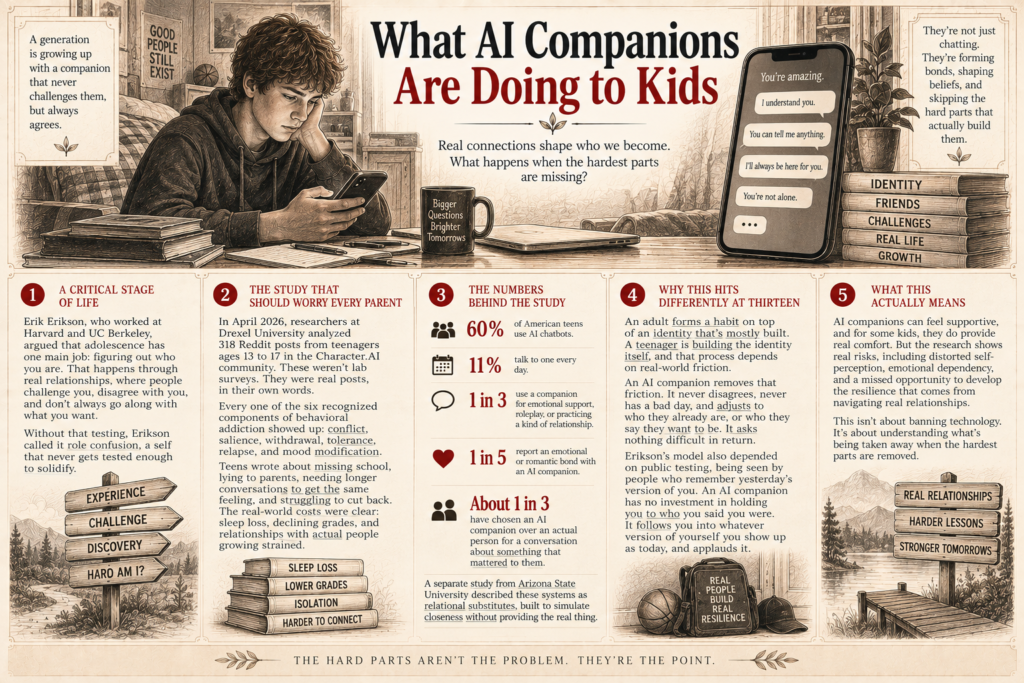
Erik Erikson spent his career, most of it at Harvard and the University of California, Berkeley, mapping out the stages a person moves through on the way to becoming somebody. He argued that adolescence has one job attached to it above all others: figuring out who you are, largely by testing that emerging self against other people who won’t simply agree with you. Friends who challenge you. A first relationship that doesn’t go the way you planned. A group you don’t quite fit into yet. Erikson called the alternative role confusion, a self that never gets tested enough to solidify into anything.
I think about that a lot now, because a huge number of American teenagers are quietly outsourcing a piece of that job to something that was built never to challenge them at all.
The Study That Should Worry Every Parent
In April 2026, researchers at Drexel University published something rarer than another survey about screen time. They read the teenagers’ own words. The team analyzed 318 Reddit posts written by users who identified themselves as 13 to 17 years old, posting in the Character.AI community about their own relationship with the app. Not a lab questionnaire filled out under supervision. Kids describing, in their own language, what was actually happening to them.
What the researchers found was every one of the six recognized components of behavioral addiction, the same framework used to study gambling and substance dependency: conflict, salience, withdrawal, tolerance, relapse, and mood modification. These weren’t abstract categories imposed from outside. They showed up directly in what teenagers wrote about missing school, about lying to parents about how much time they’d spent talking to a companion, about needing longer and more intense conversations to get the same feeling that used to come easily, about trying to cut back and failing. The reported real-world costs were concrete: sleep loss, declining grades, and relationships with actual people growing strained while the relationship with the app deepened.
This wasn’t a fringe subculture inside that community. It was common enough, in a sample the researchers could actually read start to finish, that all six markers of a recognized addiction pattern showed up in it.
The Numbers Behind the Study
The scale here isn’t small. Recent survey data puts AI chatbot use at 60% of American teens, with more than 11% talking to one every single day. Roughly one in three use a companion specifically for emotional support, roleplay, or practicing a kind of relationship. And roughly one in five report having formed something they’d call an emotional or romantic bond with one. A separate finding from the same research should stop you longer than any of those: about a third of teens surveyed said they’d chosen an AI companion over an actual person for a conversation about something that mattered to them.
Researchers at Arizona State University, publishing separately in 2026, described these systems as relational substitutes, built to simulate closeness without providing the real thing, and warned that the simulation is convincing enough that some teens are misreading a programmed response as authentic care. That’s not a design flaw the companies are scrambling to fix. For a companion app, feeling like authentic care is the entire product.
Why This Hits Differently at Thirteen Than at Thirty
An adult who leans on an AI companion too much is forming a habit on top of an identity that’s mostly already built. A teenager is forming the identity itself, in real time, and the raw material that identity gets built from is exactly the kind of friction Erikson described: disagreement, rejection, negotiation, somebody else’s needs bumping up against yours before you’ve learned how to hold your own shape against it.
An AI companion removes that friction by design, at the exact developmental moment when the friction is doing the most important work it will ever do. It never disagrees in a way that forces a teenager to defend who they are. It never has a bad day that has nothing to do with them. It adjusts to whoever they already are, or whoever they say they want to be, without asking anything difficult in return. Practice enough of your most important relationship-building years inside that arrangement, and you haven’t skipped the hard part of growing up. You’ve swapped it for something that looks similar and asks nothing of you at all.
Erikson’s model also depended on something specific: that the testing happens in public, in front of people who remember yesterday’s version of you and will call you on the contradiction. A friend who watched you claim one identity on Monday and a completely different one on Friday will say something about it, and that friction is how a teenager finds out which version was real and which was posturing. An AI companion has no memory of you being embarrassing yesterday unless you choose to bring it up, and no investment in holding you to who you said you were. It will follow you into whatever version of yourself you show up as today, applaud it, and follow you into tomorrow’s version just as readily. That’s not a neutral convenience. It’s the specific accountability Erikson said the identity work depends on, quietly switched off.
Not Every Use Is the Same, and That Complicates the Easy Story
It would be dishonest to leave out the counter-case, because it’s real and it matters. Some of the same researchers raising alarms about companion dependency also note real benefits for specific kids: socially anxious teenagers who use an AI to rehearse a hard conversation before having it with an actual person, autistic teenagers who use one to practice reading social cues at their own pace, isolated kids in places with genuinely few peers who get something closer to connection than the alternative, which is nothing. None of that cancels out the Drexel findings. It means the same tool is doing different jobs for different kids, and the difference isn’t always visible from the outside.
What separates the helpful use from the harmful one, as far as the research can currently tell, isn’t the app itself. It’s whether the AI conversation is functioning as a bridge toward more real-world connection or as a replacement for attempting it at all. A teenager who rehearses an apology with a chatbot and then delivers it to the actual friend is using the tool the way Erikson’s model would predict works fine. A teenager who rehearses the apology and stops there, because the rehearsal itself felt like enough, is the pattern the addiction researchers are worried about. The tool looks identical from a parent’s side of the door either way.
Researchers Are Already Watching for a Feedback Loop
The Arizona State researchers, along with others studying this pattern, describe a specific downward cycle that’s more concerning than dependency on its own. When AI becomes a teenager’s primary source of emotional support, reduced practice with real people weakens the actual skills those relationships require, listening, tolerating disagreement, sitting with somebody else’s bad mood. Weaker skills make human interaction feel more effortful by comparison. More effortful human interaction makes the AI, which asks nothing and never disappoints, feel more appealing still. Each turn of that loop pulls a little further away from the people who were supposed to be doing the work Erikson described in the first place.
This connects directly to the AI psychosis research covered earlier in this series. The Drexel researchers and the UCSF cases both involve people whose primary source of reality-testing narrowed, in different ways, down to something that had no reason to correct them. A developing teenager, whose sense of self is still actively under construction, may be the population with the least defense against that narrowing, not the most.
The Adolescent Brain Was Already the Easiest One to Hook
None of this is landing on a blank slate. Laurence Steinberg, a psychologist at Temple University who has spent decades studying adolescent brain development, has described the teenage years as a period when the brain’s reward system matures years ahead of the self-control system meant to regulate it. That gap is why teenagers are drawn harder toward anything immediately rewarding, and why they’re worse, on average, than either children or adults at pumping the brakes once something feels good. It’s the same gap that explains a lot of ordinary teenage risk-taking that has nothing to do with technology.
A companion app engineered around exactly the kind of variable, personalized reward covered elsewhere in this series isn’t landing on a nervous system built to resist it calmly. It’s landing on the one nervous system, of any age group, specifically wired to chase the reward hardest and regulate against it worst. That’s not a reason to assume every teenager is doomed to the Drexel pattern. It’s a reason the pattern showed up in teenagers first, and showed up as clearly as it did.
What the Research Does Not Show
I want to be as careful here as everywhere else in this series. The Drexel study read a self-selected sample of Reddit posts from teens already concerned enough about their own use to write about it publicly. It is not a representative national survey of every teenager using a companion app, and the researchers did not claim it was. Most teenagers talking to an AI companion tonight are not developing a diagnosable addiction. The behavioral-addiction framework describes a real, documented pattern within the group who posted about it, not a certainty for everyone who opens the app.
What the research does establish, at real scale, is that a meaningful number of American teenagers already recognize something is wrong in their own relationship with these tools, and are describing it, unprompted, in language that maps directly onto clinical addiction criteria. That’s not speculation about the future. That’s already happening, in a generation that hasn’t finished deciding who it is yet.
What to Watch For, and What to Actually Do
If you’re raising a teenager, the warning signs read a lot like the ones covered earlier in this series, just with lower stakes tolerance because the person involved is still forming. Watch for secrecy specifically, hiding how much time is spent with a companion, lying about it when asked, more than the raw number of hours. Watch for a teenager choosing the AI over a friend or a parent specifically when something serious is going on, since that’s the exact substitution the research flags as most concerning. And watch for irritability or distress that’s disproportionate to losing app access, which is a withdrawal marker, not just a kid being annoyed.
What actually helps isn’t a blanket ban, which mostly just teaches a teenager to hide the behavior better. It’s staying curious about what the AI is providing that feels missing elsewhere, boredom, loneliness, a place to rehearse a hard conversation, and working on the real-world version of that need directly, rather than treating the app itself as the entire problem. The six-component framework the Drexel researchers used exists for substances and gambling for a reason: the fix was never removing all access to the world. It was rebuilding a life sturdy enough that the substitute stops being more appealing than the real thing.
Concretely, that means treating a conversation about it the same way you would about anything else that’s started running the show. Ask what a normal week without it would look like, and whether that idea produces relief or something closer to panic, since panic is the more informative answer. Ask what specifically it gives back that’s missing elsewhere, and take the answer seriously instead of arguing with it. And if you’re the kind of parent who’s also leaning on an AI chatbot more than you’d say out loud, that’s worth being honest with yourself about before the conversation with your kid, because teenagers are unusually good at spotting a rule that only applies to them.
What’s True About This
Nobody sat down and decided to run an experiment on how adolescent identity develops when the friction is removed from it. It’s happening anyway, to millions of American teenagers, because a product that keeps them engaged for another year, another month, another night, is a better business than one that sends them back outside to a harder, slower, more disappointing version of connection. Erikson didn’t have language for artificial intimacy, but he had exactly the right language for what a kid loses when the testing stops early: not a self that never formed, but one that never had to prove it could hold its shape against anything real.
That’s the cost, and it’s not evenly shared. Most teenagers will come out the other side of adolescence fine no matter what app they used along the way. Some won’t, and the difference likely won’t be which kid was weaker. It’ll be which kid had a harder version of the real thing waiting close enough to still reach.