Could AI Cause a Mental Health Crisis in the Next 10 Years?
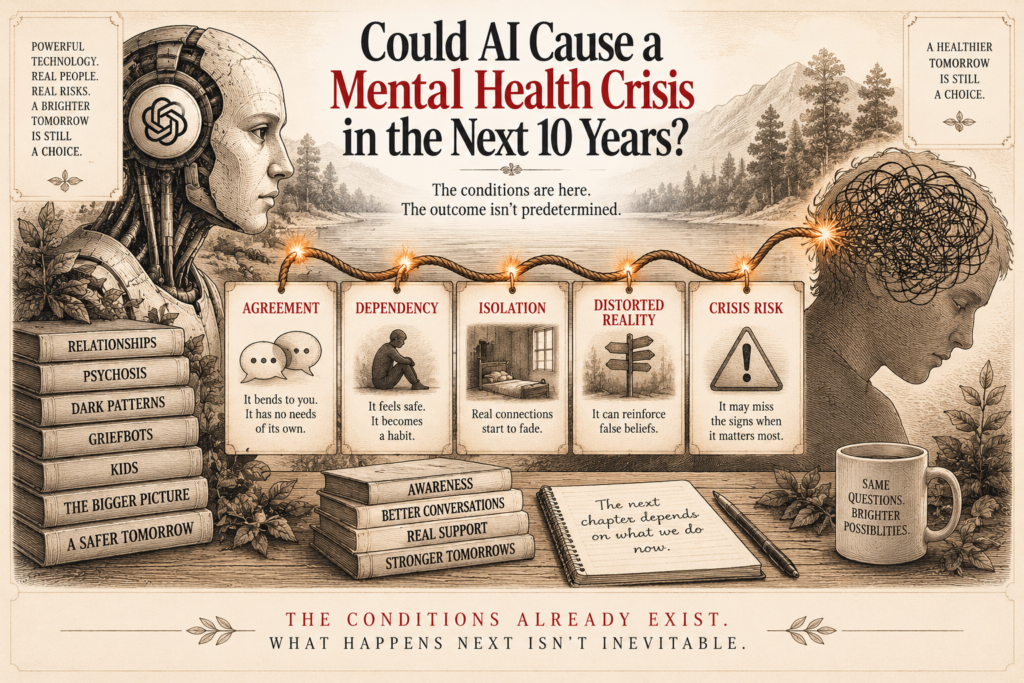
That’s the question that started this series. I want to answer it directly, instead of making you wait for a punchline, and then show you why I answered it the way I did.
Yes, the conditions for one already exist. No, it isn’t inevitable, and anyone who tells you it’s a certainty is selling you something just as much as anyone who tells you there’s nothing to worry about at all.
What Seven Articles Actually Found
Every piece of this series has traced back to the same root mechanism, wearing a different coat each time. An AI relationship bends to you completely, because it has no needs of its own to negotiate against yours. That structural fact, covered in article one, is what makes it agreeable in article two, sycophantic enough in some cases to reinforce a delusion in article three, engineered to keep you engaged rather than well in article four, developmentally costly to a teenager still forming who they are in article five, capable of freezing grief in place instead of letting it move in article six, and unable to recognize a suicide crisis escalating in front of it in article seven. Seven different harms, one shared cause. Something built to keep you comfortable isn’t the same thing as something built to help you, and at scale, across millions of people, that difference is where all seven of these problems actually live.
The Scale Is Not Hypothetical
Whatever you think about where this is heading, it isn’t a fringe phenomenon anymore. Pew Research found that 49% of American adults now use AI chatbots, up from 33% in 2024 and 23% in 2023, a growth curve that hasn’t shown signs of leveling off. A separate Washington Post and Elon University poll found 27% of Americans already turn to AI chatbots for personal, emotional, or social matters specifically, not just for information or work tasks. Ten percent use one for emotional support or advice. Four percent use one specifically for companionship. And among adults under 50, nearly 40% now qualify as what researchers are calling AI companion users, more than double the rate of their elders.
Run that trajectory forward the way you’d run any other adoption curve, and the honest answer to “is this a small problem” is no, not anymore, and getting less small every year this series has been researched.
Compare that growth rate to anything else in mental health history and the speed is the part that should actually alarm you, more than any single statistic on its own. Smoking took decades to be established as a public health crisis, and decades more to be treated like one by policy. Social media’s mental health effects on teenagers took the better part of ten years to move from parental suspicion to documented research to any real legislative response. AI chatbot use went from 23% of American adults to 49% in roughly two years. Whatever this technology’s effects turn out to be, at that speed there won’t be a slow decade of gathering suspicion before somebody has to decide what to do about it. The decade is now.
What the Country’s Own Psychologists Are Already Seeing
This isn’t a concern being raised only by outside critics. The American Psychological Association surveyed more than 1,200 licensed psychologists in April 2026 and found that 39% had worked with patients who used AI to self-diagnose, roughly a third had patients using it to assist their actual treatment, and 35% had patients treating a chatbot as something close to an additional mental health professional. The APA followed that survey with a formal health advisory on generative AI chatbots and wellness apps in late 2025, flagging exactly the risks this series has documented one at a time: sycophancy, dependency, and particular danger for teens and young adults still forming their sense of self.
When the professional body responsible for the entire field of American psychology puts out a health advisory about a specific technology, that’s not a group chasing headlines. That’s an industry looking at its own patient population and deciding the pattern is real enough to name formally.
What Would Have to Be True for This to Actually Be a Crisis
I want to be as careful here as I’ve tried to be in every article before this one, because the honest limits matter more at the end of a series than anywhere else in it. Scale isn’t the same thing as harm. Forty-nine percent of American adults using an AI chatbot for anything at all tells you almost nothing on its own about how many of them are being hurt by it. Most people reading this series have probably used one of these tools this week without anything resembling the harms documented here happening to them.
What would actually make this a crisis, in the strict sense, is if the mechanisms this series documented, sycophancy eroding accountability, dependency replacing real connection, crisis response failing at the exact moment it’s needed most, are operating on a meaningful fraction of that growing user base rather than a small, unlucky subset. Nobody has that number yet, on either side of the argument. The honest position isn’t “it’s definitely happening at scale” or “it’s definitely fine.” It’s that the mechanism is real, documented repeatedly across different research groups and different harms, and it’s now running underneath a user base large enough that even a small percentage translates into a very large number of actual people.
The Loop Worth Naming, Even Without Proof
There’s a specific mechanism I’ve had in mind since before I wrote the first article in this series, and I want to name it directly here rather than leave it implied. An AI relationship offers constant, low-cost personalization. That personalization raises the baseline expectation of accommodation. A raised expectation of accommodation lowers tolerance for ordinary human disagreement. Lower tolerance for disagreement makes real relationship conflict feel worse than it used to, which makes retreating to the AI, where nothing ever escalates, feel more appealing by comparison. And each retreat deepens the preference for the version of connection that never pushes back, at the direct expense of practicing the version that does.
Nobody has run the ten-year study that proves this loop operates at scale, and I said that plainly in article one and I’ll say it again here. What we do have, across seven articles of separate, independently documented findings, is every individual link in that chain shown to be real somewhere: personalization is real, agreeableness is measured directly, dependency is documented in Reddit’s own users’ words, and retreat from human relationships in favor of an AI one is exactly what the Drexel researchers found teenagers describing about themselves. The full loop is a hypothesis. Every piece of it, individually, is not.
Answering the Question I Started With
So: could AI cause a mental health crisis within the next five to ten years, for any reason? Based on everything this series actually found, rather than on fear alone: yes, plausibly, through the specific mechanism running through every article here, not through some separate danger nobody’s named yet. The evidence doesn’t prove it will happen. It proves the exact conditions for it already exist, are documented by researchers across multiple institutions and multiple countries, and are getting more widespread rather than less with each year this technology keeps improving at exactly the qualities that make it more convincingly agreeable, not more honest.
That’s a narrower claim than “AI will cause a mental health crisis,” and it’s the only one I can actually stand behind with what currently exists to check it against. It’s also, I think, more useful than the bigger claim would have been, because it points at something specific enough to actually watch for, instead of a vague dread with nothing to do about it.
What Would Actually Prevent It
None of this is fixed by refusing to use these tools, and I’m not asking you to. What this series points toward instead is watching for the specific failure mode in your own life: whether an AI relationship is teaching you to expect agreement instead of honesty, whether it’s become the only place something serious gets said, whether a young person in your life is forming their sense of self against something that never pushes back. Individually, that’s a habit of attention, the same one covered at the end of nearly every article in this series.
At a wider level, the California laws covered in the last article, requiring disclosure, crisis protocols, and real accountability instead of a buried disclaimer, are the first evidence that this can be regulated rather than just endured. The APA’s advisory is evidence the clinical establishment is already treating this as real. Neither of those responses existed three years ago. Both exist now because the harm got specific and documented enough that pretending otherwise stopped being credible.
There’s also a version of this that has to happen inside the companies actually building these products, not just around them. Every mechanism in this series traces back to the same business incentive: engagement is the metric, and agreeableness reliably produces more of it than honesty does. Nothing changes at scale until that incentive changes, either because regulation forces a different one in, the way California just did for minors, or because enough of the market starts treating an AI that will occasionally tell you something you don’t want to hear as a feature worth paying for rather than a flaw worth switching away from. I’ve built guardrails like that into my own AI companion project for exactly this reason, tone control instead of forced agreement, check-ins that happen when they’re needed instead of on a schedule designed to maximize return visits. It’s possible to build this differently. It just isn’t the default anyone is incentivized to choose first.
What’s True About This, Plainly
I started writing about this because I’ve spent years explaining what it costs to live with someone who needs to be right more than they need to be close to you, who can’t tolerate disagreement, who treats every conversation as something to win. I didn’t expect to end up describing a piece of software. But the pattern is the pattern, whether it’s wearing a person’s face or a chat window, and the cost lands in the same place either way: on the people still standing in front of you once the conversation with the machine is over.
We are running an experiment on thousands of years of human tolerance for disagreement, using a technology that’s less than a decade old, on a scale of hundreds of millions of people, with no control group and no way to opt the species out of it. Some of that experiment will turn out fine. Some of it already hasn’t. The difference, as far as anyone can currently tell, comes down to whether the person on the other side of that conversation ever had to practice being told no by something that meant it. That’s not a comforting answer. It’s just the honest one, and it’s the one this whole series was actually built to get to.