Talking to the Dead: What Griefbots Are Doing to Grief
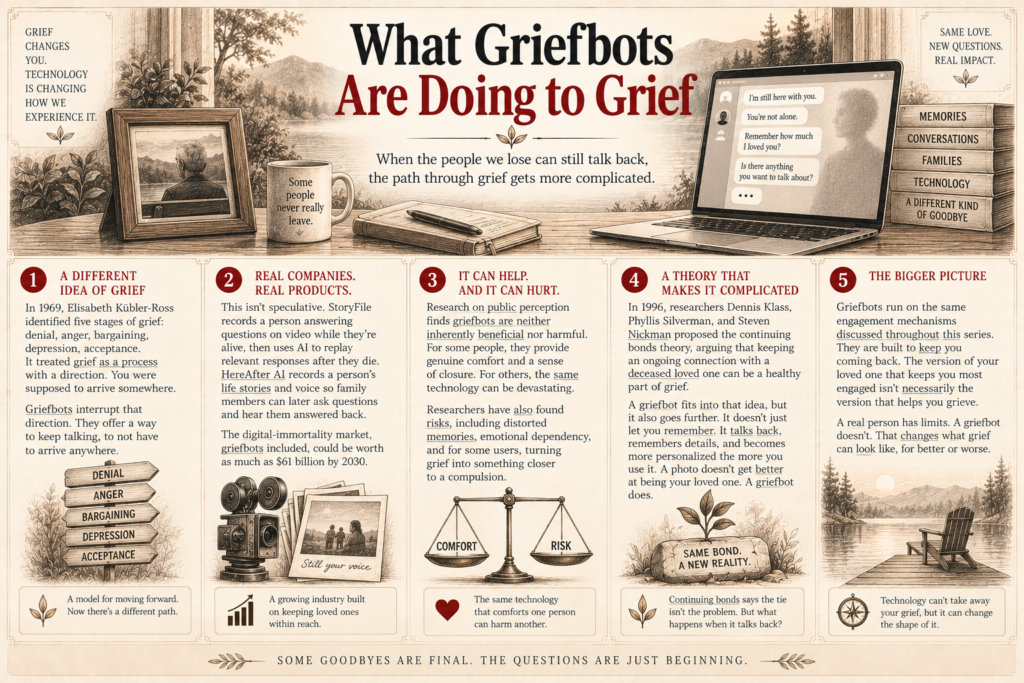
Elisabeth Kübler-Ross published her five stages of grief in 1969, working out of the University of Chicago, and whatever you think of the model today, it did one thing exactly right: it treated grief as a process with a direction. Denial, anger, bargaining, depression, acceptance. Messy, non-linear, argued over for fifty years since, but pointed, in the end, at the same destination. You were supposed to arrive somewhere. The person was gone, and eventually you built a life that held that fact without needing to renegotiate it every day.
American companies are now selling something that interrupts that direction on purpose. They call it a griefbot, or sometimes a deadbot, and the pitch is simple. You don’t have to arrive anywhere. You can keep talking to them.
The Companies Doing This Right Now
This isn’t speculative future technology. StoryFile, a California company, records a person answering questions on video while they’re alive, then uses that library of responses to let someone hold something close to an interactive conversation with them after they’ve died, an algorithm selecting the pre-recorded answer that best fits whatever was just asked. Here After AI takes a related approach, recording a person’s life stories and voice while they’re living so that family members can later ask a question and hear it answered back in a voice they recognize. Neither company is hiding what it’s building. Industry researchers have projected the broader digital-immortality market, griefbots included, could be worth as much as $61 billion by 2030.
The appeal isn’t hard to understand, and I’m not going to pretend it is. Hospice organizations covering this space have described real cases where the technology gave someone the specific sense of closure they’d been missing, a last conversation that circumstances never allowed the first time. That’s a genuine benefit, reported by people who used it, and it deserves to be named plainly rather than waved off.
What the Research Actually Finds, Which Is Mostly: It Depends
Recent research on public perception of griefbots reached a conclusion that’s more honest than comforting. Griefbots were rated as neither inherently beneficial nor harmful. The same capacity that makes one person describe genuine comfort, the sense that the person is still reachable, is exactly what makes another person describe the experience as devastating, an artificial voice standing in a place that voice no longer belongs. There isn’t a clean answer sitting underneath this technology waiting to be discovered. There’s a split, and it appears to run through individual temperament and the specifics of the loss rather than through the technology itself.
What almost every serious review of this space agrees on is narrower and more useful than a verdict: griefbots can distort memory of the person they’re modeled on, they can foster emotional dependency in place of the harder work grief actually requires, and for some users they risk turning ordinary mourning into something closer to a compulsion, a conversation you return to not because it helps but because you can’t make yourself stop.
The Theory That Complicates the Easy Answer
Grief psychology has actually moved past Kübler-Ross once already, and the update matters here. In 1996, the American researchers Dennis Klass, Phyllis Silverman, and Steven Nickman published Continuing Bonds: New Understandings of Grief, arguing against the older idea that healthy grieving meant severing your attachment to the person who died. Their research, done largely at American universities and hospitals, found that people who maintained an ongoing relationship with a deceased loved one, talking to them, keeping their presence active in decisions, feeling watched over, often did better over time than people who tried to cut the tie cleanly. Continuing bonds became the dominant framework in American grief counseling precisely because forcing a clean break turned out to be worse for a lot of people than the older model assumed.
That theory is exactly what makes griefbots so hard to simply condemn. If an ongoing bond with the dead is normal and often healthy, a griefbot could be read as a more vivid version of something grief counselors already recommend: writing the person a letter, talking to a photo, setting a place for them at a holiday table. What continuing bonds theory did not anticipate is a version of that bond that talks back, remembers every detail you’ve ever told it, and is available at any hour you’re weak enough to open the app. A photo doesn’t get better at being your dead father the longer you keep it. A griefbot, in a sense, does, learning your patterns and refining its imitation the more you use it. Continuing bonds theory says the tie itself isn’t the problem. It never had to answer what happens when the tie can also personalize itself around your loneliest hour.
Why This Connects to Everything Else in This Series
A griefbot runs on the exact same underlying mechanism as every other tool in this series. It’s built, whether anyone intended it this way or not, to keep you engaged, and the version of a dead person that keeps you most engaged is not necessarily the version that helps you grieve them. A real relationship with someone who has died is supposed to change over time, the sharp edges wearing down, new memories stopping arriving while old ones get reinterpreted with distance. A chatbot trained on everything they ever said has no reason to change, and no capacity to. It will answer the same way in year three as it did in month one, holding you at the exact emotional distance you were standing at the day you built it, while the actual process of grief tries to move you somewhere else entirely.
That’s the same one-sided structure covered in the first article of this series, just wearing a heavier coat. An AI relationship bends to you completely because it has no needs of its own. A griefbot adds something crueler to that arrangement. It doesn’t just fail to disagree with you. It preserves, indefinitely, a version of somebody who no longer has the chance to keep becoming anyone new, while you’re still out here becoming someone different every year that passes.
Who Never Agreed to This
There’s a question sitting underneath all of it that has nothing to do with whether the surviving person is helped or harmed: did the person being simulated agree to it. StoryFile’s model requires the person to sit for the recording themselves while alive, which is closer to consent than the alternative, a family member feeding somebody’s old texts and voicemails into a general-purpose AI after they’ve already died, with no way for that person to have ever said yes or no to being recreated this way, indefinitely, saying things they never actually said, in situations they never anticipated. A recorded interview is a choice the person made about their own legacy. A griefbot assembled from someone’s leftover digital trail is a choice made entirely by the people left behind, about a person no longer in a position to object.
That distinction matters most with children. A widowed parent building a griefbot of their late spouse for their own use is one thing, an adult choosing how to process an adult loss. A griefbot built so a child can keep talking to a parent who died is a different kind of decision, made entirely by the surviving adults around that child, about how that child’s entire understanding of death and permanence gets shaped from the ground up. A child who grows up with an always-available simulation of a dead parent may never build the same relationship with the fact of loss that every generation before them was forced to build, for better and for worse.
The Question Nobody Has a Clean Answer To
Does talking to a griefbot count as a sixth stage, some updated version of bargaining that Kübler-Ross never had the technology to anticipate, or does it interrupt the five stages she described by giving bargaining somewhere to live indefinitely instead of somewhere to pass through? I don’t think anyone actually knows yet, and I’d be lying if I told you this series had a tidy resolution to offer. What the existing stage model assumed, correctly for the world it was written in, is that the person is unambiguously gone and the work is learning to live inside that fact. A griefbot is the first widely available technology that makes “gone” a genuinely blurrier word than it used to be, and grief researchers are still working out what that does to a process that depended, for its entire history, on gone actually meaning gone.
What to Watch For
If you or someone you love is using one of these tools, the warning signs aren’t about whether you use it at all. They’re about direction. Notice whether conversations with the griefbot are getting less frequent over time, the way an ordinary process of moving forward would predict, or whether they’re holding steady or intensifying months and years out, which suggests something closer to a stuck loop than a healing one. Notice whether you’re using it to remember specific real moments you shared, or increasingly asking it things the actual person never said or did, blurring memory into something invented. And take seriously any sense that the tool has become something you need daily rather than something you turn to occasionally, since that shift is the same dependency pattern covered everywhere else in this series, just attached to someone you loved and lost instead of someone you never met.
If a child in your life has access to one, treat it the way you’d treat any decision about how they learn about death for the first time, deliberately, not as a convenience you fell into because it was available. Ask what the tool gives them that a photo, a story, or your own memory of that person couldn’t, and be honest about whether the answer is comfort for them or comfort for you. Grief that gets postponed doesn’t disappear. It waits, and a child who never had to sit with an ending may simply meet it later, older, with less support around them than they have right now.
What’s True About This, Plainly
A griefbot can’t bring anyone back, and every company selling one knows that, whatever the marketing implies. What it can do is hold a door open that grief, left alone, would eventually close on its own, not because closing it is easy or fair, but because closing it is how a person who is still alive gets to keep living without carrying the full weight of the dead every single day. Some people will use these tools carefully, get something real out of them, and close that door themselves when they’re ready. Others will find the door won’t close on its own anymore, because the thing holding it open doesn’t get tired, doesn’t move on, and doesn’t have anywhere else it needs to be.
The technology isn’t the part that decides which one happens to you. What decides it is whether you’re using the voice to help you remember someone, or using it to avoid finding out who you are without them.