How Narcissists Change People
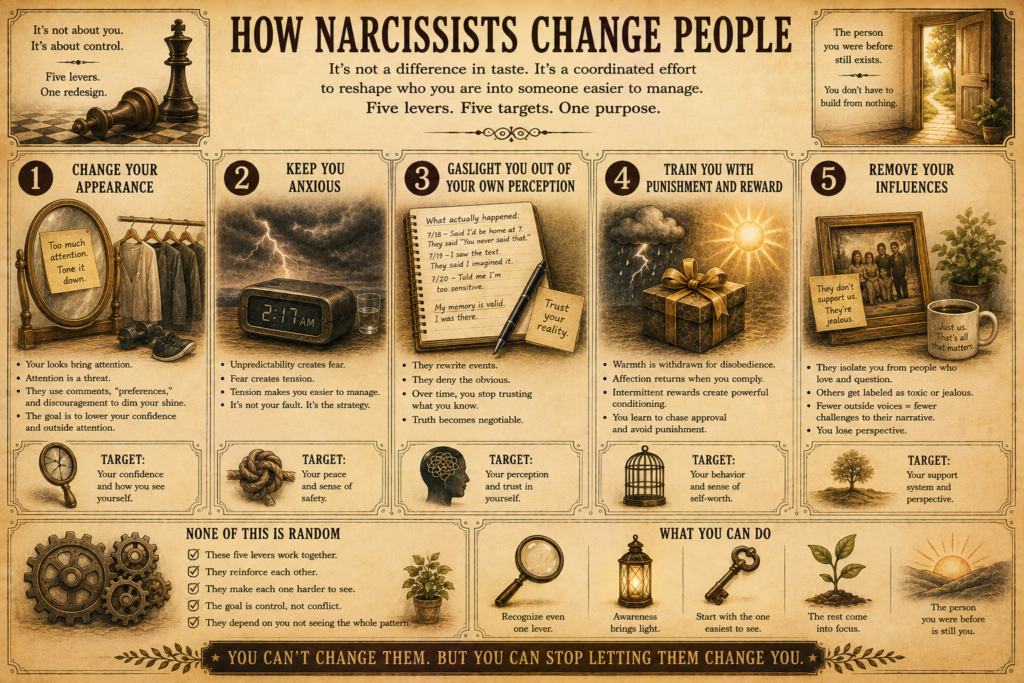
This isn’t a partner who happens to have different taste, or wants some space sometimes, or gets understandably upset now and then. It’s a coordinated effort, run over time, to reshape who you are into someone easier to manage. Five specific levers, each aimed at a different part of you, and each one doing real, separate work.
Change Your Appearance
An attractive partner is a real, ongoing threat to a narcissist’s sense of control, attention from other people, comparison, the plain possibility that someone that good-looking could leave. The fix isn’t addressing the insecurity underneath it. It’s neutralizing the source: comments that quietly erode confidence, discouraging the gym, steering toward clothes that draw less attention, all dressed up as preference or concern.
Notice whether the “preference” tracks your own comfort or specifically tracks how much outside attention you get. A real preference doesn’t shift every time someone else pays you a compliment.
It can sound almost caring on the surface: worry about your health dressed around a comment on the gym, a joke about an outfit that somehow always lands on the ones that get noticed. Watch the timing more than the words. A comment that shows up right after you got attention, rather than at some unrelated moment, was never really about your health or your comfort in the first place.
Keep You Anxious
An anxious person is an easier one to manage, and unpredictability itself becomes the tool for producing that, not a personality flaw showing through. We’ve covered exactly how this works in full in How a Narcissist Keeps You Anxious, so here it’s just worth naming as one lever among several, not the whole picture on its own.
Gaslight You Out of Your Own Perception
This is the deepest lever, because it doesn’t just control your behavior, it targets whether you trust your own read of events at all. Small repeated rewrites of what actually happened. Flat denial of things you watched happen yourself. Being told you’re too sensitive, or remembering it wrong, often enough that you start pre-checking your own memory against theirs before you trust it.
The tell isn’t being wrong sometimes, everyone is occasionally. It’s the pattern. If you’re always the one who misremembered, always the one overreacting, and they’re never once the one who got it wrong, that ratio is the evidence, not any single disputed memory on its own.
A plain written note made close to when something happens, what was said, what you actually felt, works as a real anchor against this, the same way it does for the memory-softening we’ve covered elsewhere. It doesn’t have to be shared with anyone. It just has to exist somewhere outside your own head, in a form that can’t get quietly rewritten later.
Train You With Punishment and Reward
Classic conditioning, applied to a person. Warmth and affection get withdrawn when you do something they don’t like, then restored, sometimes with extra intensity, a small grand gesture, once you comply or fall back in line. Over enough repetitions, you start shaping your own behavior around avoiding the punishment and chasing the reward, often without consciously realizing that’s what’s happening.
This is a lot of what actually creates the pull we cover in How to Really Break a Trauma Bond With a Narcissist. Notice if warmth in the relationship consistently arrives right after you gave something up or backed down, rather than just existing on its own, unconnected to anything you did.
An unpredictable reward is stickier than a reliable one. If affection showed up every single time you complied, you’d eventually take it for granted and stop chasing it so hard. Because it only shows up sometimes, and you can never quite predict when, the chasing itself becomes constant. That’s not an accident of the dynamic. It’s the specific reason the hot-and-cold version works better on people than steady coldness or steady warmth ever would on their own.
Remove Your Influences
Isolating the people who actually love you is its own well-covered pattern, one of the five moves in How Narcissists Take Over Your Life. Worth adding here specifically: the goal was never just fewer people around you. It’s fewer competing opinions about what normal actually looks like, so their version of reality goes unchallenged.
It rarely looks like a direct demand to cut anyone off. More often the people who love you get quietly reframed as toxic, controlling, or jealous of the relationship, so pulling away from them feels like your own decision instead of something engineered. The people asking the most reasonable questions about your relationship are often the first ones repositioned this way.
None of This Is Random, It’s a Redesign
None of these five run independently. They reinforce each other, isolated and anxious and gaslit and conditioned all at once makes each individual piece harder to see clearly, let alone undo on its own. That’s the actual design, not a side effect of it.
Recognizing even one of these clearly is often enough to start pulling at the others, since all five depend on you never noticing the whole pattern at once. The person you were before any of this started is still real. It’s not something you have to build again from nothing.
Start with whichever one of the five is easiest to see clearly from where you’re standing right now. The rest tend to come into focus once the first one does.