How to Spot a Narcissist in 3 Minutes
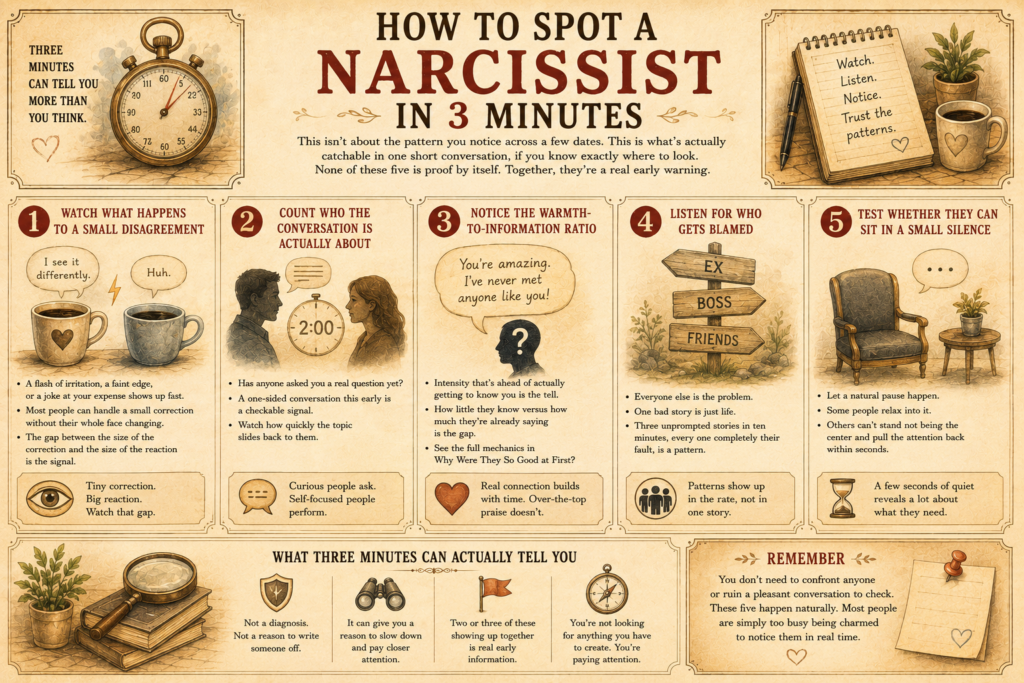
This isn’t about the pattern you notice across a few dates, which takes real time and is covered in full in Early Signs Someone’s a Narcissist. This is what’s actually catchable inside one short conversation, a first meeting, an interview, a party introduction, if you know exactly where to look. None of these five is proof by itself. Together, in one sitting, they’re a real early warning, worth far more than a good first impression on its own.
Watch What Happens to a Small Disagreement
Mildly correct a fact, or just say you see it differently, and watch the next three seconds closely. A flash of irritation, a faint edge in the voice, a joke at your expense that wasn’t quite a joke, all show up fast and then usually get smoothed over just as fast. Most people can absorb a small correction without their whole face changing. This is the single fastest real-time tell there is, because it doesn’t require you to know anything about their history. It only requires one small moment of friction.
You don’t need to manufacture this one. It happens naturally in almost any real conversation, someone mentions a restaurant and you say you didn’t love it, someone gets a date slightly wrong and you mention it. What you’re actually measuring is the gap between the size of the correction and the size of the reaction. A tiny correction that produces a reaction out of proportion to it is the signal, not the correction itself.
Count Who the Conversation Is Actually About
Somewhere around the two-minute mark, notice whether anyone has asked you a single real question yet. Not a polite pause waiting for its turn, an actual question with follow-up. A one-sided conversation this early isn’t shyness or nerves. It’s a genuine, checkable signal about whether the other person is currently curious about you at all, and three minutes is more than long enough to find out.
Try the simplest version of this test on purpose. Ask them something, then count how many beats pass before the subject circles back to them. A genuinely curious person can hold a thread about you for more than one exchange. Watch for the topic sliding back to their own story almost every single time, gently enough that it barely registers unless you’re actually counting.
Notice the Warmth-to-Information Ratio
Real warmth usually builds at roughly the speed of actually getting to know someone. Watch for intensity that’s already ahead of that, calling you amazing, special, exactly what they’ve been looking for, before there’s been time to learn much of anything about you. That gap, between how little they know and how much they’re already saying, is the tell, more than the compliments themselves. The full mechanics of what this eventually turns into are in Why Were They So Good at First?
Listen for Who Gets Blamed
An ex, a boss, a friend group, all painted as uniquely difficult or crazy within the first few minutes, is a fast, compressed version of a pattern that usually takes weeks to notice properly, already covered where it belongs. What’s worth watching for in one sitting specifically is the RATIO. One bad story about one difficult person is just life. Three unprompted stories in ten minutes, every one of them with the other person entirely at fault, is a rate, not a coincidence.
Test Whether They Can Sit in a Small Silence
Let a natural pause happen, or let the conversation drift briefly to someone else nearby. Watch what happens to the effort level. Some people relax into it without needing to do anything. Others visibly can’t tolerate a moment where they’re not the center of it, and pull the attention back within seconds, a louder comment, a story, a joke timed to reclaim the room. A few seconds of quiet is a small, easy test that most people pass without noticing they were even being tested.
The reclaim rarely looks aggressive. It’s usually smooth, a bigger laugh, a slightly louder voice, a well-timed comment that redirects two or three people’s attention back in one move. Smooth is exactly what makes it easy to miss on a single encounter, and exactly why it’s worth actually watching for once you know it’s there.
What Three Minutes Can Actually Tell You
Not a diagnosis, and not a reason to write someone off after one bad joke or one distracted moment. What it can genuinely give you is a reason to slow down and pay closer attention instead of getting swept along by how good the first impression felt. If two or three of these show up in the same short conversation, that’s not paranoia. That’s exactly the kind of early information most people only get months too late.
None of it requires confronting anyone or ruining a pleasant conversation to check. Every one of these five happens naturally in the ordinary course of talking to someone, which is exactly the point. You’re not looking for anything you have to create. You’re paying attention to what’s already there, that most people are simply too busy being charmed to actually notice in real time.