Why Were They So Good at First?
The second Tuesday of a writing class, I got to the room early and took the seat I always took. Back third, left side, where I could see the door. I’d been sitting like that since I was a boy, in a house where knowing who was about to come through a door mattered more than anything they’d say once they got there.
At four minutes to seven a woman in a denim jacket came in, swept the room once, and walked down my row past six empty desks to the chair on my left. She didn’t ask if it was taken. That chair wasn’t near the door and it wasn’t near the front. The only thing it was near was me.
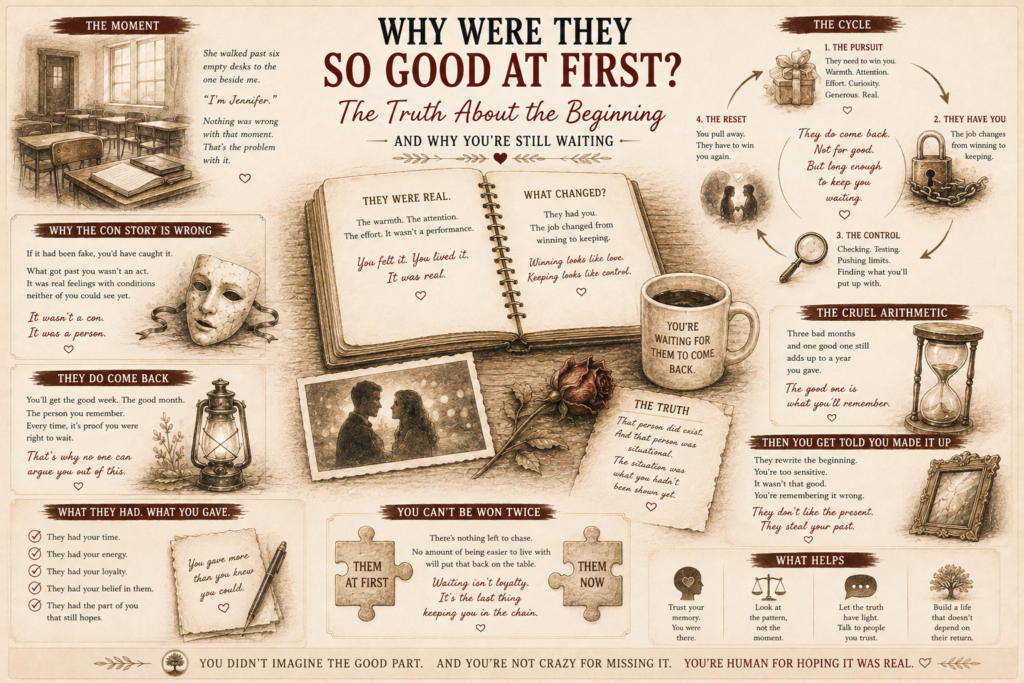
“I’m Jennifer,” she said, and put her books down like she was moving in.
Nothing was wrong with that moment. That’s the problem with it.
They were real
The internet will tell you it was love bombing. A performance. Somebody running a play on you from the first minute while you sat there believing it.
I don’t buy it, and I think that answer does more damage than the relationship did.
The research on this describes a range rather than one answer. Some people know exactly what they’re doing and know what it buys them. Plenty of others feel every bit of it, and the intensity is just what that feels like from the inside, no plan attached. And some are running a pattern they picked up somewhere and have never once looked at straight.
So I can’t tell you which one yours was. Neither can anybody else on the internet who never met them.
What I can tell you is that it doesn’t change your part in it. If it was genuine, you weren’t fooled, you were handed something real that had conditions in it nobody could see yet. If it was calculated, you were worked by somebody with practice, and being taken in by a person who’s good at it is not a defect in you. Both roads end in the same place. Your judgment isn’t broken.
When she walked past six desks, I don’t believe she was on step one of anything. She wanted to sit by me. I still think that was true.
And if it had been fake, you’d have caught it. You’ve spotted phonies your whole life, probably better than most people, especially if you grew up somewhere that made you watch faces for a living. What got past you wasn’t an act. It was the real thing, from somebody whose real thing had conditions in it that neither of you could see yet.
The con story is easier. It hands you a villain and a clean ending. It also tells you your judgment is broken and you can’t trust your own read on people, and you’ll carry that into everything after.
What changed
It wasn’t how they felt about you. It was what they needed from you.
At the start they needed to win you. That’s a real job with a real feeling attached, and the feeling is generous. Winning somebody is warm work. Attention, effort, curiosity, somebody moving their whole week around to see you. None of it fake, because in that stretch, giving is how they get what they’re after.
Then they had you. And the job changed from winning to keeping.
Keeping looks nothing like winning from where you’re sitting. It’s checking. It’s going cold for a day to see what happens. It’s finding out what you’ll put up with, and then finding out what you’ll put up with after that.
Same person. Same wanting. Different job.
People describe that as a mask coming off. I don’t think there was a mask. Winning, they’d learned. Keeping, they’d only ever seen done by holding on hard enough that the other person couldn’t go. So when the winning was over, they reached for the only other thing they had.
You’re waiting for them to come back
This is the part nobody says, and it explains more about why people stay than anything else I know.
You’re not still there because you’re weak, or blind, or slow. You’re still there because you met somebody worth staying for. You’ve got proof. You were there, you remember it, and it wasn’t a story anybody told you.
So when it’s bad, you don’t think this is who they are. You think this isn’t them. And you go back to the classroom, or wherever your version happened, and you use it as evidence. He was like that once. She was like that once. Which means it’s in there. Which means if I get it right, if I stop pushing, if I’m easier to live with, it comes back.
That’s the trap, and it’s built out of something true. Most traps aren’t.
And they do come back. That’s the part that keeps the whole thing running.
Not for good. But you’ll get a good week. Sometimes a good month. Something shifts and they’re funny again, and interested again, and you get a stretch of the person you’ve been waiting on. Every one of those stretches is proof you were right to wait.
That’s why nobody can argue you out of this from the outside. A friend tells you he’ll never change, and you’re sitting there with evidence that he already does, every few months, for a while.
This has a name, and it’s worth knowing, because the name takes the blame off you. Psychologists call it intermittent reinforcement. A reward that shows up unpredictably holds a person far harder than one that shows up every time. It’s why a slot machine is harder to walk away from than a vending machine. You’re not staying because you’re weak. You’re staying because you’re wired into the most effective pattern anybody’s ever found for making a person keep going.
What’s actually going on is that you drifted far enough, or got quiet enough, or got close enough to leaving, that they had to win you again. So they went and did the one thing they’re good at. It worked. And once it’s worked they can stop, and the whole thing resets.
I’ve heard people call those stretches getting their husband back, or their wife, or whoever it is they’ve been missing. What they got back was the pursuit. Same warmth, same attention, same effort, and real every time. Also temporary every time, for the same reason it was temporary the first time.
The cruel part is the arithmetic. Three bad months and one good one still adds up to a year you gave it, and the good one is what you’ll remember when you’re deciding whether to give it another.
Here’s what took me too long. That person did exist. And that person was situational. The situation was that you hadn’t been won yet.
You can’t be won twice. There’s nothing left to chase. The warmth you’re waiting for was the warmth of somebody trying to get something they’ve now got, and no amount of being easier to live with is going to put that back on the table.
Waiting isn’t loyalty. It’s the last thing keeping you in the chair.
Then you get told you made it up
There’s a second thing that happens, and it’s worse.
You don’t just lose the beginning. You get told it wasn’t what you remember.
You’re rewriting history. You always did make more of things than they were. Or the other direction, which sounds kinder and isn’t: we were happy, we were fine, all of this is coming from you. Some people get both inside the same month.
So now the one clean thing you had is up for argument, and you’re holding it alone, no witnesses, trying to work out whether a Tuesday in a classroom really felt the way you’ve been carrying it.
Losing a marriage is ordinary. Millions of people do it and go on. Losing your grip on your own memory of the best part is different, because that memory is what you’d normally stand on while you rebuilt.
That’s why I won’t tell anybody it was all a performance. That answer sounds clear-eyed and tough. It also finishes the job somebody else started, by taking the last solid thing you had and calling it proof of how badly you see.
You were there. Nobody gets a vote on that but you.
The one that wasn’t a setup at all
December of 2009, cold afternoon, I was filling the truck at a gas station. A gas cap came rolling across the concrete and stopped against my boot. It was hers. She came after it laughing at herself, and I handed it back.
That was the whole beginning. A woman chasing a gas cap across a lot in December and thinking it was funny.
For years I called that fate. Some days I still do.
Do I think it was staged? No. I’ve turned that afternoon over for a long time and I don’t believe anybody rolled a gas cap at my boot.
But here’s where I’ve landed after a lot of reading, and it’s less comfortable than either answer people want to hand you.
The control was probably there early. Earlier than I could see it. It didn’t show up one day in year six and announce itself. It was blanketed, and the blanket is the whole trick. Wanting to know where I was reads as interest in month two and as monitoring in year eight, and it is the exact same behavior both times. What changed wasn’t the behavior. What changed was how much of my life it had covered by then.
That’s why people can’t give you a start date. There usually isn’t one to give. You don’t get controlled on a Tuesday. You get a little more of it every year, and each increment is small enough to explain, and the only place it’s visible is from a distance you don’t have yet.
Then there’s the second thing, which I fought for a long while because it felt like letting somebody off the hook.
I don’t think she was working from a plan.
A lot of this runs on instinct. People who control other people are usually running something they learned somewhere, in a house, a long time ago, and running it without ever narrating it to themselves. Ask them and they’d say they were being caring, or worried, or just trying to hold the family together. Some part of them would mean it.
I try not to give anybody too much credit for strategy. Strategy means somebody sat down and thought it through. Most of what I lived through didn’t look like thinking. It looked like reaching, automatically, for the thing that had always worked, the way anybody reaches for what they know when they’re afraid of losing something.
Does that make it hurt less? No. It doesn’t change one thing about what it did to that house, or to me, or to how long it took to see any of it.
But it changes which question is worth your time. Whether she knew what she was doing is unanswerable. I could spend whatever I’ve got left on it and still die not knowing, and so could you. What was done, what it cost, how long it ran, those I can actually get at. Intent is a locked room. Conduct is right there on the table.
So, was the gas cap an accident? I think so. Will I ever know for certain? No. And I’ve made a rough peace with holding a thing I can’t close.
I’m saying all of this because of what people do to themselves once a marriage is over. You go back through the whole run hunting for the moment it was decided, and once you start looking you can find one anywhere. Every kindness turns into a move. Every good year turns into a setup you were too slow to catch. You lose the marriage, and then you go back and lose the years too.
Rewriting a woman laughing in a parking lot into the opening move of a con doesn’t make you smarter. It takes something that was yours and enters it as evidence against yourself.
So I keep both of these in my head on purpose. One looked like being chosen. One was pure chance. Neither one told me a thing about what was already there.
You can’t inspect the beginning and come away safe. What you can watch is the first year, and particularly the first time you let them down. Say no to something small and see what it costs. That’s the whole test, and it doesn’t require you to treat kindness as a symptom.
Why it lands hardest on people who were taught to watch
Here’s the part I understand best, and it took me until my fifties.
If you grew up reading a room before you walked into it, getting chosen doesn’t land on you as romance. It lands as relief.
Somebody walked past six empty desks. For a kid who spent his childhood listening for a truck coming up the street to figure out what kind of night was ahead, that isn’t intensity. That’s the first time anybody came toward you on purpose, without you having to earn it first by being useful, or quiet, or no trouble.
So the thing that would make somebody else slow down is the thing that puts your guard on the floor. You’re not being reckless. You’re finally getting paid in the currency you were short of your whole life. And a person who wants to keep you will work out, without ever putting words to it, exactly what that currency is worth to you.
That’s not bad judgment. That’s an old debt getting called in by whoever happened to be standing there.
That’s the half that was done to me. Here’s the half that was mine.
My part in it
It would be easy to read all of this as a man explaining that a series of women did things to him. I want to head that off, because it isn’t what I think happened, and if that’s what comes across then I’ve written it badly.
I kept walking toward the same shape. Nobody marched me anywhere. And I never once stopped to ask why the shape kept looking so familiar, which is the part that’s actually mine.
What I brought to those rooms was thirty-some years of practice. Practice at being easy to live with. Practice at reading a face and adjusting myself to whatever I found there. Practice at treating my own discomfort as the least important thing present, because in the house I grew up in, it was. Where a person picks that up, and what it costs him later, is the whole subject of Mistaking Control for Love.
A man who does that isn’t getting unlucky three times. He’s running something, same as anybody else, and he’ll keep running it until he can see it.
Saying so doesn’t let anybody off. What was done was done, and understanding how I ended up in the room doesn’t unmake a minute of it. Those are two separate accounts and they both stay open.
But if I wrote this as though I’d simply been selected by a run of bad draws, it would be a lie, and it would leave you with nothing you could use. Because the only piece of any of this anybody gets to work on is their own piece.
That’s not a criticism of you. It’s the only leverage there is.
If you’re still waiting right now
I’m not going to tell you to leave. That isn’t mine to say, and you’ve got reasons I don’t know anything about.
What I’d ask is that you put numbers on it instead of feelings. How long have you been waiting. How many of those good stretches have you had, and how long did the longest one hold. Write both down somewhere private, because those two numbers are the only part of this that can’t be argued with later.
Then look at them and ask what you’d say to somebody else who showed you the same two numbers about their own marriage.
Most people know that answer straight away and wish they didn’t. Knowing it and not being ready to act on it are two different things, and there’s no shame in the gap between them. But the numbers are yours now, and they don’t reset every time there’s a good week.
What to keep
It was real. Take that back, it’s yours.
You didn’t imagine the good part. You didn’t invent the way they looked at you. Your memory isn’t a symptom, and your read on people isn’t broken. You saw something real, it was real, then what they needed from you changed and the person you met stopped being available.
But real doesn’t mean recoverable. That’s the sentence I’d have wanted somebody to hand me twenty years ago. The beginning is not evidence that it can come back. It’s evidence that it happened.
And the last thing. You’re allowed a good beginning again someday, without treating warmth as a symptom and without running a background check on somebody who was kind to you in a parking lot. You already know the one thing worth watching, and watching it costs you nothing.
The beginning wasn’t the lie. The beginning was the truest thing they had. It just wasn’t all of them, and by the time you met the rest, you’d built a life on the part you met first.
You couldn’t have seen the whole of it from where you were standing. Nobody can, and that’s the shape of the thing, not a flaw in you.
So here’s the last thing, and it’s the only part of this that’s urgent.
The person you’re waiting for isn’t late. They’re gone. The one who’s still in the house is the one who’s left, and no amount of being quieter or easier or better is going to trade one for the other.
Every year you spend at that window is a year nobody gives back to you.
How a person gets trained to walk toward this in the first place is in Mistaking Control for Love. If you are still in it and trying to work out what you are looking at, start with Is It Abuse If They Never Hit You?.
The far end of that road, and the two endings that almost never get recorded as abuse at all, is How Abuse Kills
The reason that beginning still has a hold on you years later, and why it is relief rather than love doing the holding, is in It Was Never Love. It Was Relief..
This reflects personal experience and research, not professional advice. It isn’t therapy and it isn’t a diagnosis of anyone. If you’re worried about control or abuse in a relationship, the National Domestic Violence Hotline offers free, confidential support 24 hours a day to people of all genders. Call 800-799-SAFE (7233), text START to 88788, or chat at TheHotline.org.