How to Spot a Narcissist in X Spaces
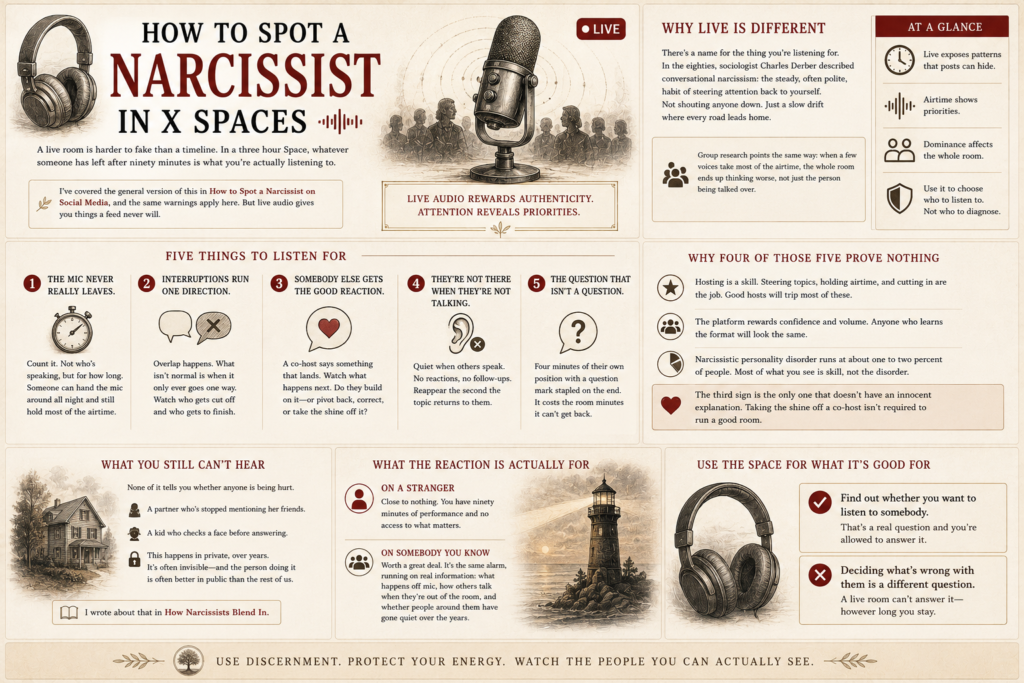
A live room is harder to fake than a timeline, and that’s the whole reason this is worth writing separately. A post gets drafted. Somebody reads it back, cuts the line that sounded needy, and posts the version that makes them look good. Nobody does that in a three hour Space. Whatever they’ve got left after ninety minutes is what you’re actually listening to.
I’ve covered the general version of this in How to Spot a Narcissist on Social Media, and the same warnings apply here, which I’ll come back to. But live audio gives you things a feed never will.
Why Live Is Different
There’s a name for the thing you’re listening for. In the eighties a sociologist named Charles Derber sat with hundreds of recorded conversations and described a pattern he called conversational narcissism: the steady, often polite, habit of steering attention back to yourself. Not shouting anyone down. Just a slow drift where every road leads home.
You can’t see that in a single post. It only shows up over time, in a conversation, which is exactly what a Space is. And the research on group talk points the same way: when a few voices take most of the airtime, the whole room ends up thinking worse, not just the person being talked over.
Five Things to Listen For
The mic never really leaves. Count it sometime. Not who’s speaking, but for how long. Somebody can hand the mic around all evening and still hold seventy percent of the airtime, because every handoff comes back to them for a comment first. Generosity with the mic and generosity with the clock aren’t the same thing.
Interruptions run one direction. People talk over each other, that’s normal. What isn’t normal is when it only ever goes one way. Watch whether the same person gets cut off twice and never does the cutting, and watch whether anyone’s ever allowed to finish a point that disagrees.
Somebody else gets the good reaction. This is the one that shows. A co-host says something that lands, the room reacts, and you listen to what happens in the next thirty seconds. A person who’s fine will build on it. Watch for the fast pivot back, the correction that wasn’t needed, the joke that takes the shine off it.
They’re not there when they’re not talking. Live audio makes this visible in a way nothing else does. Somebody finishes their turn and goes quiet, no reactions, no follow-ups, nothing, then reappears the second the topic returns to them. The room was never the point. Their turn was.
The question that isn’t a question. Somebody comes up to ask something and delivers four minutes of their own position with a question mark stapled on the end. In a text reply you’d scroll past it. Live, it costs the room four minutes it can’t get back, and you can hear whether the host protects the room or lets it run because it’s flattering.
Why Four of Those Five Prove Nothing
Here’s the part I’m not going to skip.
Hosting is a skill, and the skills that make somebody good at it look identical to the ones on that list. A host who doesn’t drive the conversation loses the room. A host who lets every rambling question run for four minutes has an empty Space by the second hour. Holding airtime, steering topics and cutting people off are the job, and somebody doing the job well will trip most of these.
There’s also arithmetic. Narcissistic personality disorder runs at about one to two percent of people. If you come out of a busy Space thinking half the speakers had it, the numbers say you watched people being good at a format that rewards confidence and volume.
The third sign is the only one that doesn’t have an innocent explanation. Nobody needs to take the shine off a co-host to run a good room. That one’s worth more than the other four combined.
What You Still Can’t Hear
None of it tells you whether anyone is being hurt.
Somebody can dominate a Space for three hours and go home and be decent to the people who live with them. Somebody else can be gracious on the mic all night, hand it around, build on everything anyone says, and be the reason his wife stopped seeing her sister.
What makes a narcissist dangerous happens in private, over years. It’s a partner who’s stopped mentioning her friends. A kid who checks a face before answering. None of that is audible, and the person doing it is often better in public than the rest of us, because public is where it pays. I wrote about that in How Narcissists Blend In.
What the Reaction Is Actually For
So you’re in a room and something about a speaker sets your teeth on edge. What’s that worth?
On a stranger, close to nothing. You have ninety minutes of them performing a format that rewards exactly the behavior you’re reacting to, and no access at all to the part that matters.
On somebody you know, it’s worth a great deal. It’s the same alarm, and near a person you can actually observe it runs on real information: what they’re like when there’s no audience, how the people around them talk when they’re out of the room, whether anybody near them has gone quiet over the years.
Use the Space for what it’s good for, which is finding out whether you want to listen to somebody. That’s a real question and you’re allowed to answer it. Deciding what’s wrong with them is a different question, and a live room can’t answer it however long you stay.