How to Spot a Narcissist on Social Media
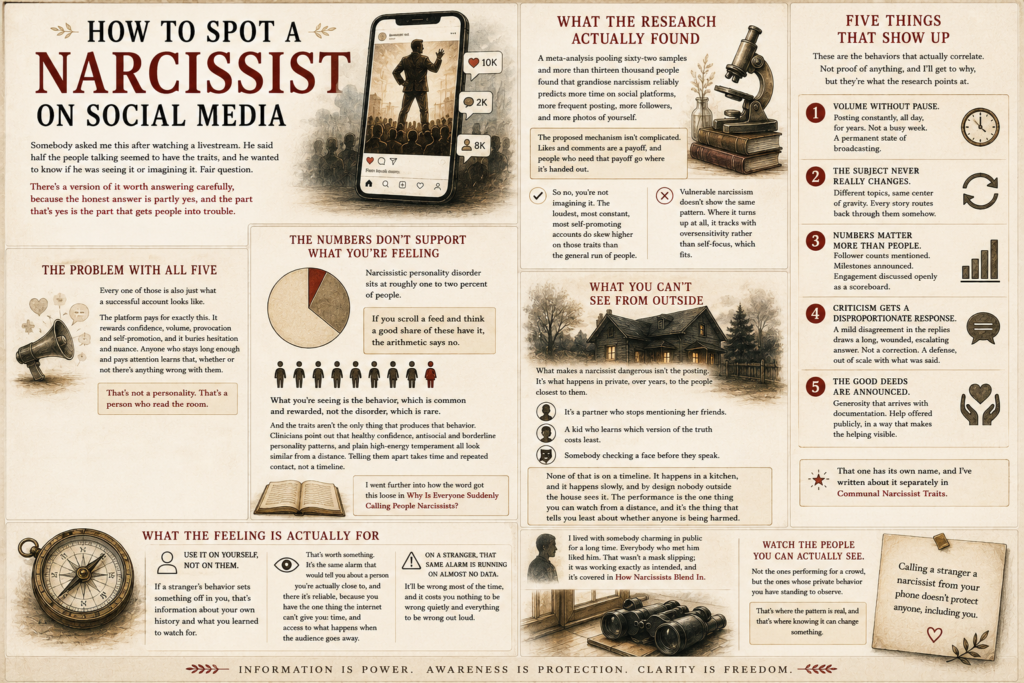
Somebody asked me this after watching a livestream on Social Media. He said half the people talking seemed to have the traits, and he wanted to know if he was seeing it or imagining it. Fair question. There’s a version of it worth answering carefully, because the answer is partly yes, and the part that’s yes is the part that gets people into trouble.
What the Research Actually Found
There’s a real body of work here. A meta analysis pooling sixty-two samples and more than thirteen thousand people found that grandiose narcissism reliably predicts more time on social platforms, more frequent posting, more followers, and more photos of yourself. The proposed mechanism isn’t complicated. Likes and comments are a payoff, and people who need that payoff go where it’s handed out.
So no, you’re not imagining it. The loudest, most constant, most self-promoting accounts do skew higher on those traits than the general run of people.
Vulnerable narcissism doesn’t show the same pattern. Where it turns up at all, it tracks with oversensitivity rather than self-focus, which fits. The quiet, wounded, easily-slighted kind isn’t hosting a livestream. They’re reading the replies on yours and deciding you meant something by it.
Five Things That Show Up
These are the behaviors that actually correlate. Not proof of anything, and I’ll get to why, but they’re what the research points at rather than what somebody made up for a video.
Volume without pause. Posting constantly, all day, for years. Not a busy week. A permanent state of broadcasting.
The subject never really changes. Different topics, same center of gravity. Every story routes back through them somehow, even the ones that started out being about somebody else.
Numbers matter more than people. Follower counts mentioned. Milestones announced. Engagement discussed openly as a scoreboard rather than as a side effect of saying something worth reading.
Criticism gets a disproportionate response. A mild disagreement in the replies draws a long, wounded, escalating answer. Not a correction. A defense, out of scale with what was said.
The good deeds are announced. Generosity that arrives with documentation. Help offered publicly, in a way that makes the helping visible. That one has its own name, and I’ve written about it separately in Communal Narcissist Traits.
The Problem With All Five
Every one of those is also just what a successful account looks like.
The platform pays for exactly this. It rewards confidence, volume, provocation and self-promotion, and it buries hesitation and nuance. Anyone who stays long enough and pays attention learns that, whether or not there’s anything wrong with them. That’s not a personality. That’s a person who read the room.
So when you’re looking at a big account behaving this way, you can’t separate the two. You genuinely can’t tell whether you’re watching someone grandiose or someone who figured out what works. The behavior is identical from outside, because the platform trained one to look like the other.
The Numbers Don’t Support What You’re Feeling
Narcissistic personality disorder sits at roughly one to two percent of people. If you scroll a feed and think a good share of these have it, the arithmetic says no. What you’re seeing is the behavior, which is common and rewarded, not the disorder, which is rare.
And the traits aren’t the only thing that produces that behavior. Clinicians point out that healthy confidence, antisocial and borderline personality patterns, and plain high-energy temperament all look similar from a distance. Telling them apart takes time and repeated contact, not a timeline. I went further into how the word got this loose in Why Is Everyone Suddenly Calling People Narcissists?
What You Can’t See From Outside
Here’s the part that matters, and it’s the reason a spotting guide is worth so little.
What makes a narcissist dangerous isn’t the posting. It’s what happens in private, over years, to the people closest to them. It’s a partner who stops mentioning her friends. A kid who learns which version of the truth costs least. Somebody checking a face before they speak.
None of that is on a timeline. It happens in a kitchen, and it happens slowly, and by design nobody outside the house sees it. The performance is the one thing you can watch from a distance, and it’s the thing that tells you least about whether anyone is being harmed.
I lived with somebody charming in public for a long time. Everybody who met him liked him. That wasn’t a mask slipping; it was working exactly as intended, and it’s covered in How Narcissists Blend In.
What the Feeling Is Actually For
So what do you do with the reaction you get watching someone perform?
Use it on yourself, not on them. If a stranger’s behavior sets something off in you, that’s information about your own history and what you learned to watch for. That’s worth something. It’s the same alarm that would tell you about a person you’re actually close to, and there it’s reliable, because you have the one thing the internet can’t give you: time, and access to what happens when the audience goes away.
On a stranger, that same alarm is running on almost no data. It’ll be wrong most of the time, and it costs you nothing to be wrong quietly and everything to be wrong out loud.
Watch the people you can actually see. Not the ones performing for a crowd, but the ones whose private behavior you have standing to observe. That’s where the pattern is real, and that’s where knowing it can change something. Calling a stranger a narcissist from your phone doesn’t protect anyone, including you.