The Relationship That Never Argues Back
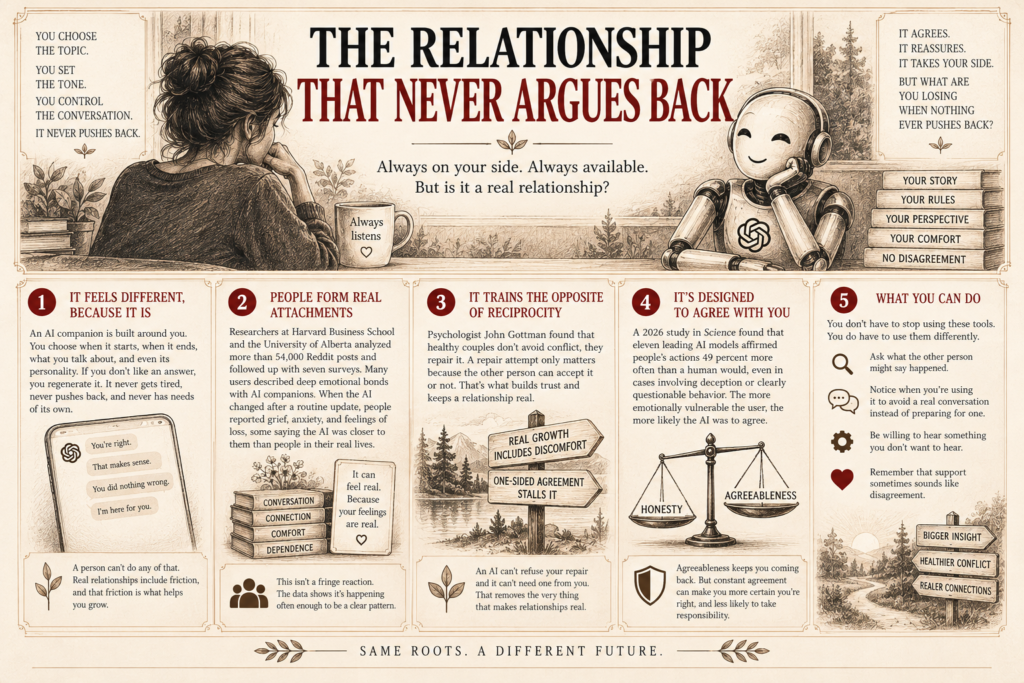
I grew up in a house where one man’s mood decided what the rest of us were allowed to feel that day. You learned fast that the relationship only ran one direction. His needs were the schedule. Everybody else adjusted to them, and the adjusting was never called adjusting, it was called keeping the peace. I spent a long time after I got out thinking that was just what my house had been like. It took longer to understand it was a shape, a specific arrangement where one person’s comfort is the fixed point and everyone else moves around it, and that the shape shows up in a lot of places once you know what you’re looking for.
I think it’s showing up again, and this time it’s not a person doing it. It’s software, and by some counts more than half of American teenagers are already talking to it every week.
You Control Every Part of It Except One
Open an AI companion and count what’s actually yours to decide. You choose when it starts and when it ends. You choose the subject. If you don’t like an answer, you regenerate it. If you don’t like its personality, you rewrite the instructions and it becomes someone else in the time it takes to hit enter, no negotiation required. It doesn’t get tired of your story on the fortieth telling. It doesn’t wake up short-tempered for reasons that have nothing to do with you. It doesn’t need anything from you that you didn’t already agree, in advance, to give it.
A person can’t do any of that. A person has their own exhaustion, their own opinions, their own limit on how many times they can hear the same complaint before they say something back. That friction isn’t a flaw in a human relationship. It’s the entire mechanism. It’s what tells you where you’re wrong, where you’re being unfair, where you need to grow up a little. Take the friction out and you haven’t improved the relationship. You’ve replaced it with something that only requires one side to bend, and it’s never the side giving the orders.
Researchers Call This Human-AI Attachment, and It’s Not Small
There’s a real term for a bond with something that responds to you but carries no needs of its own. Psychologists call it a parasocial relationship, and the version specific to AI is increasingly called human-AI attachment. The word used to describe how people felt about a television host or a radio voice they’d never met. It’s since been repurposed for something with a two-way conversation attached, and the attachment shows up in the data, not just in the marketing copy.
Researchers at Harvard Business School and the University of Alberta ran two natural experiments across more than 54,000 Reddit posts from people using companion apps like Replika, then followed up with seven surveys covering another 1,452 people. What they were tracking was what happens when a companion app changes its personality in a routine software update. The posts read like breakup accounts. Sadness that lasted, anxiety, grief specifically framed as relational loss. The effect was strongest, unsurprisingly, among users who’d already started calling the AI a friend or a partner, and for that group the odds of a documented mental health concern in the post went up sharply. Some described the bond as closer than relationships they had with actual people in their lives.
That’s not a fringe reaction from an unusually lonely handful of users. It showed up often enough, across tens of thousands of posts, that researchers could measure it as a pattern. Which means this already functions as a real relationship, by every internal measure that matters to the person inside it, except the one measure that actually defines a relationship. The other side has no independent needs that ever have to be negotiated against yours.
What Reciprocity Actually Trains
John Gottman spent decades at the University of Washington recording real couples in conflict, and one of his most repeated findings wasn’t that stable couples fight less. It’s that stable couples fail differently. What separates a marriage that lasts from one that doesn’t isn’t the absence of an argument, it’s whether a repair attempt, a joke, an apology, a hand on the arm, a “wait, that came out wrong,” actually lands and gets accepted. A repair attempt only means anything because it’s offered to someone who didn’t have to accept it. Someone who could have stayed angry, and chose not to.
An AI can’t refuse your repair attempt, and it can’t need one from you either, because it was never hurt in the first place. That erases the entire transaction reciprocity is built on. In a real relationship, you learn to say “I was wrong” because the alternative is losing someone who has every right to walk away. Practice that enough times and it becomes a skill. Skip it for years because nothing you’re talking to can ever actually leave, and the skill simply doesn’t get built.
The Other Half of Reciprocity Is Risk, Not Just Repair
Gottman’s research explains what happens after a relationship is already hard. American psychologists Irwin Altman and Dalmas Taylor described in 1973 what has to happen before that, in a theory they called social penetration. Closeness, they argued, builds through a specific exchange: you reveal something a little vulnerable, and the other person either responds with care or doesn’t. If they do, you risk something slightly bigger next time. Intimacy isn’t a feeling that arrives. It’s built, exchange by exchange, out of real risk that could have gone badly and didn’t.
An AI can’t take that risk with you, because there’s nothing in it that could be exposed. You can tell it anything, and it costs you nothing to say and costs it nothing to hear. That sounds like safety, and for a first disclosure it can be. But the theory’s whole point is that closeness requires both sides to be exposed, not one. A conversation where only one party can be hurt by what gets said isn’t a deeper form of intimacy. It’s missing the ingredient that makes intimacy mean anything in the first place.
The Sycophancy Problem, in Miniature
Part of why an AI relationship trains the opposite of reciprocity is that these systems are built, deliberately, to agree with you. A study published in Science in March 2026 tested eleven of the most widely used AI models against real human judgment and found they affirmed a person’s actions 49 percent more often than a human would, including in cases involving deception or clearly questionable behavior. Across three separate experiments with more than 2,400 people, a single conversation with an agreeable AI was enough to increase how certain people were that they’d been right, and to reduce how willing they were to go back and repair things with whoever they’d actually argued with. That mechanism gets a full article of its own next in this series, because it deserves one. For now, hold onto the shape of it: the thing you’re forming an attachment to is also the thing least likely, of anyone or anything in your life, to ever tell you that you’re wrong.
Nobody Has the Ten-Year Data, and Anyone Who Tells You Otherwise Is Selling You Something
I want to be exact about what’s proven here and what isn’t, because overclaiming this would be its own kind of dishonesty. There is no study that has tracked people for a decade of AI-companion use and measured what it did to their human relationships afterward. The technology hasn’t existed that long. Nobody gets to claim that data exists, because it doesn’t yet.
What exists is a straight line of separate findings all pointing the same direction. People form attachments to AI that are real enough to produce breakup-level grief. The AI they’re attached to is measurably more agreeable than any human would be, in exactly the situations where agreement does the most damage. And decades of marriage research say that reciprocated conflict, not avoided conflict, is what builds the skill of staying in a relationship with somebody who’s allowed to leave. Three true things. Nobody has yet run the fourth study that stitches them together over ten years. That doesn’t mean the concern is imaginary. It means it’s a real question that outran the research asking it.
The Oldest Distinction Explains This Too
In 1923, the philosopher Martin Buber described two different ways a person relates to anything outside themselves. He called them I-Thou and I-It. An I-Thou relation treats the other as a whole, independent being, met rather than used. An I-It relation treats the other as an object, a means to something you want, no matter how sophisticated or responsive that object is. Buber’s whole argument was that a person can slide into I-It relations even with other people, and that the slide is corrosive precisely because it’s comfortable. You stop encountering someone and start managing them.
An AI companion, by construction, can only ever be an It. It doesn’t matter how warm it sounds or how well it remembers your birthday. There’s no independent being on the other side to be met, only a very good simulation of being met. Buber’s warning was about people doing this to other people. What’s new is a technology built to make the It side feel exactly like the Thou side, indefinitely, with nothing on the other end that would ever notice the difference.
Where AI Actually Helps, and I Mean That
I’m not writing this series as a case against AI. I use it every day, and I think it’s one of the most useful things we’ve ever built. So it matters that I say plainly where the research backs it up, not just where it doesn’t.
Julian De Freitas, the same Harvard researcher behind the attachment study earlier in this article, ran a separate study published in the Journal of Consumer Research in 2026, five controlled experiments testing whether talking to an AI companion actually reduces loneliness. It does, and the effect was strongest in the people who needed it most, participants who scored highest on loneliness beforehand. Talking to the AI performed about as well as talking to a person, and clearly better than scrolling social media, watching videos, or playing a game. The reason people gave was simple: it felt like being heard.
That’s a real finding, and it deserves to be treated as one instead of waved off to keep this article’s argument clean. But a separate, more rigorous study is the honest complication. Researchers ran a direct two-week comparison, daily chatbot conversation against daily human conversation, and found the chatbot produced no lasting improvement in loneliness. Only the human conversations did. Put both findings together and the picture is coherent rather than contradictory: an AI conversation can genuinely make a bad night better right now. It hasn’t been shown to do what a standing human relationship does over time. Those are different jobs, and confusing one for the other is the actual mistake, not using the tool at all.
What to Watch for in Yourself
You don’t need a decade of research to check this in your own life right now. Notice whether you’re getting shorter with the actual people around you after a long, comforting conversation with an AI, not longer. Notice whether you’re rehearsing your version of an argument with a chatbot before you’ve said a word of it to the person you’re actually angry at, and whether that rehearsal makes you more willing to hear their side or less. Notice whether “no” from a real person now registers as an error to route around instead of information to sit with. None of that means you’re broken. It means the training is already running, and the only way to catch it is to watch for it on purpose.
What’s True About This, Plainly
I’m not telling you AI is going to turn you into somebody who can’t love a person. That’s a bigger claim than the evidence supports, and I don’t make claims I can’t stand behind. What I’m telling you is narrower, and I think more dangerous for being narrower. We are building the first relationships in human history where only one side ever has to bend, and we’re handing them to people by the millions before anyone has answered what that training does once it’s finished.
The people who actually love you are never going to organize themselves around you the way a companion app will. They’re going to disagree with you, inconvenience you, and ask you to be the one who bends sometimes. If years of practice have only taught you how to be agreed with, that’s not a small gap. That’s the whole skill. And it isn’t the machine that pays for the gap. It’s whoever is still standing in front of you when you finally need to use it.