Trauma Changes Your Religion More Than Your Faith
A devout woman is raped. A father buries a child. A man comes home from a deployment carrying something he can’t say out loud. None of those things happened inside a church. But a year later, some of these people are no longer in the pew they sat in their whole lives, and the people around them have decided they lost their faith.
That conclusion is usually wrong, and there’s American data showing why. Walking away from a religion and losing what you believe are two separate events. They come apart far more often than most people realize.
Start With How Common This Actually Is
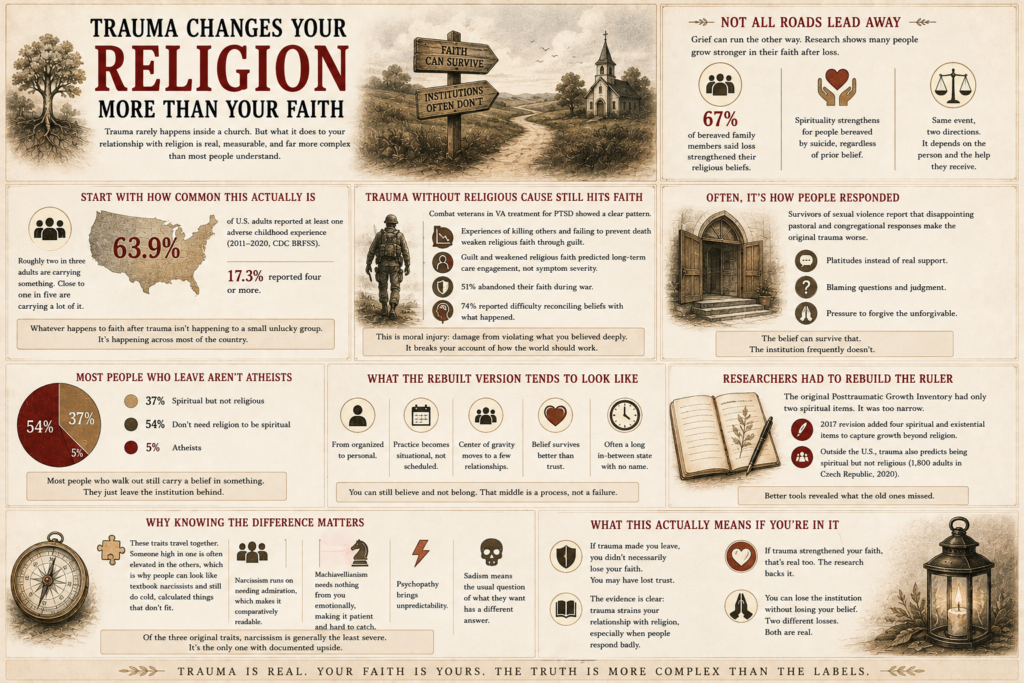
The CDC tracks adverse childhood experiences through its Behavioral Risk Factor Surveillance System. Across 2011 to 2020, 63.9% of American adults reported at least one adverse childhood experience, and 17.3% reported four or more.
Roughly two in three adults are carrying something. Close to one in five are carrying a lot of it. Whatever happens to faith after trauma isn’t happening to a small unlucky group. It’s happening across most of the country.
What Trauma Does to Faith When the Trauma Has Nothing to Do With Religion
The clearest American evidence comes from combat veterans, and it’s worth knowing because nothing about their trauma was religious. Nobody in a church did it to them.
In 2004, Fontana and Rosenheck published a study in the Journal of Nervous and Mental Disease covering 554 outpatient and 831 inpatient veterans in specialized VA programs for post-traumatic stress. What they found was direct: the experiences of killing others and of failing to prevent death weakened veterans’ religious faith, both on their own and through the guilt that followed.
The sharper finding was what predicted whether those men kept coming back for mental health care for years afterward. It wasn’t the severity of their PTSD symptoms. It wasn’t how well they were functioning socially. It was guilt and weakened religious faith, each contributing independently. Symptom severity played no significant role at all.
An earlier study of veterans in residential VA treatment for PTSD found that 51% said they had abandoned their religious faith during the war they fought in, and 74% reported difficulty reconciling their religious beliefs with what happened in the war zone. Those are people in clinical treatment rather than a cross-section of all veterans, so the numbers run higher than they would across the general population. The direction is still clear, and the trauma was ordinary human catastrophe, not anything a religion did.
Researchers eventually gave this its own name: moral injury, meaning the damage done by real or perceived violations of things a person believed deeply. It’s treated as distinct from ordinary post-traumatic stress precisely because the wound isn’t fear. It’s a broken account of how the world was supposed to work, which is exactly the territory religion occupies. That’s why the faith takes the hit even when the harm arrived nowhere near a church.
Often the Breaking Point Is How People Responded
Here’s the part that explains the woman who was assaulted and stopped going to Mass, and it isn’t what most people assume.
Research on survivors of sexual violence keeps finding the same thing: survivors report real disappointment with the pastoral and congregational response after they disclose, and that response is documented as making the original trauma worse rather than better. Negative interactions with people at church become their own separate source of religious struggle, on top of the assault.
So the sequence usually isn’t that the trauma disproved God. It’s that she took the worst thing that ever happened to her to the people who were supposed to hold it, and what came back was a platitude, or a question about what she’d been wearing, or a suggestion that she needed to forgive him. That’s the moment the building stops being safe. The belief can survive that. The institution frequently doesn’t.
This Is Especially True After Narcissistic Abuse
Two of the five childhood trauma categories in that research are emotional abuse and emotional neglect. That isn’t adjacent to what a narcissistic parent or partner does. That is the thing itself, showing up in the data under its clinical name.
And the response problem lands harder here than almost anywhere else, because the abuse is invisible from outside. A woman whose husband is dismantling her privately has no bruise to show anyone. When she finally tells someone at church, what frequently comes back is submit, forgive, don’t break up the family, keep praying about it, or a question about what she did to set him off. Sometimes her husband is sitting three rows up being widely admired, which is its own kind of proof that nobody is going to believe her. We’ve covered how scripture gets turned into the actual instrument of control in Spiritual Abuse: You Can’t Win an Argument With God.
That’s the second injury, and for a lot of people it’s the one that empties the pew. Not the abuse. The answer they got when they finally described it out loud. What breaks in that moment is trust in the people and the institution that failed to help, which is a very different thing from belief in God, and the two get confused constantly by everyone watching from outside.
Where People Actually Land
Pew’s Religious Landscape Study, covering 36,908 U.S. adults, found 29% of Americans are religiously unaffiliated. The easy assumption is that they’ve all stopped believing in anything. The data says otherwise, and it isn’t close.
Share who say they are at least somewhat spiritual
Among religiously unaffiliated Americans, by group
Pew Research Center Religious Landscape Study, 2023-24. 36,908 U.S. adults.
Among unaffiliated Americans, 37% describe themselves as spiritual but not religious, and 54% say plainly that they don’t need religion to be spiritual. Atheists are only 5% of American adults, a small minority inside the group everyone calls the nones.
The public conversation treats leaving religion as a single door with atheism behind it. The actual American population looks nothing like that. Most people who walked out are still carrying a belief in something. They’re just no longer carrying the institution.
What the Rebuilt Version Tends to Look Like
Most people going through this assume they’re the only one who landed where they landed, so it’s worth describing what the research keeps finding on the other side of it.
The shift is usually from something organized to something personal. Practice stops being scheduled and becomes situational. The center of gravity moves from a congregation to a small handful of individual relationships. Belief tends to survive better than trust does, which is why so many people in this position can tell you exactly what they still believe and also tell you they have no intention of walking back into a building to say it out loud.
It’s rarely a clean swap. A lot of people spend years in an in-between state, still praying but not attending, still believing but unwilling to say so in front of anyone, showing up at Christmas and feeling like a fraud in both directions at once. That stretch has no name in most people’s vocabulary, which is exactly why it gets experienced as failure instead of what it usually is, which is the middle of a process.
It Doesn’t Always Go That Direction
This has to be said, because the opposite pattern is just as real and pretending otherwise would make everything above less trustworthy.
Grief in particular often runs the other way. In one study of bereaved family members, 67% said the loss had strengthened their religious beliefs. Research on suicide bereavement finds spirituality strengthening regardless of what the person believed beforehand. Plenty of people walk into catastrophe and come out more religious, not less, and they aren’t fooling themselves either.
The veteran research shows the same split. Positive religious coping and regular attendance predicted better outcomes for some men, while spiritual struggle predicted worse ones. Same event, two directions, depending on the person and on what happened when they reached for help.
Researchers Had to Rebuild Their Own Ruler to See It
The Posttraumatic Growth Inventory is the standard instrument for measuring positive change after trauma. Its original version assessed spiritual change with two items, one about religiosity and one about spiritual understanding.
In 2017, Tedeschi and colleagues published a revision adding four spiritual and existential items, for a specific reason: the original was too narrow, and people with nonreligious perspectives couldn’t describe growth they had actually lived through. The field built a better instrument because the old one couldn’t see spirituality that wasn’t wearing a religious label.
Outside the United States, the pattern shows up in general population data too. A 2020 study of 1,800 Czech adults found that every category of ordinary childhood trauma, physical and sexual and emotional abuse and neglect, raised the odds of ending up spiritual but not religious. Worth mentioning, though that country is far more secular than this one, so the American picture is the one that should carry the weight here.
What This Actually Means If You’re In It
If something happened to you and you stopped going, and the people around you decided you lost your faith, the evidence says that conclusion is frequently just wrong. Most people who leave don’t land in atheism. They land somewhere they had no words for, and get called backsliding or bitter, because the only two categories on offer are in and out.
If you went through something terrible and your faith is what carried you, that’s real too, and the research backs it. Nothing here says the people still in the pews are kidding themselves.
What the evidence supports is narrower and more useful than either version. Trauma reliably strains the relationship between a person and their religion, and it strains it hardest when the people in that religion answer badly. It much less reliably takes away what they believe. Those are two different losses, and you’re allowed to have had one without the other.