Spiritual Abuse: You Can’t Win an Argument With God
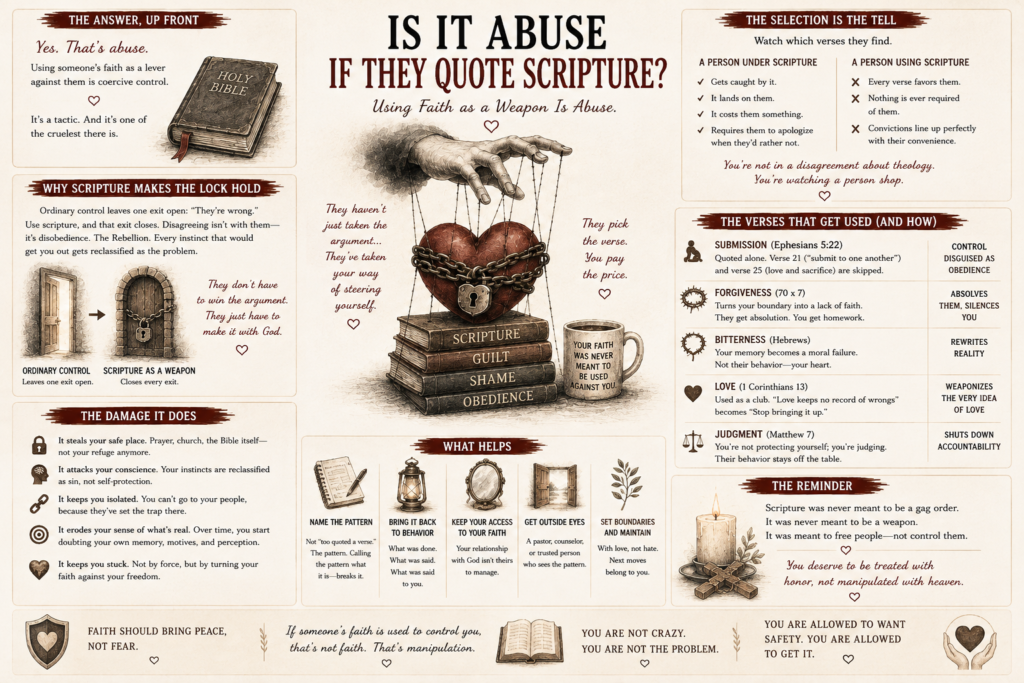
You brought up something that hurt you. And what came back wasn’t an answer. It was a verse.
Maybe it was about forgiveness, and how many times you’re supposed to do it. Maybe it was about bitterness taking root in you. Maybe it was that love keeps no record of wrongs, so the fact that you remember last March is its own kind of sin. Whatever it was, the conversation ended there, because you can’t argue with that. Not without becoming the bad Christian in the room.
So here’s the answer to the question in the title, up front, before anything else. Yes. That’s abuse. Not a rough patch, not a theological difference, not two people who read the Bible differently. Using someone’s faith as a lever against them is a recognized form of coercive control, it has a name, and people study it. What’s being done to you is a tactic, and it’s one of the cruelest ones there is, because it aims at the exact place a person keeps the things they can’t afford to lose.
I should say where I stand, because you deserve to know who’s talking. I was raised in the church. It faded on me over the years the way it does for a lot of people, quietly, no dramatic break. Then something happened to me I’ve never been able to explain and have never once been able to call nothing, and I haven’t managed to close that door since. So I’m not a believer by trade and I’m not on the other side either. I’m somewhere in between. I’m not writing this to move you out of whatever faith you’ve got. What’s being done to you looks to me like a theft of it, and I’d like you to get it back.
Why scripture makes the lock hold
Ordinary control leaves one exit open, even when everything else is shut. Eventually the person can think: they’re wrong. Not wrong about this one thing. Wrong about how they’re treating me. That thought is where getting out starts.
Run the same control through scripture and you close that exit too. Now disagreeing isn’t disagreeing with your partner. It’s disobedience. It’s rebellion. It’s a sin problem in you. Every instinct that would normally get you out gets reclassified as the thing that’s wrong with you.
That’s the whole mechanism. They don’t have to win the argument. They just have to make the argument be with God, and you can’t win that one, so you stop having it.
And understand what that costs you beyond the marriage. The place you’d normally go for comfort is the place they’ve set up shop. Prayer, church, the book itself, all of it now runs through them. They haven’t just taken the argument. They’ve taken your way of steadying yourself and pointed it at you.
The selection is the tell
Here’s the test that settles it for me, and I’d hand it to anybody who’s still wondering whether they’re being unfair.
Watch which verses they find.
Somebody genuinely trying to live under scripture gets caught by it sometimes. It lands on them. It costs them something, tells them to do a thing they didn’t want to do, requires them to apologize when they’d rather not. That’s what it looks like when a person is actually under a thing rather than holding it.
Now go back over every verse that’s been quoted at you in the last year. How many required something of you? How many required anything of them?
If it runs one direction every single time, you’re not in a disagreement about theology. Nobody’s convictions line up that perfectly with their own convenience. What you’re watching is a person shopping, and the store is your faith.
That’s the part I’d call by its name. This isn’t devotion and it isn’t strictness. Somebody worked out that the fastest way to stop you was to put God on their side of the table, and they’ve been doing it on purpose, whether or not they’d ever admit that to themselves.
The verses that get used, and who they get used on
The famous one is submission. Ephesians 5:22, wives submitting to husbands, and it’s usually quoted alone. It almost never gets read with verse 21, which comes first and tells the whole congregation to submit to one another. It very rarely gets read out to verse 25, which tells husbands to love their wives the way Christ loved the church and gave himself up for it. That’s the standard being set for him in the same breath. Someone quoting 22 while skipping 21 and 25 isn’t teaching you the passage. They’re editing it in front of you and hoping you don’t notice.
I’ll be straight about the asymmetry, because pretending otherwise would be dishonest. Submission doctrine is aimed at wives, that’s who it’s used on, and that’s what most of the research covers. Women are also the large majority of domestic violence victims generally.
But here’s what gets missed, and it’s most of what actually happens between two people. The verses that do the daily damage don’t need a gender at all. They work on a husband as easily as a wife, on a boyfriend or girlfriend who never married anybody, on anyone who takes their faith seriously enough to be held by it.
Forgiveness. Seventy times seven. Forgive as you’ve been forgiven. Used properly it’s one of the most freeing ideas there is. Used as a tool it means you’re required to drop it, now, permanently, and any part of you that hasn’t is disobedient. Advocacy groups working on this name forgiveness specifically as the concept abusers exploit most, because it turns the conversation away from what was done and onto whether you’re spiritual enough to let it go. Notice the trade. They get absolution, you get homework.
Bitterness. The root of bitterness, from Hebrews. This one converts your memory into a defect. You’re not describing a pattern, you’re harboring something. Now the problem isn’t what happened, it’s that you haven’t gotten over it, and the longer it goes on the sicker you look.
Love keeps no record of wrongs. This is the one I’d flag hardest. Coercive control is only ever visible as a pattern. One incident is always deniable, always explainable, always small enough to be your fault for making something of it. The only way anybody ever sees it is by setting the incidents next to each other. That verse, wielded right, forbids you from doing the one thing that would let you see what’s being done to you. It doesn’t just win the argument. It disables the instrument. Whether they understand that or not, that is what it accomplishes.
Judge not. Used to make any assessment of their behavior into a sin of yours.
Turn the other cheek. Used to make absorbing harm the holy option and objecting to it the worldly one.
A gentle answer turns away wrath. Used to make your tone the subject. You raised your voice, so now that’s what we’re discussing instead of what you raised it about.
None of those require a wife on the receiving end. The same verses get aimed at men who won’t be believed if they say so, and used by people who aren’t married and never will be. The mechanism doesn’t care who’s holding it.
The one that traps people hardest
Then there’s the four words people carry like a verdict. God hates divorce, from Malachi 2:16.
The Hebrew in that verse is genuinely hard. One standard translators’ commentary calls the first half of it one of the most obscure places in the entire Old Testament. So this isn’t somebody inventing a convenient reading. Older translations, the King James among them, render it as God hating divorce. Translations built on more recent Hebrew scholarship, including the ESV, NIV and CSB, read the hating and the violence as the husband’s actions rather than God’s. The ESV puts it this way: the man who does not love his wife but divorces her covers his garment with violence.
Sit with that a second. The verse most often used to keep somebody in a violent marriage is, in several major modern translations, a condemnation of the person doing the violence.
I’m not going to tell you that settles it. The scholarship is genuinely divided and I’m not qualified to close a debate translators are still having. What I’ll say is this. Anyone quoting those four words at you as though the matter is obvious and closed is either unaware of the argument or uninterested in it, and neither one entitles them to your life. It’s also worth knowing Jerome, Wycliffe, Luther and Calvin all read the passage as being about treachery and covenant-breaking rather than a blanket ban.
You were handed a fragment and told it was the whole thing.
Why help can be hard to find
If you take this to your church, the response is close to a coin flip, and the numbers explain why.
Lifeway Research surveyed 1,000 Protestant senior pastors. 87% strongly agreed that someone experiencing domestic violence would find their church to be a safe haven. Confidence was nearly total. In the same body of research, only about half said they had a plan if a victim came forward, 47% didn’t know whether anyone in their congregation had been a victim in the last three years, and fewer than half had any training. Most seldom addressed it from the pulpit at all.
Read those together. Nearly 9 in 10 are certain they’re a refuge. Around half have no idea whether it’s happening in front of them.
Other work points the same way. A survey of faith leaders found roughly 74% underestimated the level of sexual and domestic violence in their own congregations. An older study of clergy who counseled people in violent relationships found only about 37% referred them to services that specialize in it. And the assumption underneath all of it, that this doesn’t really happen among churchgoing families, doesn’t survive contact with the research, which finds it about as common inside those families as outside them.
Most of those pastors meant every word about being a safe haven. Good intentions and no training is a common combination, and it is not one to stake your safety on. Go in knowing that, and have a second option ready.
What to do with this
Find help that speaks both languages. An advocate who understands faith communities, or a counselor in your tradition with actual training in abuse rather than just in marriage. They exist. You shouldn’t have to choose between your safety and your faith, and anyone forcing that choice is offering you a false one. And if you have already left over this, what the research actually says about whether that means you lost your faith is in Trauma Changes Your Religion More Than Your Faith.
Be careful who you tell first. In a tight congregation information travels, and it can reach your partner before help reaches you. Telling a leader is not the same as telling a professional.
Keep the record anyway. If you’ve been taught that writing things down is unforgiving, look hard at what that teaching accomplishes and who it protects. You’re not building a case against someone you love. You’re holding onto your own memory so the conversation can’t be restarted from zero every time.
Watch whether questions are allowed. It’s the clearest test I know. In a healthy relationship, and a healthy church, you can push back on a teaching or say a passage troubles you and the room stays safe. Where doubt itself is the sin, the doctrine has stopped being a faith and started being a fence.
And keep the two things apart, because they are two things. What your partner did and what you believe about God are not the same subject, however completely they tied them together. They needed those fused. You don’t.
And if you’re the one holding the verses
Some of you reading this are on the other side of it. You didn’t come here to get caught, you came because the title bothered you, and you’ve already decided two or three times that this doesn’t describe you.
Stay a minute anyway.
You probably don’t think of it as a weapon. Most people doing it don’t. You think you’re being faithful, and you think you’re right, and being right feels like reason enough. Reaching for a verse in the middle of an argument doesn’t feel like reaching for a weapon. It feels like reaching for the truth. That’s exactly why it works, and exactly why it’s almost impossible to see from the inside.
So run the same test on yourself. When did scripture last cost you something? Not cost them. You. When did it last make you apologize, back down, sit through something you’d rather not, or give up a position you’d already dug into?
If you can’t come up with a recent example, you’re not living under the book. You’re carrying it. And a book you only ever aim outward has quit being your faith and turned into your equipment.
Here’s what better looks like, and not one piece of it asks you to give up anything you believe.
Answer the actual sentence. When they say something hurt them, respond to that. Not to their tone. Not to their spiritual condition. Not to what a better Christian would have said instead. Just the thing they actually said.
Put the verse down during the fight. If a passage is true it’ll still be true Thursday. Quoting it right now isn’t teaching, it’s ending the conversation, and somewhere in you, you know that.
Let one land on you. Go find the verse in the same passage that asks something of you. Sit with it as long as you’ve been asking them to sit with theirs.
Ask what it’s been like to be married to you. Then don’t explain, don’t correct the record, don’t reach for anything. Just listen to the answer all the way to the end.
People do change this. It happens. But it only happens when somebody decides that being right is worth less to them than being trusted, and that’s an actual trade, not a good feeling on a Sunday. If you make it, the person across from you is going to need a long time before they believe it, and you’ll have to be all right with that too. That’s the price, and it’s a fair one.
Plenty of people leave something like this and keep their faith. Plenty leave the church and keep it. Some lose it for a while and later run into something they can’t explain and can’t dismiss. Those are all real roads, and the person quoting verses at you across the kitchen doesn’t get to pick which one you take.
But be clear about one thing on the way out, whatever you decide.
The broader pattern this belongs to is in Is It Abuse If They Never Hit You?, and how somebody gets trained to accept it in the first place is in Mistaking Control for Love.
God didn’t do this to you. A person did, and they used His name because it worked.
This reflects personal experience and research, not theological training or professional advice. The translation questions raised here are genuinely debated by scholars, and I’ve tried to represent that rather than pick a side. If you’re worried about control or abuse in a relationship, the National Domestic Violence Hotline offers free, confidential support 24 hours a day to people of all genders and all faiths. Call 800-799-SAFE (7233), text START to 88788, or chat at TheHotline.org. If you’re in immediate danger, call 911 or your local emergency service.