What Is Psychological Layering?
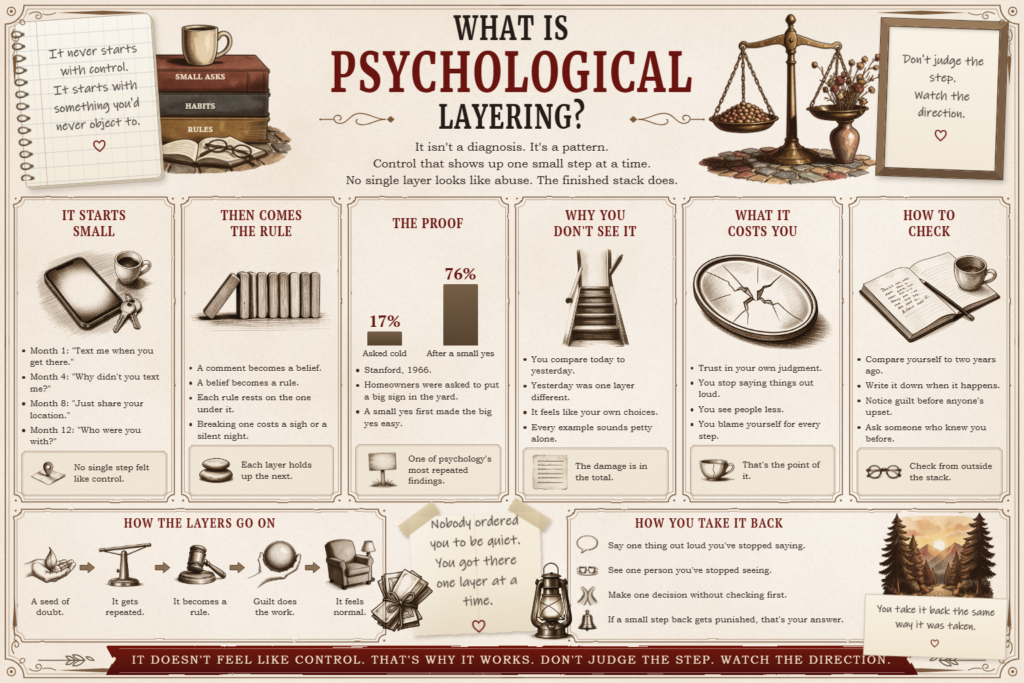
Psychological layering is a name for manipulation that works in small steps. One comment, then another like it, then a request a little bigger than the last, each one too minor to fight about, until the pile of them has changed what you believe about yourself and what you’ll put up with. No single layer looks like abuse. The finished stack does.
I was raised by a narcissistic stepfather and I’ve been married to three narcissists, and this is the part I most want people to understand. There’s no day you can point to where it changed. There’s just a point where you look up and you’re living a life you’d never have agreed to if somebody had handed it to you all at once.
The term is all over social media right now. Here’s where it came from, what’s real underneath it, and how to tell if it’s happening to you.
Where the Term Came From
Psychological layering isn’t a clinical term. You won’t find it in the DSM or in the research on abuse. It started showing up by early 2025 in “dark psychology” posts on Threads, X, and Substack, and a lot of those posts are the same text copied from account to account. They open with “I’m studying dark psychology,” call layering the most powerful manipulation tactic there is, more powerful than gaslighting, and lay out three steps. Plant a seed of doubt. Repeat it. Stack new beliefs on top of the old ones.
People in the comments pushed back and said it’s just gaslighting or conditioning with a new name. They’re half right. But the label caught on for a reason. People who’ve lived through this needed a word for something that never felt like one big thing, and “layering” matches how it felt from the inside.
So use the word if it helps you. Just know it’s a description, not a diagnosis, and what it describes has been studied for decades under other names.
How the Layers Go On
It doesn’t start with control. It starts with something you’d have no reason to object to.
The first layer is usually a small comment. That outfit’s a little much. Your sister’s kind of a lot, isn’t she? You get emotional about stuff. Any one of those is something a normal person might say on a bad day. That’s what makes it work.
The second layer is repetition. The same comment comes back in a slightly different form, week after week. Repetition does something an argument can’t. Researchers at Temple and Villanova named it the illusory truth effect in 1977: hearing a statement again makes it feel more true, even when you knew better the first time. You don’t decide to believe it. It starts sounding familiar, and familiar starts feeling like fact.
The third layer is the rule. Once you half believe you’re too emotional, it seems reasonable that they handle the hard conversations. Once your sister is “a lot,” it seems reasonable to see her less. Each rule is small. Each one rests on the layer underneath it.
The fourth layer is the feeling tied to the rule. Break it, and you get a sigh, a silent evening, a “fine, do whatever you want.” Keep it, and things are warm again. After enough rounds you don’t need their reaction anymore. The guilt shows up on its own, before you’ve even done anything.
Here’s what the stack looks like in real life. Month one: “Text me when you get there.” That’s sweet. Month four: “Why didn’t you text me?” Now it’s a rule. Month eight: “Just share your location. It’s easier.” Now it’s tracking. Month twelve: “Who were you with?” No single step felt like control. That’s the tactic.
It runs the same way with parents. A parent who says “if you really loved me” once is guilt-tripping. A parent who says it for twenty years has built your whole idea of what love costs.
The Science Under the Buzzword
The best-known proof that small steps work came out of Stanford in 1966. Psychologists Jonathan Freedman and Scott Fraser had people ask California homeowners to put a big, ugly “Drive Carefully” sign in their front yard. Asked cold, about 17% said yes. Homeowners who’d agreed two weeks earlier to put up a tiny “Be a Safe Driver” sign said yes about 76% of the time. The small yes made the big yes feel like who they already were. It’s called the foot-in-the-door technique, and it’s one of the most repeated findings in social psychology.
Robert Cialdini at Arizona State built on that in his book Influence. Once people commit to something, even something small, they feel pressure to keep acting in line with it. Every layer you accept becomes a commitment the next layer leans on.
Before either of them, an Air Force researcher named Albert Biderman studied how American prisoners of war in Korea were pushed into false confessions. His 1957 report found that physical brutality usually wasn’t what broke them. Steady pressure did: isolation, exhaustion, threats, occasional kindness, and what he called enforcing trivial demands. Small, pointless rules, followed every day, built the habit of doing what you’re told. Advocates have used his chart for decades to explain domestic abuse, because the list reads like a description of a controlling marriage.
Sociologist Evan Stark, who helped open one of the first battered women’s shelters in the country, gave the pattern its modern name in his 2007 book Coercive Control. His point was that abuse often isn’t a string of separate incidents. It’s an ongoing campaign that takes away a person’s freedom piece by piece. That’s layering, described by somebody who spent a career working with the people it happened to.
And sociologist Diane Vaughan, studying the 1986 Challenger disaster, named the last piece: the normalization of deviance. NASA engineers accepted a small problem with the shuttle’s seals, and since nothing went wrong, the next small problem looked acceptable too. Each exception became the new normal. If it can happen to NASA, it can happen to anybody.
Why You Don’t See It Happening
You don’t see it because you’re always comparing today to yesterday, and yesterday was only one layer different.
Every layer gets measured against the one before it, not against where you started. Your sense of normal moves with the stack. By the time things are bad, they’ve been nearly this bad for a long time, so nothing ever feels like a change.
It also doesn’t feel like control. It feels like you made reasonable choices. You did decide to see your sister less. You did decide to stop bringing things up. That’s why people coming out of these relationships blame themselves so hard. They remember choosing every step, and they don’t remember being steered, because the steering was built not to be noticed.
And there’s no single moment to show anyone. Every example sounds petty on its own. The damage is in the total, and the total is hard to show, which is part of why it works.
How to Tell If It’s Happening to You
Since you can’t feel the layers going on, you have to check from outside them.
Compare yourself to two or three years ago, not to last week. Who did you used to see? What did you used to say out loud? What did you used to buy without asking? If the list of things you’ve quietly dropped is long, and every drop happened to suit the same person, that’s a pattern, not a coincidence.
Write things down when they happen. The date, what was said, what you did after. Memory edits itself to fit the current story. A notebook doesn’t. Reading three months of entries at once shows you a stack you’d never see one day at a time.
Watch for guilt that shows up before anyone’s upset. If you feel like you’ve done something wrong for wanting to see a friend or buying something for yourself, ask where that feeling came from and who benefits from it.
Ask somebody who knew you before to tell you how you’ve changed. People outside the stack can see what you can’t.
If several of these hit home, read How to Tell If You’re in Narcissistic Abuse. How Narcissists Take Over Your Life covers the same slow takeover from the other side.
What It Costs and How You Take It Back
Layering costs you the one thing you’d need to fight it, which is trust in your own judgment. Once enough small doubts are stacked on you, you can’t tell anymore whether you’re being treated badly. That’s the point of it.
You take it back the same way it was taken, in small steps. Say one thing out loud this week that you’ve stopped saying. See one person you’ve stopped seeing. Make one decision without checking first how it’ll go over. Then watch what happens. If a small step back gets punished, you’ve learned something true about the relationship.
Don’t judge the step. Watch the direction. Call it layering, coercive control, or nothing at all. If your life has gotten smaller one reasonable step at a time, and every step moved you toward what one person wanted, you weren’t being difficult when you noticed. You were seeing how it was built.
If you’re in danger, call the National Domestic Violence Hotline at 1-800-799-7233 or text START to 88788. It’s free, confidential, and open 24 hours a day.