What Is Frankensteining in a Relationship?
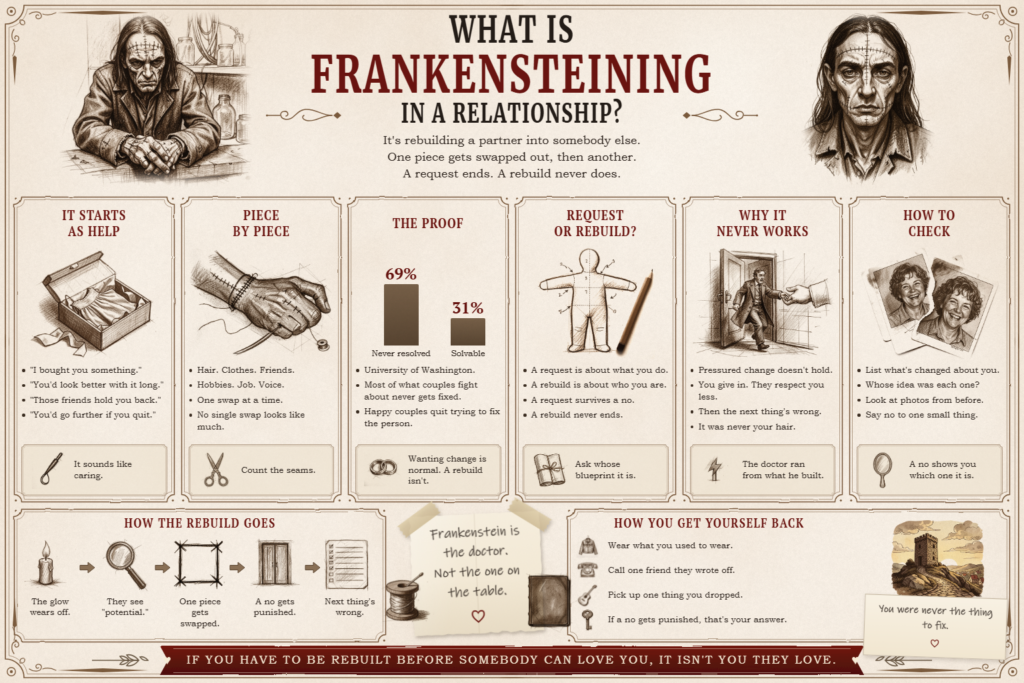
Frankensteining is when one partner tries to rebuild the other into the person they’d rather be with. Your clothes, your hair, your hobbies, your friends, your job, the way you talk at dinner. One piece gets swapped out, then another, until the person they’re dating is somebody they put together themselves.
I was married to three narcissists, and I can tell you nobody announces a remodel. It shows up as help. It shows up as “I just think you’d look better in this color.”
The word has been going around since summer of this year (2026). Here’s what it means, where a normal request ends and a rebuild starts, and how to tell which one you’re living in.
Where the Term Came From
Frankensteining isn’t a clinical term. It took off in June 2026, when Vice ran a piece quoting Sara Sloan, a marriage and family therapist in Austin, Texas. She described it as trying to change a partner’s appearance, interests, and habits to match your idea of the ideal partner. By fall it was all over the lifestyle sites and X.
Sloan was clear that the behavior is old and only the name is new. She said it usually starts when the new-relationship energy wears off. That’s when somebody who picked a partner for their “potential” looks at the actual person and gets to work.
The name comes from Mary Shelley’s 1818 novel, and two details from the book matter here. Frankenstein is the doctor, not the creature. And the moment his creation opens its eyes, the doctor is disgusted by it and runs out of the room.
Online, about half the comments say this is just having standards. That’s a fair challenge, and it has an answer.
What It Looks Like
It starts small and it sounds like caring.
He buys you clothes that are nothing like what you wear, and goes quiet when you don’t put them on. She tells you which of your friends are holding you back. You’d be so pretty if you lost fifteen pounds. You’d go further if you quit that job. You laugh too loud. Nobody says “y’all” at these dinners.
Your hobbies fade out and theirs fill the calendar. Your music stops playing in the car. You get a gym membership for your birthday that you never asked for.
The tell is the sentence running in their head, and both Sloan and Psychology Today’s Bruce Lee, a physician, landed on the same one: if they would only change this one thing, everything would be so much better. When that sentence is about you all the time, and the thing keeps changing, you aren’t a partner. You’re a project.
Men do it and women do it. Narcissism isn’t a male-only problem, and neither is this.
Standards or a Rebuild?
Asking a partner to change something is normal.
John Gottman’s lab at the University of Washington followed couples for years and found that about 69% of their conflicts were perpetual. They came from personality differences that never got resolved. The couples who stayed happy didn’t fix those problems. They learned to live with them. So wishing your partner were different in some way is the normal condition of being with another person.
Four things separate a request from a rebuild.
Is it about what you do, or who you are? “Call me if you’re going to be late” asks for a behavior. “Be quieter, be thinner, be less like your family” asks for a different person.
Whose goal is it? In 1999, psychologists Stephen Drigotas and Caryl Rusbult, working at Southern Methodist and the University of North Carolina, published four studies on what they called the Michelangelo phenomenon. People whose partners saw them and treated them as the person they were already trying to become actually moved toward it, and those relationships did better. Rusbult and Northwestern’s Eli Finkel later described the reverse and called it the Pygmalion phenomenon: a partner pushing you toward their ideal instead of yours. In the original studies, people whose partners didn’t back who they were trying to become moved further from it, and those couples were less satisfied. Both partners are “helping.” The difference is whose blueprint it is.
What does a no cost you? A request survives a no. A rebuild punishes it, with sulking, coldness, or a comment about how the ex never minded.
Does it ever end? A request gets met and it’s over. A rebuild has no finish line. You fix the hair, and next it’s the laugh.
When It Turns Into Control
Sloan called Frankensteining a way to control a partner. Sociologist Evan Stark of Rutgers said the same thing years earlier in his 2007 book Coercive Control. He found that abusers regulate the small stuff of daily life: how a partner dresses, cooks, cleans, and who she sees. He called it microregulation.
Not every case is abuse. Some of it is immaturity. Somebody fell for an idea, got a person, and doesn’t have the guts to leave, so they try to edit you into the idea.
It’s control when the changes all run one direction. Away from your friends, your money, your own opinions, and toward needing them. It’s control when a no gets punished. And it almost never comes as one big demand. It comes in steps too small to fight about, which is how psychological layering works.
With a narcissist there’s one more piece. You aren’t a separate person to them. You’re part of how they look to the world, so your weight, your clothes, and your job are their business the way their own haircut is. How Narcissists Change People covers what that does to you over years, and Mistaking Control for Love covers why it feels like devotion at the start.
Why It Never Works
Rebuilding a person fails even when the person goes along with it.
Psychologists Edward Deci and Richard Ryan at the University of Rochester spent decades on what they named self-determination theory. One of their steadiest findings is that people need to feel their choices are their own. Change that’s pressured out of somebody doesn’t hold, and it breeds resentment.
Then there’s the part from the book. The doctor got exactly what he built, and he couldn’t stand to look at it.
You change the hair, drop the friends, take the job they wanted, and they don’t love you more. They respect you less, because you gave in. Then the next thing is wrong with you. You can’t win by complying, because the problem was never your hair.
What it costs you is the list of things you liked. Ask somebody five years into one of these what music they like or what they’d do with a free Saturday, and a lot of them can’t answer. When Did You Learn to Stop Being Yourself? is about that.
How to Check and What to Do
Write down everything that’s changed about you since the relationship started. Clothes, hair, weight, friends, hobbies, job, church, how often you see your family. Next to each one, write whose idea it was and whether you wanted it. A list that’s mostly their ideas is your answer.
Look at photos from before. Ask somebody who knew you then what’s different. People outside it can see what you can’t.
Say no to one small thing and watch what happens. A partner who was only asking will shrug. A partner who’s building something will make you pay for it.
If you’re the one doing the rebuilding, be straight with yourself. If you need them to be a different person, the decent move is to leave. Sloan said the same: parting ways is more loving than trying to change them.
Somebody who loves you will ask you to change things. They’ll ask you to pick up your towels and stop being late. They won’t ask you to be somebody else. If you have to be rebuilt before a person can love you, it isn’t you they love, and every piece you hand over to find that out is a piece you’ll have to go get back.
If you’re in danger, call the National Domestic Violence Hotline at 1-800-799-7233 or text START to 88788. It’s free, confidential, and open 24 hours a day.