Why Gambling Appeals to a Narcissist
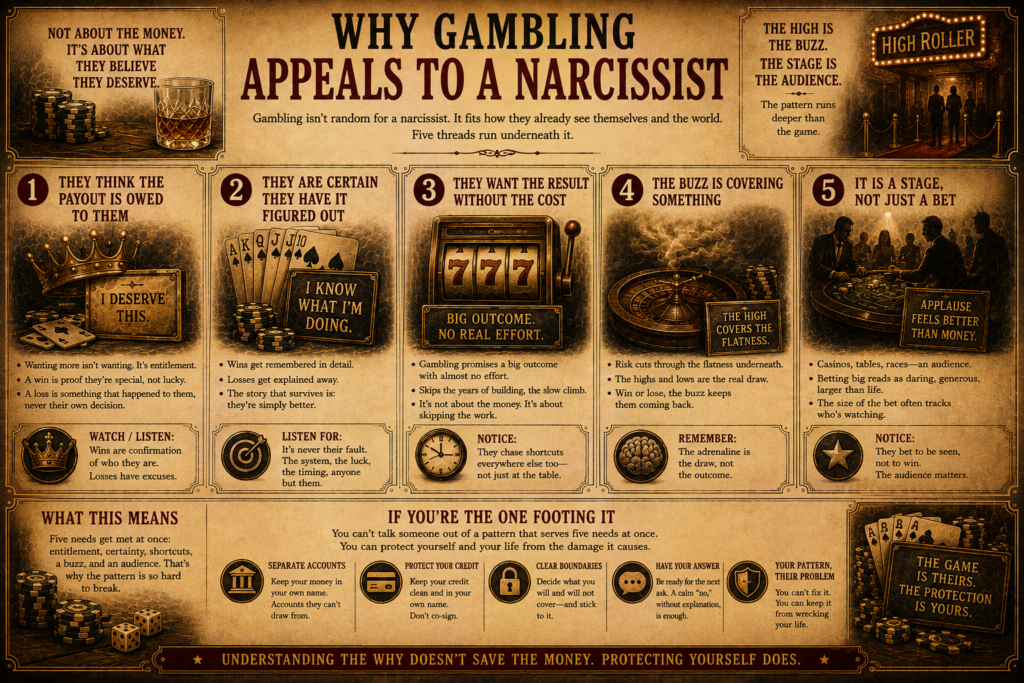
Gambling is not a random habit for a narcissist. It fits how they already see themselves and the world so well that it barely needs an explanation once you know what to look for. Five threads run underneath it: what they think they deserve, what they believe about their own skill, how much effort they think a payoff should actually cost, what emptiness the buzz is covering, and who is meant to be watching. None of this is a diagnosis, and not everyone who gambles fits this pattern. This is about the specific way it clicks into place for someone who already runs on entitlement, certainty, and a need to be seen. Here is what is actually driving it.
They think the payout is owed to them
To a narcissist, wanting more is not really wanting. It is entitlement, and gambling looks like a shortcut straight to what they already believe should have been theirs anyway. The slow route, years of ordinary work, does not fit someone convinced they are the exception the normal rules were not written for. A win does not feel like luck to them. It feels like proof.
Notice whether a win gets talked about as confirmation of who they are, and a loss gets talked about as something that happened to them, never as their own decision. That asymmetry is the entitlement talking, not the odds.
Listen for how a big win gets told to other people afterward. If it turns into a story about how special or sharp they are, rather than a story about a lucky night, that is the same entitlement, just wearing its public face.
They are certain they have it figured out
The wins get remembered in detail. The losses get explained away: bad luck, a rigged table, someone distracting them at the wrong moment. Over time the story that survives is the one where they are simply better at this than everyone else in the room, and the losing stretches were never really about their own choices. It is the same self-editing that shows up everywhere else in their life, just running on a scoreboard now.
Ask what actually happens to the story after a bad night. If the losses always have an outside cause and the wins never do, you are not looking at a system being beaten. You are looking at a story being protected.
They want the result without the cost
Gambling promises the one thing that matches how a narcissist wants life to work: a big outcome for almost no real effort. No years of building anything, no slow climb, just a number that could change everything tonight. That appeal is not really about the money. It is about skipping the part where they would have to actually earn something the ordinary way, which was never the part they were interested in.
Notice whether this same shortcut-seeking shows up everywhere else too, in work, in relationships, in anything that is supposed to take real time. Gambling is rarely a stray habit. It is usually one more place the same pattern found a table to sit down at.
Watch what happens to a plan that requires patience: a savings goal, a slow career move, a debt paid down a little at a time. If those consistently lose out to whatever promises a faster number, gambling is not the exception in this person’s life. It is the clearest example of the rule.
The buzz is covering something
This piece of it runs on the same engine behind most of a narcissist’s reckless risk-taking: a flatness underneath that risk is one of the only things that reliably cuts through. Gambling delivers that charge efficiently, on demand, at a table that is always open, and it does not much care whether the night ends in a win or a loss.
The highs and lows themselves are the actual draw, not the outcome, which is why the losses rarely teach the lesson you would expect them to. See the piece above for the full mechanism behind it.
It is a stage, not just a bet
A casino floor, a high-stakes table, a day at the races, all of it comes with an audience, and a narcissist plays to it as much as they play the game. Betting big in front of people reads as daring, generous, larger than life, which lines up with the same instinct that reaches for status symbols everywhere else, just spent at a table this time instead of on a car or a watch.
Notice whether the size of a bet seems to track who is watching more than what they can actually afford. A bet made to be seen is not really about the game either.
What this means if you are the one footing it
None of this makes the money any easier to watch disappear, and understanding the why does not undo the damage a losing streak can do to a shared life. If you are attached to someone like this, protect what is actually yours: your own accounts, your own name on what matters, a clear line about what you will and will not cover.
You cannot talk someone out of a pattern that is quietly serving five different needs at once. You can make sure it does not quietly take you down with it.
That means real, unglamorous steps: separate accounts they cannot draw from, your own credit kept clean, a plain answer ready for the next time you are asked to cover a loss. None of that fixes them. It just means their pattern stays their problem instead of quietly becoming your bill.