Why Narcissists Are Prone to Addiction
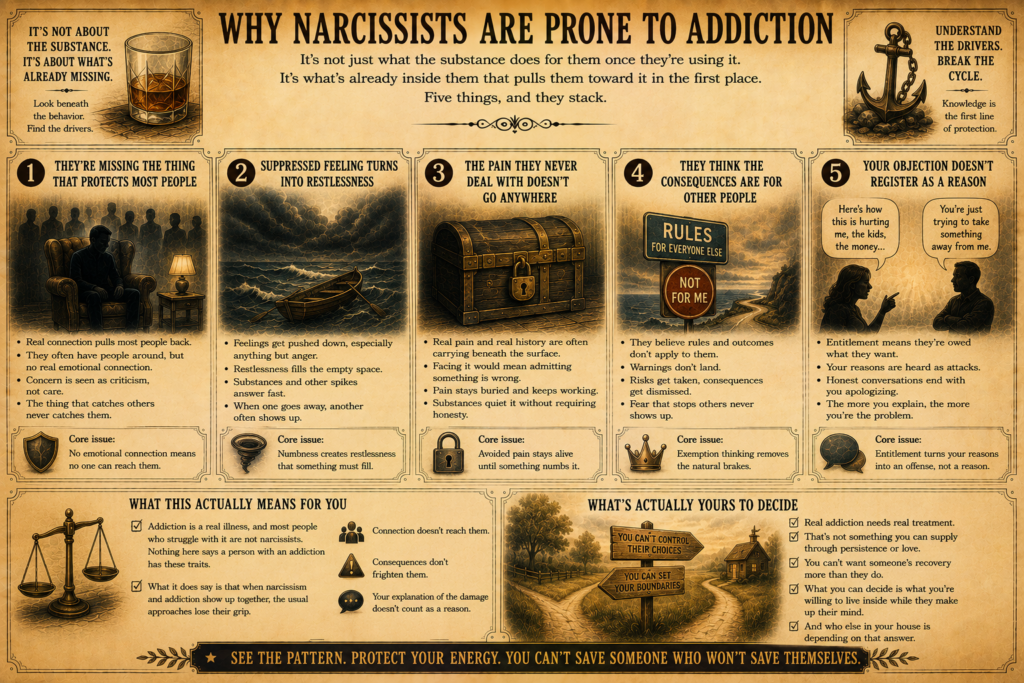
We’ve already covered what the drink itself does for a narcissist, the excuse it provides and the image it builds, in Why Narcissists Drink Alcohol. This is the other half of it: not what the substance does for them once they’re using it, but what’s already sitting inside them that pulls them toward it in the first place. Five things, and they stack.
They’re Missing the Thing That Protects Most People
The strongest protection anyone has against a habit turning into an addiction is other people. Real connection, the kind where someone actually knows how you’re doing and you actually care what they think, is what pulls most people back before something takes over. Recovery programs are built on that principle for a reason.
A narcissist doesn’t have that, and not because nobody’s around. There are often plenty of people around. What’s missing is the emotional connection underneath the contact, the part that would make another person’s worry land as something real instead of something inconvenient. So the thing that catches most people before they fall never catches them. They can be surrounded and still have nothing holding them back.
You can watch this happen in real time. Someone who loves them sits down and says they’re scared, and it produces irritation instead of reflection. The concern gets treated as criticism, because that’s the only category it fits into. Every conversation that would slow an ordinary person down gets filed as an attack and dismissed.
Suppressed Feeling Turns Into Restlessness
A lot of narcissists treat any feeling that isn’t anger as weakness, so they push it down and keep it down. That doesn’t make the feeling disappear. It converts into a low, constant restlessness with no obvious source, a sense that something’s wrong and nothing’s happening and this can’t be it.
Substances answer that restlessness fast, which is exactly why they take hold. So does anything else that spikes hard enough. This is different from ordinary boredom, which is an empty schedule looking for something to do. This is a person who’s shut off their own emotional life and now can’t sit inside the quiet it left behind.
It also explains why quitting one thing so often just moves the problem. Take away the drinking and the gambling arrives, or the spending, or a new person to chase. The restlessness was never about the substance. It was about what got buried to produce it, and until that changes, something will always show up to fill the gap.
The Pain They Never Deal With Doesn’t Go Anywhere
Plenty of narcissists are carrying real pain, and often a real history behind it. That part deserves to be said plainly, because it’s true and because it explains a lot.
What doesn’t follow is that anyone else has to absorb it. Facing that pain would mean admitting something is wrong with them, and admitting something is wrong is the one move the whole structure is built to prevent. So it stays buried and it keeps working underneath, and a substance is one of the few things that quiets it without requiring a single honest conversation. That’s a genuinely hard position to be in. It still isn’t a reason to accept damage, and it still leaves the choice to get help with them.
They Think the Consequences Are for Other People
The belief that rules and outcomes apply to everyone else runs underneath all of this, and it’s why warnings that would frighten most people into changing simply don’t land. We’ve covered that exemption in full in Why Narcissists Take Reckless Risks, including what it means when a doctor’s warning gets waved off. Worth naming here as its own driver: it doesn’t just make them take the risk, it removes the moment where most people get scared enough to stop.
Your Objection Doesn’t Register as a Reason
Entitlement finishes the set. If a person believes they’re owed whatever they want, then the cost their habit puts on the people around them isn’t a factor to weigh. It’s an obstacle to get past.
This is why the conversation where you explain what it’s doing to you, to the kids, to the money, so often changes nothing. You’re presenting a reason. They’re hearing an attempt to take something away from them. The more clearly you explain the damage, the more you can end up cast as the problem for bringing it up, which is a pattern we’ve covered in How Narcissists Make You the Problem. If every honest conversation about it ends with you apologizing, that’s the entitlement working, not a failure to explain it well enough.
What This Actually Means for You
Two things need saying clearly, and they don’t cancel each other out. Addiction is a real illness, and most people who struggle with it are not narcissists. Nothing here says a person with an addiction has these traits, and it would be unfair to read it that way.
What it does say is that when narcissism and addiction show up together, the usual approaches lose their grip. Connection doesn’t reach them, consequences don’t frighten them, and your explanation of the damage doesn’t count as a reason. Real addiction needs real treatment, and that’s not something you can supply through persistence or love. You can’t want someone’s recovery more than they do. What’s actually yours to decide is what you’re willing to live inside while they make up their mind, and who else in your house is depending on that answer.