Why Niceness From a Narcissist Isn’t Kindness
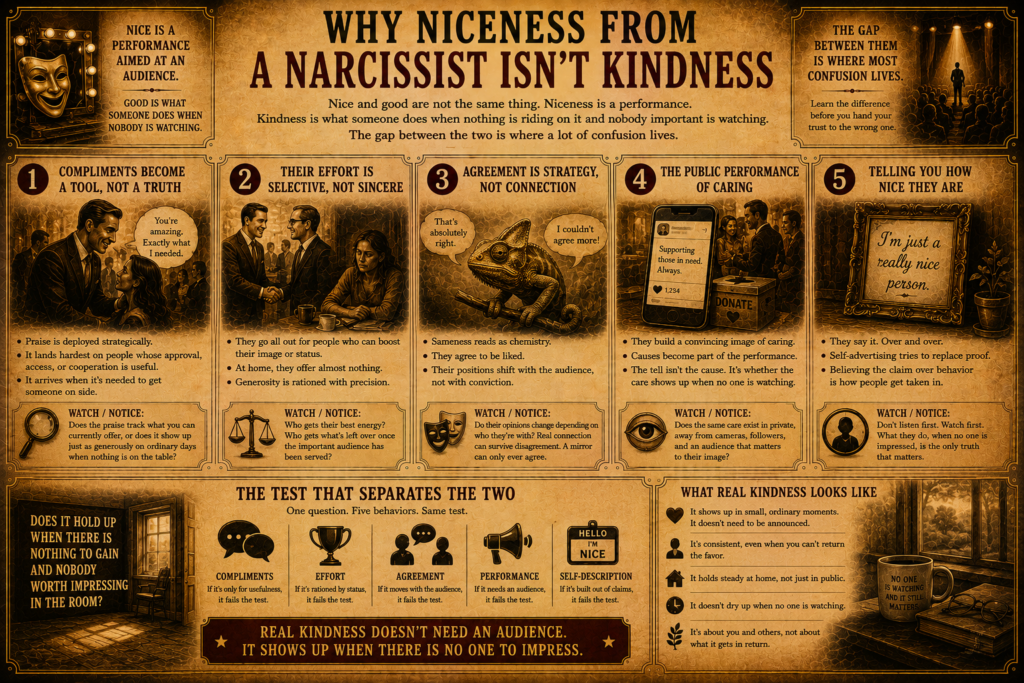
Nice and good are not the same thing, and a narcissist can be genuinely excellent at the first one without ever touching the second. Niceness is a performance aimed at an audience. Good is just what someone does when nothing is riding on it and nobody important is watching. The gap between the two is where a lot of confusion lives, because the performance can be so convincing that it takes real time and real distance to notice what it was actually for. Here are five ways the performance shows up, and the one test that separates it from the real thing every time.
Compliments become a tool, not a truth
Praise gets deployed strategically, not felt spontaneously. It lands thickest on the people whose approval, access, or cooperation is currently useful, and it tends to arrive right when it is needed to get someone on side. This is the same currency spent hardest in the opening act of a relationship, and it never really stops being transactional, it just gets aimed at whoever the current audience happens to be.
Watch whether the compliments track what you can currently offer, or whether they show up just as generously on an ordinary day when nothing at all is on the table. Real appreciation does not need a reason to exist. Strategic praise always has one, even when it is never named out loud.
Notice the specificity too. A compliment that could apply to almost anyone, said to a room full of different people over a single week, is doing a job that has very little to do with you in particular. It is closer to a net than a gift, thrown wide on purpose to see who it catches.
Their effort is selective, not sincere
Some narcissists will bend over backwards for a boss, a new acquaintance, anyone whose opinion currently matters to their image, and then offer almost nothing to the people who actually live with them day to day. The generosity is real in the moment it is performed. It is also rationed with real precision, aimed entirely at whoever can do something for their reputation, standing, or comfort.
Notice who gets the effort and who gets whatever is left over once the audience that matters has been served. Genuine kindness does not usually run exclusively toward people who can pay it back in status. It shows up just as often for the people who cannot do a single thing for you in return.
Pay attention to the excuse that shows up at home, tired, busy, not really feeling like it, right after a full day of being generous, warm, and endlessly patient with people who barely know them. Running out of effort is human. Running out of it specifically and only for the people closest to you is a pattern, not a coincidence.
Agreement is strategy, not connection
Sameness reads as chemistry, and a narcissist knows it, so agreement gets handed out freely, not because the opinion is actually held, but because agreeing is the fastest way to be liked by whoever is currently in the room. Say something in one conversation and hear the opposite echoed back approvingly in the next, and you are not watching someone with complicated views. You are watching a mirror.
Notice whether their positions shift depending on who they are with, sliding to match whatever will land best in that specific room. Real connection can survive an honest disagreement. A mirror can only ever agree, because agreeing was the entire point of showing up that way in the first place.
The public performance of caring
Touchy-feely posts, talk about injustice, visible support for a charity or a cause, all of it can build a convincing public image of someone deeply caring, and this exact move gets covered in full elsewhere, because it is common enough and specific enough to earn its own look. The short version: the tell was never the cause itself. It was whether the same care shows up once there is nobody left to perform it for.
Telling you how nice they are
Some narcissists simply say it, over and over, in enough rooms that the claim starts to do the work the actual behavior never quite manages. Believing someone’s advertising over their behavior is one of the most common ways good people get taken in, and it deserves the fuller look linked here rather than a repeat of it. The short version holds up on its own though: watch what people do. Listen to what they say only after that.
What actually tells the two apart
Line the five up and one test runs underneath every single one of them: does it hold up when there is nothing to gain and nobody worth impressing in the room. Compliments that only ever chase usefulness, effort that is rationed by status, agreement that moves with the audience, causes performed for an audience, and a reputation built mostly out of self-description, none of it survives that test, because none of it was ever actually about you or anyone else on the receiving end.
Real kindness does not need an audience, does not need to be announced, and does not dry up the second nobody who matters is watching. Nice is a performance with a purpose behind it. Good is simply what is left over once the performance has nowhere left to run, and it is worth learning to tell the two apart before you hand your trust to the wrong one.