Am I the Narcissist?
Somebody called you one. Or you read a list online and half of it landed. Either way you ended up here, typing the question into a search bar where nobody can see you do it, half hoping for an answer and half dreading one.
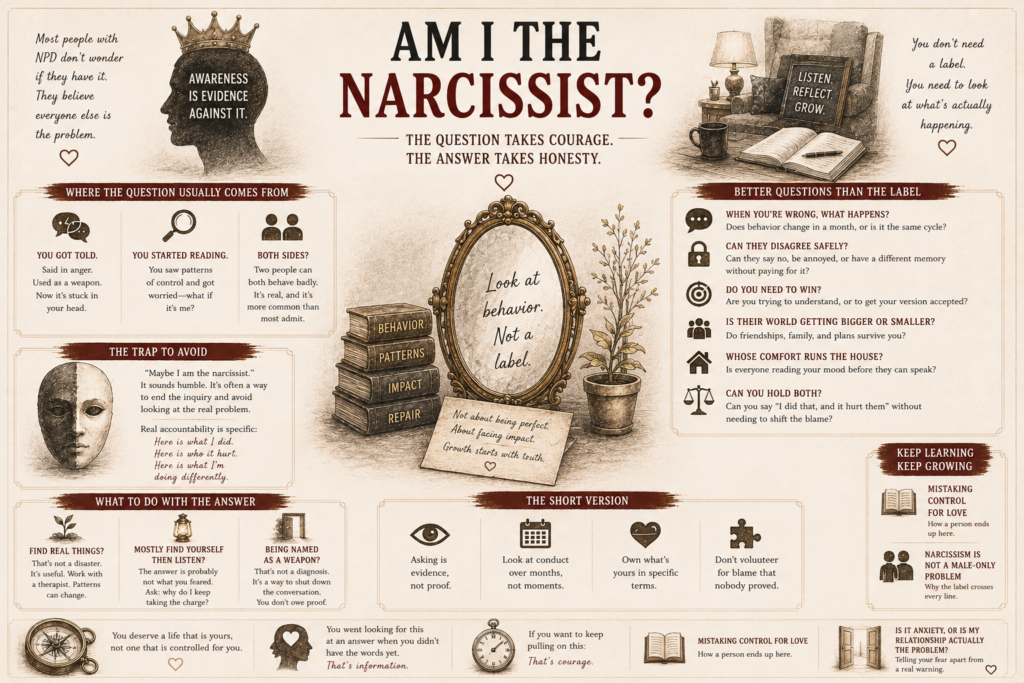
Start with this. People who actually meet the clinical bar for narcissistic personality disorder almost never sit up at night worrying they might. The whole architecture of it runs on not being the problem. Somebody else is always the reason.
That’s evidence in your favor. It isn’t a free pass, and I’m not going to hand you one, because the people who need this article least are the ones who’ll take that sentence and stop reading. So let’s do the real version.
In my experience there are two kinds of people who end up asking, and they need different answers.
The first got told. In the middle of a fight, or on the way out the door, somebody said it: you’re a narcissist. And it lodged, because it was said by a person who knows you, and because you can’t prove a negative about your own character. So you go looking, and the lists don’t help, since every human being alive has done a few things on them.
The second is trying to name what happened to them and got nervous. They started reading about control, saw themselves in the receiving end of it, and then thought, wait, what if I’m doing this. What if I’m the one. That worry is usually a sign of a working conscience, not a disorder.
There’s a third case worth naming. Sometimes both people are behaving badly. That’s real, it’s common, and it doesn’t make it fifty-fifty by default. Two people can both be doing damage without both holding the same power.
All three run into the same wall, though, which is that the word itself has stopped carrying any weight. Narcissist now means selfish, rude, vain, cheating, confident, loud, or a person we’ve stopped liking. That’s not what it means clinically. Narcissistic personality disorder is a lasting pattern that gets in the way of somebody’s whole life. It is usually put at around one to two percent of people, though published estimates run from well under one percent to several times that, depending on how it is measured. It takes a professional to say so, which means almost nobody arguing about this online is qualified to settle it. That includes me, and it includes whoever said it to you.
Here’s what that inflation costs you. Once narcissist and abuser mean the same thing, everyone stops looking at behavior and starts trying to win a labeling fight. I’ve watched people burn years trying to prove what somebody is while completely ignoring what that person keeps doing. The label became the project. Meanwhile nothing at home changed.
So put the word down for a minute. It can’t answer your question anyway.
Look at conduct instead
If you want to know whether you’re the problem, don’t go down a trait list. Traits are easy to argue with, and you’ll always find a way to read yourself as either guilty or innocent depending on the mood you’re in. Conduct is harder to talk yourself out of. Be specific.
When you’re wrong, what happens? Not whether you apologize. Whether the behavior is different in a month. Anybody can say sorry. Repair is when the thing stops.
Can the other person disagree with you safely? Do they get to be annoyed with you, say no, or remember something differently without paying for it in mood, silence, or a long night?
Do you need to win? Watch yourself in an argument. Are you trying to understand what happened, or are you trying to get them to agree with your version of it? That second one, done for years, is corrosive no matter what you’d score on a quiz.
Is their world getting bigger or smaller around you? Do their friendships survive you. Does their family. Do their own plans.
Whose comfort does the house run on? If everybody’s reading your mood before they decide what to say, that’s worth knowing whether you ever intended it or not.
Can you hold both? Can you say “I did that, and it hurt them” without immediately needing to explain why they made you? People who can’t stay in that sentence for even ten seconds are telling on themselves.
Those work on anybody. They work on you, and they work just as well on the person who called you a narcissist, which is worth remembering if the two of you have been trading the accusation back and forth.
The trap that looks like accountability
There’s a move that feels like accountability and isn’t. It goes: maybe I am the narcissist, maybe all of this is me. It sounds humble. It’s actually a way of ending the inquiry, because once you’re the sole problem, there’s nothing left to look at and nothing to change.
I’ve seen this a lot in people who were trained young to take the blame. If keeping the peace was your job as a kid, accepting fault is the fastest route to calm, and you’ll take it automatically. Somebody hands you a diagnosis and you accept the delivery without checking the address.
Real accountability is narrower and harder. It sounds like: here is the specific thing I did, here is who it landed on, here is what I’m doing differently. It doesn’t require you to be the villain of every story. Shame says something is wrong with who I am, and it freezes you. Responsibility says here’s what I can own and change, and it moves.
That difference decides what you do with whatever you find.
If you go through those questions and turn up real things, that’s not a disaster. It’s the useful outcome. Most of us are carrying habits we picked up somewhere and never examined. A decent therapist will help you sort what’s a pattern from what was a bad year, and neither of those requires a personality disorder to be worth fixing.
If you go through them and mostly find a person who’s exhausted, apologizing constantly, and re-reading old texts to figure out whether they’re crazy, then you’ve probably got your answer, and it isn’t the one you were afraid of. In that case the more useful question isn’t am I the narcissist. It’s why do I keep taking the charge.
And if somebody’s using the word as a weapon, understand what that is. Calling your partner a narcissist mid-argument isn’t a diagnosis, it’s a way to end the conversation and put them on defense. You don’t owe anybody proof that you’re not one. You don’t have to win that fight to be allowed to say a relationship is hurting you.
How somebody gets trained to accept that charge is in Mistaking Control for Love. Why the label crosses every line people try to draw around it is in Narcissism Is Not a Male-Only Problem.
The question you walked in with can’t be settled tonight, and it can’t be settled by a list. What can be settled is whether you look at your own conduct in specifics instead of verdicts, and whether you can tell owning something apart from handing yourself over.
If you have worked through this and landed on the other answer, that you are the one being worked on, start with Is It Abuse If They Never Hit You?.
One of those makes a person better. The other just makes them quieter.
This reflects personal experience and research. It isn’t a diagnosis of anyone, including you, and it isn’t a substitute for professional mental health advice. If you’re worried about control or abuse in a relationship, the National Domestic Violence Hotline offers free, confidential support 24 hours a day to people of all genders. Call 800-799-SAFE (7233), text START to 88788, or chat at TheHotline.org.