Is It Anxiety, or Is My Relationship Actually the Problem?
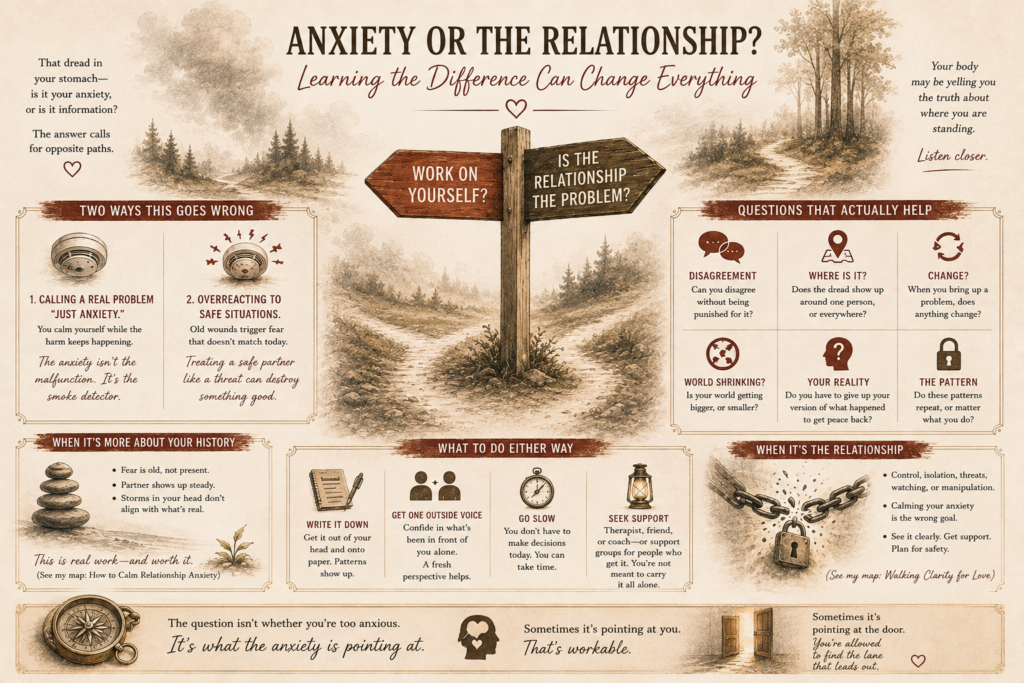
For a long time I couldn’t tell the two apart. Whether the knot in my stomach was my own anxiety, something I needed to manage, or whether it was information, my body telling me the truth about where I was standing. I’d feel that dread on a Sunday night and go straight to blaming myself. I’m too sensitive. I’m insecure. I need to calm down. Sometimes that was fair. Sometimes it was the most useful lie I ever told myself, because it kept me from looking at the relationship I was actually in.
This is one of the hardest questions a person can ask, and it doesn’t have a clean answer: is it anxiety, or is my relationship actually the problem? It matters, because the two call for opposite things. If it’s your own anxiety, the work is to steady yourself and not let fear run the show. If it’s the relationship, steadying yourself just helps you tolerate something you should be naming out loud. Do the wrong one and you can spend years getting very good at surviving a situation you were supposed to leave.
Two ways this goes wrong
The first way is to call a real problem “just anxiety.” Somebody, maybe your partner, maybe a well-meaning friend, maybe the voice in your own head, tells you you’re overreacting, you’re paranoid, you’re insecure. So you swallow it. You work on your breathing and your self-talk while the thing making you anxious keeps right on happening. If a person is watching your phone, punishing you for disagreeing, or rewriting what happened until you doubt your own memory, no amount of calming down is going to fix that. The anxiety isn’t the malfunction. It’s the smoke detector.
The second way is the opposite. Some of us come out of hard childhoods with an alarm that goes off at the smallest thing. A partner runs ten minutes late and you’re sure you’re being left. They want an evening with their friends and it feels like the beginning of the end. Here the fear is real, but it isn’t reporting on the person in front of you. It’s reporting on something old. Treat a safe partner like a threat long enough and you can wear down something that was actually good.
Both of those are true, and that’s what makes this so hard. The same feeling can mean “get out” or “hold on and steady yourself,” and it doesn’t come with a label attached.
Why it’s so confusing if you grew up under control
If you were raised in a house where love came with conditions, your alarm can be miscalibrated in both directions at once. You learned to brace for danger that isn’t there, and you also learned to talk yourself out of danger that is. You can be jumpy about ordinary things and dead calm about things that should scare you, because being controlled felt normal for so long that it doesn’t register as a threat. I lived on both settings for years and didn’t know it. I’d panic over nothing and stay steady through things I should never have accepted.
So the honest starting point isn’t “trust your gut.” Your gut might be a great alarm or a broken one, and a lot of the time it’s both. The starting point is to slow down enough to look at behavior instead of just the feeling.
Questions that actually help
Instead of asking “am I too anxious,” ask what’s happening and what it does to you. These aren’t about diagnosing your partner. They’re about the relationship you’re actually in.
Can you disagree without being punished for it? In a relationship that isn’t the problem, you can say “I don’t want to” and the roof doesn’t come off. If disagreement reliably gets you anger, silence, guilt, or the cold shoulder, that’s information.
Does the dread show up around this one person, or everywhere? If you feel steady at work, with friends, and on your own, and it only switches on around one relationship, that points outward. If the same fear follows you into every corner of your life, some of it is yours to work on.
When you bring up a problem, does anything change? A partner who isn’t the problem can hear “this hurt me” and adjust, at least sometimes. If every one of those conversations ends with you apologizing for having brought it up, notice that.
Is your world getting bigger or smaller? Healthy love makes room for your friends, your family, your own opinions. If your world keeps shrinking while their say keeps growing, your anxiety may just be tracking that.
Do you have to give up your version of what happened to get peace back? If the truth keeps bending toward whatever helps the other person, and you keep surrendering your own memory to end the fight, that’s not something breathing exercises are going to fix.
None of these require you to prove your partner is a narcissist or an abuser. You don’t need a label. You need to look at what’s being done and what it’s costing you.
When it’s more about your own history
Sometimes the honest answer is that the relationship is safe and the fear is old. The signs look different. The panic tends to fire fast and then pass. Your partner keeps showing up steady, and the story in your head, they’re leaving, they don’t care, keeps not coming true. You can name the fear and, on a good day, see that it belongs to another time.
That’s not a character flaw either, and it’s not nothing. It’s worth real work, the kind you can do with a good therapist, because it can quietly poison something decent. If that’s where you land, I wrote about steadying it in How to Calm Relationship Anxiety. Learning to sit with the fear without acting on it, without accusing a safe person of the crimes an unsafe one committed, is one of the harder skills there is. I’m still working on it.
When it’s the relationship
And sometimes the fear is accurate. If what you’re looking at is control, getting cut off from people, punished for independence, threatened, watched, or made to doubt your own mind, then calming your anxiety is the wrong goal. The goal is to see it clearly and get support. That’s a whole subject of its own, and I’ve put most of what I know about it in Mistaking Control for Love. If you’re not sure whether what you’re living with crosses that line, an advocate can help you think it through without you having to prove anything to anyone first.
What to do either way
Whichever it turns out to be, the first move is the same: get the situation out of your head and onto something you can look at. Write down what happened, what was said, what changed when you objected. Not to build a case, just so you stop having to re-argue reality with yourself every night. Patterns show up on paper that feelings hide.
Then get one outside voice. Control gets stronger as your world gets smaller, and anxiety lies best when you’re alone with it. A friend you trust, a support group, or a trauma-informed therapist can help you tell the old alarm from the accurate one. Pick somebody who helps you make your own decisions, not somebody who just hands you their answer.
And go slow. You don’t have to decide today whether to stay or go. You have to figure out what you’re actually dealing with. Once you can tell your own fear from a real warning, the next step usually gets clearer on its own.
If the answer turns out to be the relationship, Is It Abuse If They Never Hit You? is the next thing to read, and Healing From a Toxic Relationship covers what comes after.
The question isn’t whether you’re too anxious. It’s what the anxiety is pointing at. Sometimes it’s pointing at you, and that’s workable. Sometimes it’s pointing at the door. You’re allowed to take the time to find out which.
This reflects personal experience, not professional advice. It isn’t therapy and it isn’t a diagnosis of anyone. If you’re worried about control or abuse in a relationship, the National Domestic Violence Hotline offers free, confidential support 24 hours a day. Call 800-799-SAFE (7233), text START to 88788, or chat at TheHotline.org. If you’re in immediate danger, call 911 or your local emergency service.