When Did You Learn to Stop Being Yourself?
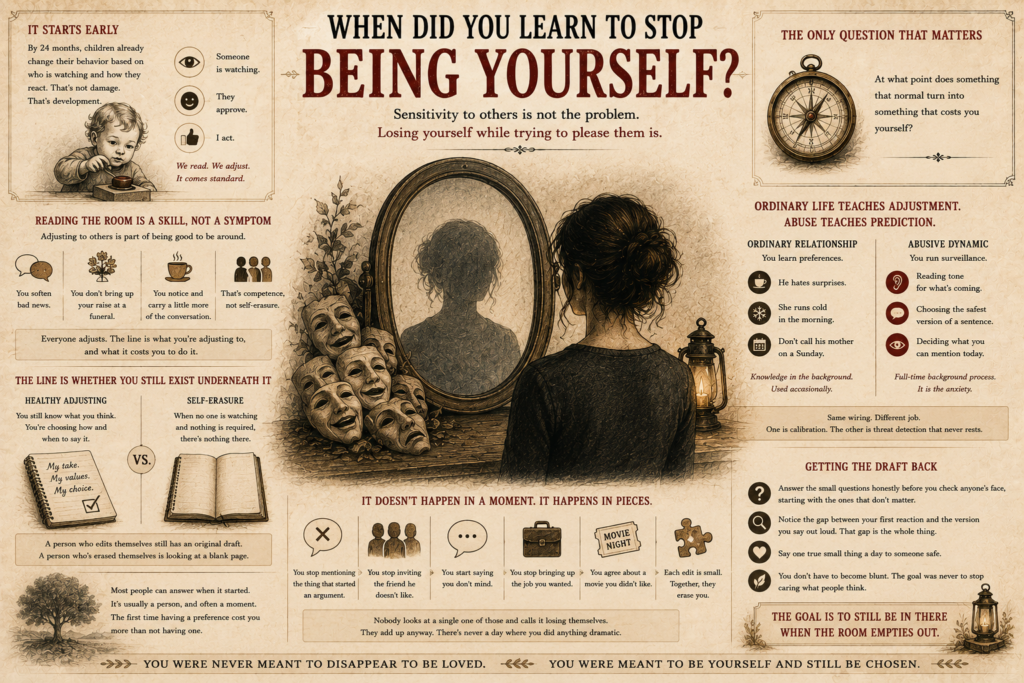
On August 27, 2018, the American Psychological Association published research in Developmental Psychology showing that children as young as 24 months already change their behavior based on whether someone is watching them, and on how that person reacted to them before.
Sara Valencia Botto and Philippe Rochat of Emory University ran four experiments with toddlers between 14 and 24 months. A researcher would show a child a toy, signal that she either liked it or disliked it, and then either watch attentively or turn away and read a magazine. The two year olds adjusted. They pressed the button more when the adult had approved of it and was looking. They held back when she disapproved and was watching.
That’s not damage. That’s development working exactly as designed. Before we can explain ourselves, before we can argue a point or state a preference out loud, we can already read a face and adjust. Caring what other people think isn’t a flaw someone installed in you. It came standard, and it came early.
Which raises the only question that actually matters here: at what point does something that normal turn into something that costs you yourself?
Reading the Room Is a Skill, Not a Symptom
Adjusting to other people is most of what makes someone good to be around. You soften bad news. You don’t bring up your raise at a funeral. You notice your friend is having a hard week and you carry a little more of the conversation. None of that is self-erasure. It’s competence, and people who lack it are exhausting in a completely different way.
So the problem was never sensitivity to other people. Being told that your awareness of others is itself the disease is bad advice, and it tends to produce people who mistake bluntness for health. The line isn’t about whether you adjust. Everyone adjusts. It’s about what you’re adjusting to, and what it costs you to do it.
The Line Is Whether You Still Exist Underneath It
Here’s the cleanest test I know. Healthy adjusting is something you do on top of a position you actually hold. You still know what you think. You’re choosing how and when to say it.
Self-erasure is different, and the difference is checkable. Somebody asks where you want to eat, and there’s genuinely nothing there. Not “I’ll go along with it” but a blank where the preference should be. You’ve read the room so many times that you stopped generating your own answer first, because your own answer stopped being useful information a long time ago.
The tell isn’t that you accommodate. It’s that when accommodation isn’t required, nothing comes back up. A person who edits themselves still has an original draft. A person who’s erased themselves is looking at a blank page and calling it easygoing.
Ordinary Life Teaches Adjustment, Abuse Teaches Prediction
In an ordinary relationship, you learn a person’s preferences. He hates surprises, she runs cold in the morning, don’t call his mother on a Sunday. That knowledge sits in the background, and you use it occasionally.
With someone who punishes you, you’re not learning preferences. You’re running surveillance. You’re reading tone of voice for what’s coming, choosing which version of a sentence is safest, deciding whether today is a day you can mention the thing. That’s a full-time background process, and we’ve covered what it does to you in Anxiety and How a Narcissist Keeps You Anxious, where the constant previewing of every sentence isn’t a side effect of the anxiety. It largely is the anxiety.
Same underlying wiring the toddlers had. Completely different job. One is calibration. The other is threat detection that never gets to stand down.
It Doesn’t Happen in a Moment, Which Is Why You Missed It
Nobody decides to stop being themselves. It comes off in pieces, and every individual piece looks reasonable at the time.
You stop mentioning the thing that started an argument last time. You stop inviting the friend he doesn’t like, because it’s easier than the conversation afterward. You start saying you don’t mind, and at first that’s a small lie for the sake of peace. Then you stop bringing up the job you wanted. Then you notice you’ve been agreeing about a movie you didn’t like, to a person who wasn’t even going to argue about it.
Each edit is small enough to defend on its own. Nobody looks at a single one of those and calls it losing themselves. They add up anyway, and the reason it’s so hard to spot from inside is that there’s never a day where you did anything dramatic.
The Question Worth Sitting With
So: when did you learn to stop being yourself?
Most people who’ve been through this can answer it, and they can usually answer it fast, which is itself informative. It’s rarely a year. It’s usually a person, and often a specific incident, the first time having a preference cost you more than not having one.
Worth being fair about the answer, though. Sometimes it’s a childhood, and a parent whose mood ran the house. Sometimes it’s one relationship in your thirties. Sometimes it’s a job. And sometimes the honest answer is that nobody did it to you and you’re just conflict-averse, which is a real thing that isn’t abuse. If you’re genuinely unsure which one you’re in, Is It Abuse If They Never Hit You? is a more direct way at that question.
Getting the Draft Back
The good news is buried in the research itself. This capacity showed up at 24 months, before language, before reasoning, before anyone taught you anything. It’s not a personality you lost. It’s a setting that got turned all the way up by someone who benefited from it being there.
Practically, it comes back the same way it left, in pieces. Answer the small questions honestly before you check anyone’s face, starting with the ones that genuinely don’t matter, like what you want for dinner. Notice the gap between your first reaction and the version you say out loud, because that gap is the whole thing, and most people can feel it once they’re looking for it. Say one true small thing a day to someone safe.
You don’t have to become blunt, and you shouldn’t. The goal was never to stop caring what people think. Two-year-olds care what people think. The goal is to still be in there when the room empties out.