Narcissism Is Not a Male-Only Problem
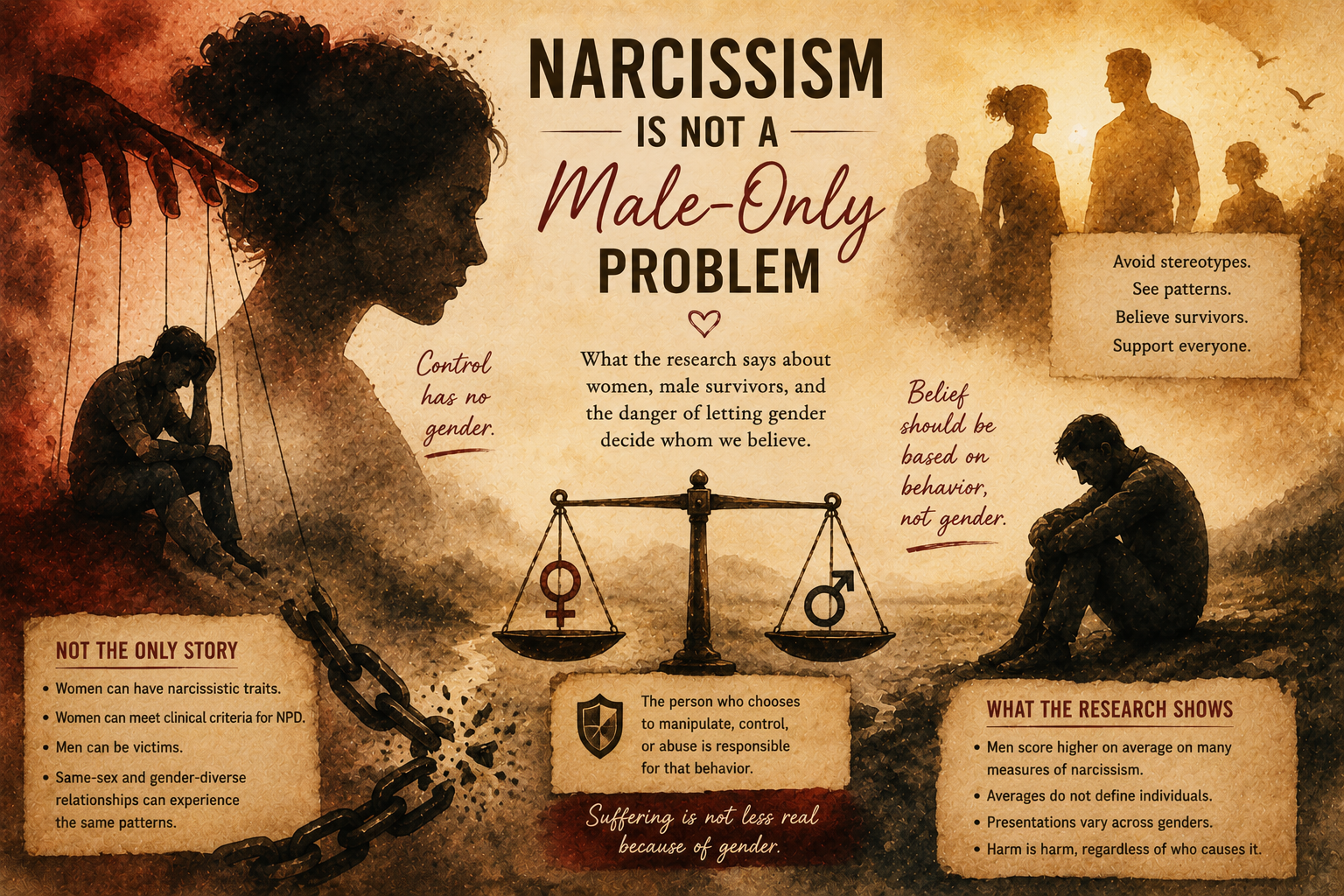
What the research says about women, male survivors, and the danger of letting gender decide whom we believe
When most people hear the word narcissist, they picture a man. He is loud, arrogant, controlling, and convinced that every room belongs to him. When most people picture the person living with him, they picture a woman trying to survive.
That story is real. It happens every day, and no honest discussion of narcissism or intimate partner violence should minimize it. But it is not the only story.
Women can have narcissistic traits. Women can meet the clinical criteria for Narcissistic Personality Disorder. Women can manipulate, isolate, humiliate, threaten, deceive, and control their partners. Men can be victims of psychological abuse and coercive control. People in same-sex and gender-diverse relationships can experience the same patterns. None of these facts cancels the others.
The problem begins when a familiar story becomes the only story we are willing to recognize. A controlling man is more likely to fit the image people already understand. A controlling woman may be called difficult, emotional, jealous, wounded, protective, or simply unhappy. Her male partner may be told to stand up for himself, stop being weak, or accept that this is just how relationships work. If he finally reacts, people may see the reaction while missing everything that led to it.
This is not an argument that women and men experience abuse in identical numbers or with identical consequences. The evidence does not support that. It is an argument that suffering does not become harmless when the person causing it is a woman, and a man does not stop being a victim because his experience makes other people uncomfortable.
What narcissism actually means
The word narcissist is used so casually that it can now mean selfish, vain, rude, unfaithful, confident, attention-seeking, or simply someone we no longer like. That kind of usage may feel satisfying, but it makes serious conversations less accurate.
Narcissistic traits exist on a spectrum. People can show entitlement, grandiosity, self-centeredness, exploitation, or impaired empathy without having a personality disorder. Narcissistic Personality Disorder, usually shortened to NPD, is a clinical diagnosis involving a persistent and impairing pattern. A 2024 overview from the American Psychiatric Association explains that NPD is more severe and enduring than ordinary self-centeredness and estimates that it affects approximately 1 to 2 percent of the United States population.
A diagnosis cannot be made from a social media checklist, a bad argument, or one person’s description of a former partner. It requires professional assessment. That does not mean we must remain silent about behavior. We can describe patterns as narcissistic without claiming the authority to diagnose someone, and we can identify abuse without proving that the person responsible has any particular disorder.
This distinction matters because narcissism and abuse are not interchangeable. Not everyone with narcissistic traits abuses a partner. Not every abusive partner has NPD. A person can use coercive control for reasons that have nothing to do with narcissism, and someone can be deeply narcissistic without using every form of control associated with abusive relationships.
The label may help a survivor organize a confusing experience, but the behavior is what determines whether the relationship is safe. The questions that matter are concrete. Can you disagree without being punished? Can you maintain friendships and privacy? Do apologies lead to changed behavior? Are your memories constantly challenged until you surrender them? Does affection disappear whenever you assert yourself? Is your world becoming smaller while the other person’s authority becomes larger?
Those questions apply regardless of gender.
What the research says about gender and narcissism
Men do score higher on average on many measures of narcissism. Avoiding that fact would be just as misleading as pretending women cannot be narcissistic. A 2023 study examining eight narcissism measures and data from more than 250,000 participants found higher average scores among men across many measures. The differences were strongest in dimensions related to assertive self-promotion and self-centered antagonism. The study did not find the same gender pattern for the more vulnerable or neurotic dimension of narcissism.
The words on average are doing important work. An average describes a group. It does not diagnose an individual. Men being higher on a measure does not mean every man scores higher than every woman, and it does not mean narcissism in women is rare enough to ignore. The distributions overlap. Women appear throughout the range, including at levels that can cause serious interpersonal harm.
Measurement also matters. Narcissism is not one simple characteristic. Grandiosity, entitlement, vulnerability, antagonism, admiration-seeking, and self-centeredness do not always travel together in the same amounts. A questionnaire designed to recognize obvious dominance may identify a different presentation than an assessment focused on personality functioning, shame, hostility, or exploitation.
This helps explain why the public image of narcissism can become narrower than the reality. The obvious, boastful person who announces his superiority is easy to recognize. Someone who maintains control through guilt, victimhood, social punishment, emotional withdrawal, or constant reinterpretation of events may not match that image. Those behaviors are not female by definition, and they should not be called a uniquely female form of narcissism. Men use them too. The point is that a stereotype built around visible male grandiosity may fail to recognize other presentations in anyone.
Can diagnostic expectations hide narcissism in women?
There is evidence that gender expectations can influence how narcissistic presentations are interpreted, but this is an emerging area and should not be overstated. A 2025 study on gender bias in assessing narcissistic personality asked 157 mental health clinicians to evaluate hypothetical patients showing grandiose or vulnerable narcissistic features. The researchers examined whether using the newer dimensional approach in the ICD-11 could reduce the influence of gender stereotypes.
The clinicians’ ratings of overall personality impairment and severity were generally consistent regardless of the hypothetical patient’s gender. The researchers concluded that focusing on the severity of personality dysfunction may be less susceptible to gender stereotypes than relying on familiar categorical images. The study does not prove that women with NPD are routinely missed, and a vignette study cannot reproduce every complication of a real clinical assessment. It does, however, show why researchers are examining whether older expectations emphasize grandiose features culturally associated with men while giving less attention to vulnerable presentations.
Outside a clinic, the bias can be even less controlled. People bring assumptions about women, men, anger, fear, strength, motherhood, sexuality, and victimhood into every story they hear. A woman’s controlling behavior may be interpreted as insecurity that her partner should soothe. Her threats may be treated as emotional outbursts rather than attempts to control. Her surveillance may be called concern. Her humiliation of a male partner may be treated as a joke because people assume he has the physical or social power to stop it.
None of those interpretations proves narcissism. They do show how the same behavior can receive different names depending on who performs it.
Control does not require a male body
Coercive control is a pattern through which one person steadily restricts another person’s freedom, autonomy, relationships, or sense of reality. It can include monitoring, isolation, financial restriction, threats, humiliation, sexual coercion, intimidation, destruction of property, manipulation involving children, or repeated punishment for independence. Physical violence may be present, but it is not required for the pattern to cause profound harm.
A woman does not need to be physically larger than a man to control him. She may control access to children, money, affection, reputation, family relationships, or the story other people hear. She may threaten to harm herself, accuse him of abandonment, tell him nobody will believe him, or provoke him until his reaction becomes the only part anyone sees. A man may be physically capable of leaving the room while feeling psychologically, financially, or socially unable to leave the relationship.
These examples should not be used as a checklist for diagnosing a woman with NPD. They are examples of controlling conduct that can be evaluated without a diagnosis. The essential question is not whether a behavior looks masculine or feminine. It is whether one person is using it repeatedly to gain power over another.
The same principle applies when the victim and perpetrator do not fit a heterosexual male-female pairing. A 2024 scoping review of coercive control in sexually and gender-diverse relationships found major research and measurement gaps, especially for people with gender-diverse and less frequently studied identities. Those gaps are another reason not to let one cultural image define every abusive relationship.
What the newest numbers show
The most recent national data make two facts clear at the same time. Women experience higher rates of many serious forms of intimate partner violence, and male victimization is still far too common to dismiss.
The CDC’s 2023/2024 Intimate Partner Violence Data Brief reports that 34 percent of United States women and 17 percent of men experienced contact sexual violence, physical violence, or stalking by an intimate partner during their lifetimes. Severe physical violence was reported by 18.2 percent of women and 8.6 percent of men. Those numbers show a substantial gender difference, particularly in serious harm.
The same report found that psychological aggression affected 30.2 percent of women, approximately 38.6 million people, and 22.3 percent of men, approximately 27.3 million people. Coercive control and entrapment were reported by 27.2 percent of women and 19.5 percent of men. Among both groups, common experiences included a partner demanding to know where they were and what they were doing or trying to keep them away from friends and family.
CDC NISVS 2023/2024
Intimate-partner victimization affects women and men
Lifetime prevalence among United States adults. Every measure remains visible so the differences and the shared reality can be seen together.
Important: These figures measure victimization, not the gender of the person who caused it. Categories overlap, and the data do not diagnose narcissism.
Twenty-seven million male victims of psychological aggression are not a statistical curiosity. They are people whose experiences may be difficult to name because the public story gives them no obvious place to stand. At the same time, recognizing them does not require us to erase the higher rates, injury, sexual violence, fear, and lethal danger experienced by women.
This should not become a contest over which group is allowed to hurt. Good research can hold two realities at once. Women bear a greater burden across several severe forms of partner violence. Men also experience psychological aggression, coercive control, physical violence, stalking, and sexual coercion in numbers large enough to demand serious services and cultural recognition.
What narcissism contributes to partner violence
Narcissism is associated with intimate partner violence, but the relationship is not strong enough to justify using narcissist as another word for abuser. A 2024 systematic review and meta-analysis of 22 studies found a statistically significant but weak positive association between narcissistic traits and intimate partner violence perpetration. Vulnerable narcissism showed a stronger relationship with perpetration than grandiose narcissism, but the authors also reported high variation among the included studies.
For this article, one finding is especially important: the researchers did not find a significant difference between male and female perpetrator groups in the strength of the association between narcissism and intimate partner violence. That does not mean men and women perpetrate every type of violence at equal rates or cause identical harm. It means the available studies did not support the idea that narcissistic traits matter only when the perpetrator is male.
The result also warns against easy conclusions. The overall association was weak, the studies relied heavily on self-report, and socially undesirable behavior may be underreported. Narcissism is one possible risk factor within a much larger system that includes personality, learning, substance use, trauma, opportunity, relationship dynamics, and conscious choices.
There is no scientific justification for diagnosing every abusive woman as a narcissist. There is equally little justification for assuming a woman cannot be narcissistic or coercively controlling because the stereotype says the narcissist should be a man.
Why male survivors may remain silent
Men face many of the same barriers that keep other survivors silent: fear, financial dependence, concern for children, isolation, shame, hope that the relationship will improve, and uncertainty about whether the behavior qualifies as abuse. They can also face a specific cultural problem. Many men have been taught that victimhood is incompatible with masculinity.
A 2024 systematic review of male survivors and help-seeking examined how cultural responses affect identity and decisions to seek support. The literature describes barriers involving shame, fear of not being believed, limited awareness of services, and social expectations that men should be able to handle the situation themselves. Another 2024 mixed-studies review similarly examined barriers and facilitators for men experiencing violence from female partners.
For a man living with a controlling woman, disclosure can feel dangerous in several directions. He may believe friends will laugh. He may fear that police or professionals will assume he is the aggressor. He may worry that defending himself will be used as evidence against him. If children are involved, he may fear losing access to them or being portrayed as unstable. If the abuse is primarily psychological, he may have no photograph, injury, or single event that seems serious enough to explain the cumulative damage.
He may also love her. That should not be surprising, but it often is to outsiders. Abuse does not erase attachment. A person can fear a partner, resent the control, recognize the lies, and still remember the relationship’s good periods. Men are not less vulnerable to hope simply because they have been taught to hide it.
When a man finally speaks, the correct first response is not to decide whether his story threatens our understanding of violence against women. The correct response is to listen, assess safety, and take the behavior seriously. Believing a male survivor does not require disbelieving women. Support is not a limited resource that must be taken from one group before another can receive it.
The danger of making women harmless
Treating women as incapable of serious psychological harm is not respect for women. It is another stereotype. Women are full human beings with the capacity for generosity, courage, selfishness, manipulation, tenderness, aggression, honesty, and cruelty. Equality cannot mean recognizing women’s agency only when the agency is admirable.
The harmless-woman assumption can also harm female victims. Women can be abused by female partners, mothers, relatives, employers, and friends. If society assumes women are naturally safe, survivors harmed by women may struggle to name what happened. The stereotype protects the person causing harm more than it protects women as a group.
None of this requires turning female narcissism into the next internet obsession. Online culture already encourages people to label every difficult former partner. A better response is greater precision. We should be willing to recognize harmful behavior by women while remaining cautious about diagnosis, context, and claims we cannot prove.
Name the behavior before naming the disorder
If you believe you are living with someone who has narcissistic traits, start with what can be observed. Record what was said, what agreement existed, what changed, and what happened when you objected. Notice whether apologies result in different behavior or merely restart the cycle. Pay attention to whether the other person accepts limits, respects outside relationships, and allows you to maintain a version of events that is not identical to theirs.
You do not need to win an argument about NPD before seeking help. In fact, confronting someone with the label narcissist may increase conflict and rarely produces insight. A therapist or advocate can help you examine the pattern without requiring certainty about the other person’s diagnosis. If you fear retaliation, threats, false accusations, stalking, financial harm, or interference involving children, safety planning should come before confrontation.
Friends and family can help by resisting gender shortcuts. Do not tell a man he should be able to control the situation because he is larger. Do not tell a woman that her female partner cannot be abusive. Do not assume the calmer person is truthful or the more emotional person is the victim. Look for patterns of fear, restriction, degradation, isolation, and control.
The same standard should apply to everyone. Does the relationship permit dignity, autonomy, honesty, and disagreement? If not, the gender of the person taking those things away does not make the loss less real.
Two truths can remain true
Women experience a disproportionate share of severe and sexual intimate partner violence. Men score higher on many measures of narcissism. Those findings matter and should not be softened for the sake of a cleaner argument.
Women can also be narcissistic, coercively controlling, and abusive. Male survivors can be frightened, isolated, psychologically damaged, and in need of protection. Those findings matter too.
We lose accuracy when we force one truth to defeat the other. We also lose survivors. A woman harmed by a man should not have to compete with a man harmed by a woman. A male survivor should not have to minimize violence against women before his own experience is heard. The purpose of understanding abuse is not to award a gender the permanent role of villain or victim. It is to recognize the use of power and respond to the person being harmed.
Narcissism is not a male-only problem because narcissism is part of human personality, not a trait assigned to one sex. Abuse is not made harmless by a woman’s voice, and victimhood is not erased by a man’s body. The moment we understand that, we become better at seeing the person in front of us instead of the stereotype we expected to find.
This article reflects personal experience and current research. It does not diagnose any individual and is not a substitute for professional mental health or legal advice. If you are concerned about control or abuse in a relationship, the National Domestic Violence Hotline provides confidential support to people of all genders. Call 800-799-SAFE (7233), text START to 88788, or chat at TheHotline.org. If you are in immediate danger, call 911 or your local emergency service.