Can Narcissists Be Good Partners?
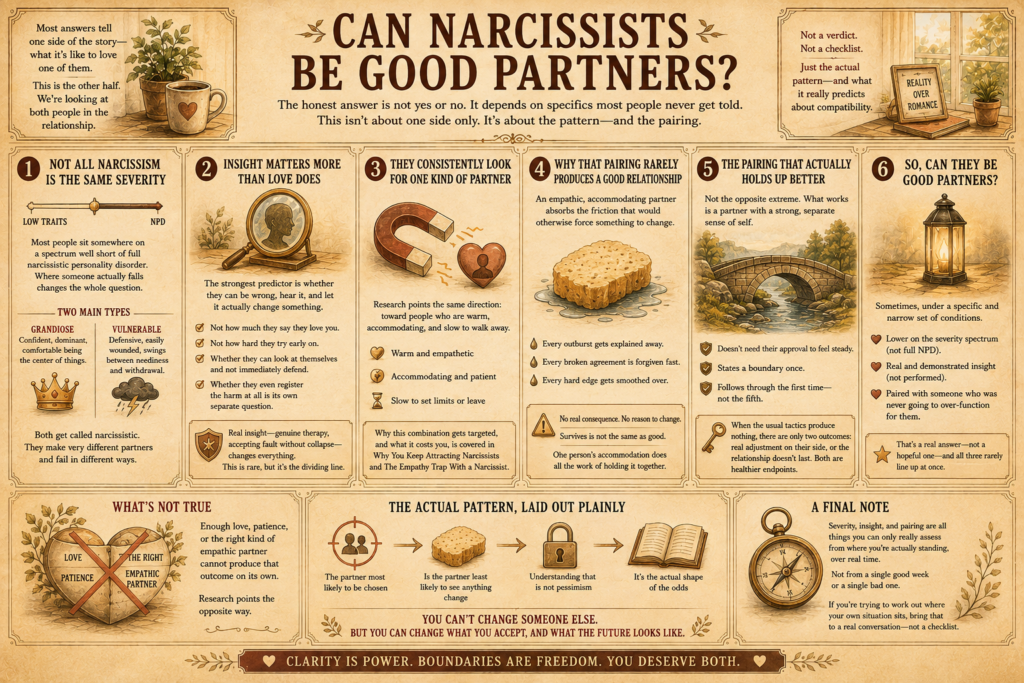
Most answers to this question come from one side only, what it is like to love one of them. That is real and worth reading, and this site covers it elsewhere. This is the other half: what the actual pattern predicts about compatibility, looking at both people in the pairing, not just one. The honest answer is not yes or no. It depends on specifics most people never get told.
Not All Narcissism Is the Same Severity
Full narcissistic personality disorder is a real diagnosis, and it is a lot less common than the word’s everyday use suggests. Most people who get called a narcissist sit somewhere on a trait spectrum well short of that, closer to ordinary self-focus and confidence than to the clinical picture. Where someone actually falls changes the whole question, because a mildly self-centered partner and someone meeting full diagnostic criteria are not the same proposition wearing the same label.
There is also a split in how it shows up. The grandiose type is confident, dominant, comfortable being the center of things. The vulnerable type is defensive and easily wounded, reads neutral moments as attacks, and swings between neediness and withdrawal. Both get called narcissistic. They make very different partners, and they fail in different ways.
Insight Matters More Than Love Does
Whether someone with these traits can be wrong, hear it, and let it actually change something in them, is the single strongest predictor of whether a relationship with them can function. Not how much they say they love you. Not how hard they try in the honeymoon stretch. Whether they have any real capacity to look at themselves and not immediately defend. Whether they even register the harm at all is its own separate question, covered in Do Narcissists Know They’re Hurting You?
A person with real insight, someone in genuine therapy and not just performing the vocabulary of it, who can sit with being at fault without the whole structure collapsing into rage or victimhood, is a fundamentally different partner than one who cannot. This is rare, and it is also the actual dividing line, far more than charm, effort, or how the relationship started.
They Consistently Look for One Kind of Partner
Research on how narcissists select partners points the same direction over and over: toward people who are warm, accommodating, and slow to walk away, exactly the traits that make someone a genuinely good partner to almost anyone else. Why that particular combination gets targeted, and what it costs the person carrying it, is covered in full in Why You Keep Attracting Narcissists and The Empathy Trap With a Narcissist.
Why That Pairing Rarely Produces a Good Relationship
Here is the part that gets missed. The pairing a narcissist actively seeks out is close to the worst one for producing an actual good relationship, and the reason is structural, not romantic. An empathic, accommodating partner absorbs the friction that would otherwise force something to change. Every outburst gets explained away, every broken agreement gets forgiven fast, every hard edge gets smoothed over before it can cost anything.
Behavior that never produces a real consequence has no reason to change, and a partner whose whole strength is patience and forgiveness supplies exactly that kind of consequence-free environment. The relationship can survive a long time this way. Survives is not the same as good. It usually means one person’s accommodation is quietly doing all the work of holding it together.
The Pairing That Actually Holds Up Better
Not the opposite extreme, someone cold or combative back. What actually seems to work, when it works at all, is a partner with a strong, separate sense of self, someone who does not need the narcissist’s approval to feel steady, states a boundary once, and follows through the first time it gets tested rather than the fifth. That kind of partner cannot be pulled into the usual patterns, because the tactics built to work on an accommodating person simply produce nothing, no big reaction, no long negotiation, no slow erosion of the boundary.
That is not a warmer or more loving pairing. It is a pairing where the narcissist’s usual toolkit stops paying off, which leaves exactly two outcomes: some real adjustment on their side, or the relationship not lasting. Both of those are healthier endpoints than a relationship that survives only because one person keeps absorbing the cost.
So, Can They Be Good Partners?
Sometimes, under a specific and fairly narrow set of conditions: lower on the severity spectrum rather than full NPD, real and demonstrated insight rather than performed self-awareness, and paired with someone who was never going to over-function for them in the first place. That is a real answer, not a hopeful one, and it is worth being honest about how rarely all three line up at once.
What is not true is the reverse assumption, that enough love, patience, or the right kind of empathic partner can produce that outcome on its own. The research points the opposite way. The partner most likely to get chosen is the partner least likely to see anything change, and understanding that is not pessimism. It is the actual shape of the odds, laid out plainly instead of guessed at.
None of this is a verdict on any one relationship, and none of it can be checked from outside. Severity, insight, and pairing are all things you can only really assess from where you’re actually standing, over real time, not from a single good week or a single bad one. If you’re trying to work out where your own situation sits, that’s a more useful question to bring to a real conversation than to a checklist.