How to Escape a Covert Narcissist?
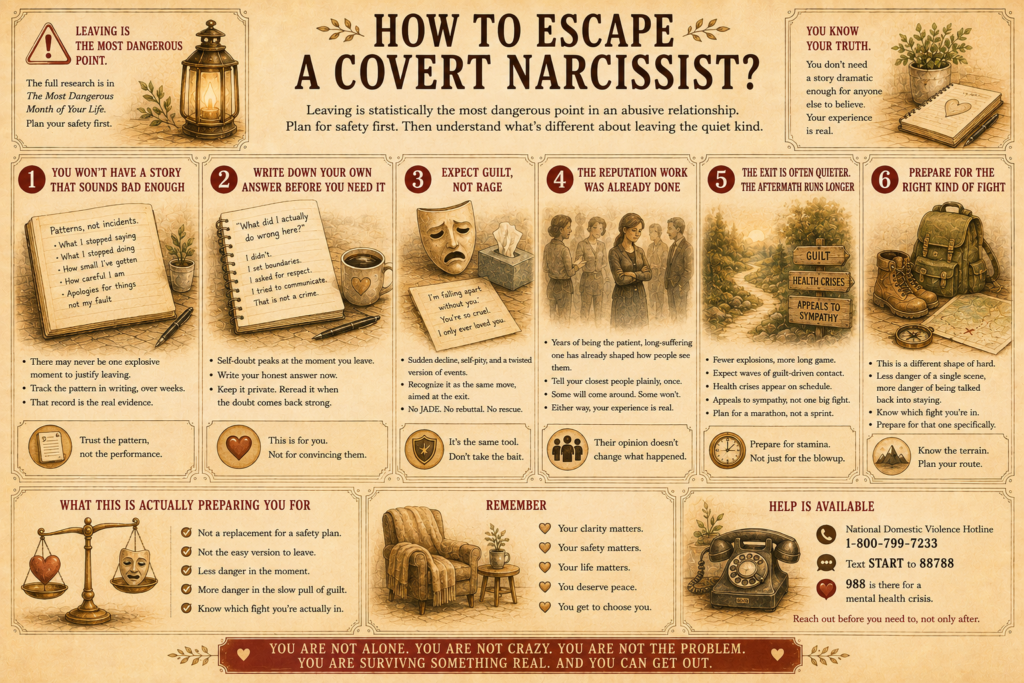
One thing has to be said before anything else, because it matters more than any tactic below: leaving is statistically the most dangerous point in an abusive relationship, and that is true regardless of whether the person is the loud kind or the quiet kind. The full research on that, with real numbers, is in The Most Dangerous Month of Your Life, and it belongs in the plan before anything else does. What follows is what’s specifically different about leaving the covert version, once safety is actually accounted for.
You Won’t Have a Story That Sounds Bad Enough
Most people wait for a moment that justifies leaving, something explosive enough to repeat out loud and have it land. A covert narcissist rarely, if ever, hands you that moment, which is exactly why so many people stay years longer than they would with the loud version, covered in What Is Covert Narcissism? The evidence you actually have isn’t one bad night. It’s how small you’ve gotten, how careful you are around someone nobody watching would ever call controlling.
Stop waiting for a story dramatic enough to justify the decision to other people. Track the pattern instead, in writing, over weeks: what you stopped saying, what you stopped doing, how often you apologize for things that were never your fault. That record is the real evidence, even without a single incident anyone else would recognize as one.
Write Down Your Own Answer Before You Need It
The moment of leaving is exactly when the self-doubt peaks, and that is precisely when it’s hardest to think clearly enough to counter it. Write your own honest answer to “what did I actually do wrong here” while you still have a clear head, not in the middle of the conversation where you’ll need it most. Keep it somewhere private and reread it if the doubt comes back stronger than expected, which it usually does.
This isn’t for convincing them. It never was going to. It’s for you, on the night the guilt is loudest and your own memory of the last five years suddenly feels unreliable, which is exactly the moment this kind of doubt is built to strike.
Expect Guilt, Not Rage
The tools that worked on you the whole relationship are the tools that show up when you try to leave. For this version, that’s rarely a threat or a scene. It’s a sudden decline, a wave of self-pity, a version of events where you’re the one doing something cruel to a person who never did anything but love you. Prepare for this specifically, because it doesn’t look like the dramatic pushback people expect and it can be more effective for exactly that reason.
Recognize it as the same move it’s always been, just aimed at the exit instead of at everyday compliance. The same refusal to JADE, covered in How to Disarm a Narcissist?, applies here. You don’t owe a rebuttal to a performance of collapse.
The Reputation Work Was Already Done
A loud narcissist smears you after the fact, in a visible campaign people can eventually see through. A covert one has often spent years quietly being the patient, long-suffering, misunderstood one in front of the exact people you’ll need in your corner. By the time you leave, some of that work is already finished, without anything that looked like a campaign at all.
Do not measure whether your experience was real by how it looks from outside, and do not expect people to immediately understand. Tell the people closest to you plainly, once, and let the rest take the time it takes. You are not required to win the room before you’re allowed to leave it.
Some people will come around later, once they’ve had more time around the person than a curated version of them. Some won’t, and that’s a real loss worth grieving honestly rather than minimizing. Either way, it isn’t evidence you were wrong about what happened to you.
The Exit Is Often Quieter. The Aftermath Runs Longer
Because the tools are guilt and sympathy rather than rage or threats, the actual moment of leaving can be logistically less volatile than it might be with someone prone to open confrontation. That is not a promise, and safety planning still comes first regardless of type. What tends to be genuinely different is the length of what follows: expect a longer stretch of guilt-driven contact attempts, health crises that appear right on schedule, and appeals to sympathy rather than one dramatic confrontation and done.
Plan for a marathon of declining the guilt, not a single hard conversation. That’s a different kind of stamina than bracing for a blowup, and it’s worth knowing which one you’re actually preparing for.
What This Is Actually Preparing You For
None of this replaces a real safety plan, and none of it means the covert version is the easy version to leave. It’s a different shape of hard: less danger of a single explosive scene, more danger of being slowly talked back into staying by guilt with no obvious villain in the room. Know which fight you’re actually in, and prepare for that one specifically, not the one movies and most advice are built around.
If you are in immediate danger, the National Domestic Violence Hotline is 1-800-799-7233, or text START to 88788, and 988 is there for a mental health crisis. Reach out before you need to, not only after.