The Most Dangerous Month of Your Life
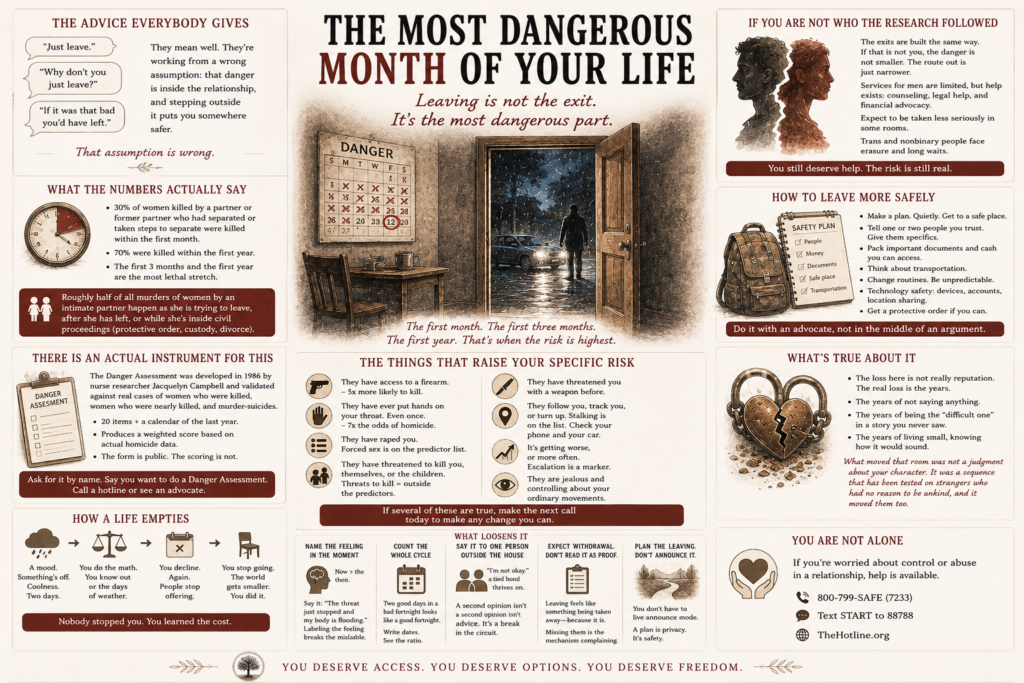
The advice everybody gives is two words long, and it’s the most dangerous sentence in this entire subject.
Just leave. Why don’t you just leave. If it was that bad you’d have left.
The people saying it mean well, and they’re working from an assumption that sounds obvious: that the danger is inside the relationship, and stepping outside it puts you somewhere safer. That assumption is wrong, and the research has been clear about it for thirty years.
Leaving is not the exit from the danger. It’s the most dangerous part of it.
What the numbers actually say
Among women killed by a partner or former partner who had separated or taken steps to separate, 30% were killed within the first month, and 70% within the first year. The first three months and the first year are the most lethal stretch, and the risk declines from there rather than ending.
Roughly half of all murders of women by an intimate partner happen as she is trying to leave, after she has left, or while she’s inside civil proceedings: a protective order, a custody case, a divorce.
And leaving a specifically controlling partner carries its own multiplier. Research puts it at around nine times more likely to be murdered.
Read those together and the picture is not “leaving is scary.” It’s that the act of leaving is itself the trigger, because for somebody whose entire arrangement depended on controlling you, your leaving is the moment the arrangement fails. That’s what escalates. Not their temper. The loss of the thing they built.
None of which is a reason to stay. Staying has its own mortality, laid out in How Abuse Kills, and it isn’t lower. It’s a reason to do this the way people who study it say to do it, rather than at eleven at night in the middle of a fight.
The things that raise your specific risk
This is the part that deserves a list rather than paragraphs, because somebody reading it under pressure needs to find themselves in it fast. These come out of decades of research into which abusive relationships actually turn fatal. That research followed women killed by male partners, because that is who the fatality studies tracked, so the multipliers are measured on women. The factors themselves are not sex-specific, and an advocate will work through them with anybody.
They have access to a firearm. An abuser with access to a firearm is roughly five times more likely to kill their partner. This is the single biggest item on the list.
They have ever put hands on your throat. Even once. Even briefly. Even with no marks left afterward. Prior non-fatal strangulation is associated with more than seven times the odds of a completed homicide.
They have raped you. Forced sex by a partner sits on the same predictor list as the gun and the hands, which most people never hear.
They have threatened to kill you, themselves, or the children. Threats to kill are a predictor. So is threatening suicide, which is not a cry for help in this context, it’s a control tactic that also signals danger.
They have threatened you with a weapon before.
They follow you, track you, or turn up. Stalking is on the list. If part of it runs through your phone or your car, that’s Is My Partner Tracking My Phone?
It’s getting worse, or more often. Escalation in frequency or severity is itself a marker.
They are jealous and controlling about your ordinary movements. Which is where most of this site lives, and it is not the mild end of the list.
If several of those are true for you, that isn’t a reason to panic. It’s a reason to make the next call before you make any other move.
There is an actual instrument for this
Most people never learn this exists, and it is the most useful thing in this article.
A nurse and researcher named Jacquelyn Campbell built a tool called the Danger Assessment, first developed in 1986 and validated since against real cases of women who were killed, women who were nearly killed, and murder-suicides. It’s a twenty-item questionnaire plus a calendar where you mark the last year, how often, how bad. It produces a weighted score, and the weighting came out of the actual homicide data rather than anybody’s judgment.
The form itself is public. The scoring is deliberately not, because the weighted interpretation is reserved for people who have been trained in it.
That sounds like an obstacle and it’s actually the point. It means you can walk into an advocate’s office, or call a hotline, and get a structured read on your own situation that is better than your instincts, better than your friends’ opinions, and better than an article. Ask for it by name. Say you want to do a Danger Assessment.
This is also the honest answer to why “call an advocate” isn’t a brush-off. They are not there to tell you to leave. They are there to help you find out how dangerous your particular situation is, and then to plan around that specific answer.
If you are not who the research followed
Everything above was built on women killed by male partners, and the exits are built the same way. If that is not you, the danger is not smaller. The route out is just narrower, and it is better to know that before you need it than at the door.
For men, the risk factors still apply, but the services thin out. There are far fewer shelter beds for men, though more places are setting some aside, and organizations without beds usually still offer counseling, legal help, and financial advocacy. Expect to be taken less seriously in some rooms. Research on the people who staff support lines for male victims describes men opening the call by saying they cannot be a victim of domestic abuse, because the idea does not fit anything they have been told about themselves. Men abused by male partners fall through the widest gap of all, since most services were designed around a woman and a male abuser.
For same-sex couples there is a specific and serious problem with the standard advice, and almost nobody says it out loud. Calling the police is not the same act for you. Dual arrest, where both people are taken in, is reported at around thirty times more common in same-sex cases than in cases with a female victim and a male offender. Officers arriving at a scene with two people of the same sex frequently cannot tell who did what, so they take both. That changes the arithmetic of every safety plan that ends with dialing 911, and it is worth working out in advance, with an advocate, what you will actually do instead.
Shelter is the other wall. In one national survey of LGBTQ survivors who tried to get into emergency housing, 44% were turned away, and most of those refusals came down to gender identity. Gay men are rarely admitted anywhere. So the plan that assumes a bed exists needs to be replaced with a plan that finds out first.
And the leverage is different too. The threat to out somebody, to their family or their employer, does not stop when the relationship does. It often sharpens, because it is the last thing left to hold. That mechanism is in You Could Say No. You Just Couldn’t Afford To.
The hotline below serves people of all genders and orientations. Say who you are at the start of the call, so they can point you at the services that will actually take you rather than the ones that will not.
What planning actually means
Not a dramatic escape. Mostly it’s dull preparation done slowly, while everything looks normal.
Documents first, because they take longest to replace and are the thing most often destroyed or withheld. Birth certificates, passports, social security cards, immigration papers, insurance, the children’s records. Photographs of them count, stored in an account they have never had the password to.
Money next, in whatever form is possible for you. If everything runs through a joint account they watch, an advocate can talk through options that don’t leave a trail on a statement, and there are more of them than people expect.
Then the technical side, which most planning guides still under-treat. Change nothing on your devices until you have advice, because removing tracking software tells them you found it, and that notification arrives at exactly the wrong moment. Assume the car knows where it is. Assume shared accounts, family plans, and cloud photos are visible. Get a device they have never touched before you make any real arrangements on it.
And a place, and one person who knows the plan. Not everybody. One.
The single most consequential detail: do not announce it. The conversation where you tell them you’re leaving is the moment the risk spikes, and it’s a conversation many people have while still living there, with no arrangements made, because it feels dishonest not to. You do not owe somebody advance notice of your own safety.
Protective orders, honestly
People want to know if they work, and the truthful answer has three parts.
They help on average. One study following 2,691 women who had reported an incident to police found that having a permanent protective order in effect was associated with about an 80% reduction in police-reported physical violence over the following year, and the wider evidence associates them with fewer intimate partner homicides.
They get violated, and the violations cluster early. Most breaches happen within the first three months of the order being issued, which is the same window that’s already the most dangerous.
And the research overall is mixed rather than settled, partly because orders are handed out more often to the highest-risk cases, which makes clean comparisons hard.
So: worth getting, in most situations, and not a substitute for a plan. A protective order is a piece of paper that raises the cost of coming near you and creates a record when they do. It is not a wall.
What you are actually walking into
Nobody tells you this part, and it is the part that sends people back. Not weakness. Arithmetic, arriving after the decision has already been made.
Start with the courtroom, because it is the one that does the most damage to people who assumed the system was on their side. A five-year study out of George Washington University, funded by the National Institute of Justice, tracked what happens when a mother tells a family court that the father is abusive. Roughly one in three of those mothers lost custody. If he answered by saying she was turning the children against him, it went to one in two. And in the cases where the allegation was child sexual abuse and he made that same counterclaim, the courts credited the allegation once in forty-nine times.
Once in forty-nine. The same study found that fathers who allege abuse are not undermined the same way when mothers make the counterclaim, so this is not simply courts being skeptical of everybody. Get a lawyer who has read that research before you say anything in front of a judge.
Money is the next one, and it decides more of this than courage does. In one national survey, 67% of survivors said they went back, or stayed longer than they meant to, because of finances. Not because the fear went away. Because the sums did not work. Partner abuse is documented as a route into poverty, unemployment and homelessness for people who were in none of those categories when it started.
Then the practical wall. Shelter capacity is finite and the answer is often no, and in one survey 43% of people who found their local shelter had no room went back to the abuser. So the plan that assumes a bed will exist needs replacing with one that finds out first, on an ordinary afternoon, rather than at eleven at night with a child in the car.
And you will probably leave more than once. Almost everybody does. It gets treated as a failure of resolve, and it is usually a trial run: a way to find out what he does, what your family says, whether the help you were promised is real. The number people repeat is seven attempts, which is softer than it sounds. British data on high-risk cases found most had tried two or three times in the year before anybody helped them properly. Either way, going back once ends nothing. It is the ordinary shape of this, and people who go back go on to leave.
None of it argues for staying. Staying has its own numbers and they are at the top of this page. It argues for knowing which particular wall is coming, so that hitting it is not the thing that decides your life at the worst possible moment.
The window does not close when you walk out
The most common mistake after leaving is treating the danger as finished, and it’s understandable, because you are exhausted and you want it to be over.
The elevated risk runs for months, and it stays raised for a good while beyond that. The first year is the one to get through carefully. Court dates, handovers, and anything involving the children are the pinch points, because they’re the moments when contact is guaranteed and predictable, which is exactly what somebody planning something needs.
Assume they know your patterns. Change the ones you can, particularly the predictable ones. Tell your workplace, because work is the location an abuser can always find you and the one place a stranger might intervene. Keep the record going.
And expect the version of them that shows up now to be reasonable, wounded, and persuasive, aimed at everybody except you. That has its own name and its own piece, in They Told Everyone First.
What’s true about it
The reason “just leave” persists is that it lets the person saying it off the hook. It relocates the whole problem into your decision-making, where it costs them nothing.
What’s actually true is that leaving is a planned operation with a known danger window, that the danger is highest in the first month and stays raised for a year, and that there is a validated instrument for measuring your own situation which almost nobody is told about.
You are not slow for still being there. You’ve been doing risk assessment with no training, no data, and no help, about a situation somebody else designed to be hard to leave.
Get somebody trained to do it with you.
This reflects personal experience and research, not legal or safety advice for your particular situation. If you are planning to leave, please talk to an advocate first. The National Domestic Violence Hotline is free, confidential, and available 24 hours a day to people of all genders: call 800-799-SAFE (7233), text START to 88788, or chat at TheHotline.org, and ask about a Danger Assessment and safety planning. Use a device you believe is safe. If you are in immediate danger, call 911.
Where this comes from
Everything above is drawn from published research. It is listed here so you can read it, or hand it to somebody who thinks you are overreacting.
The Danger Assessment. Campbell, Webster and Glass, “The Danger Assessment: Validation of a Lethality Risk Assessment Instrument for Intimate Partner Femicide,” Journal of Interpersonal Violence, 2009. Developed by Jacquelyn Campbell in 1986 and validated against femicide, attempted femicide, and femicide-suicide cases.
Firearms, strangulation, and the predictor list. Campbell and colleagues, “Risk Factors for Femicide in Abusive Relationships: Results From a Multisite Case Control Study,” American Journal of Public Health, 2003; and Glass and colleagues, “Non-fatal Strangulation is an Important Risk Factor for Homicide of Women,” Journal of Emergency Medicine, 2008.
The timing of the danger. Research on post-separation abuse and intimate partner homicide finds the first three months and first year after separation to be the most lethal, with 30% of these deaths occurring in the first month and 70% within the first year.
Protective orders. A study of 2,691 women reporting intimate partner violence to police, associating permanent orders with roughly an 80% reduction in police-reported physical violence over the following year; alongside Cordier and colleagues, “The Effectiveness of Protection Orders in Reducing Recidivism in Domestic Violence: A Systematic Review and Meta-Analysis,” 2021, which is the source for the evidence being mixed.
Men, and the services that do not exist. Hine, Bates and Wallace, “I Have Guys Call Me and Say I Can’t Be the Victim of Domestic Abuse: Exploring the Experiences of Telephone Support Providers for Male Victims of Domestic Violence and Abuse,” Journal of Interpersonal Violence, 2022.
Same-sex couples, dual arrest and shelter refusal. National Coalition of Anti-Violence Programs data on emergency shelter access, and the widely reported finding that dual arrest is far more common in same-sex cases. Summarized by the Human Rights Campaign.
Family court outcomes. Meier, Dickson, O’Sullivan, Rosen and Hayes, “U.S. child custody outcomes in cases involving parental alienation and abuse allegations: what do the data show?”, Journal of Social Welfare and Family Law, 2020. A five-year study funded by the National Institute of Justice, covering cases from 2005 to 2014.
Money, shelter capacity, and returning. National Resource Center on Domestic Violence survey finding 67% of survivors returned or stayed longer for financial reasons; survey data on survivors returning after being turned away from a full shelter; and SafeLives data on how many times high-risk victims attempt to leave before receiving effective help.