Weaponized Incompetence: When “I’m Just No Good at That” Is a Strategy
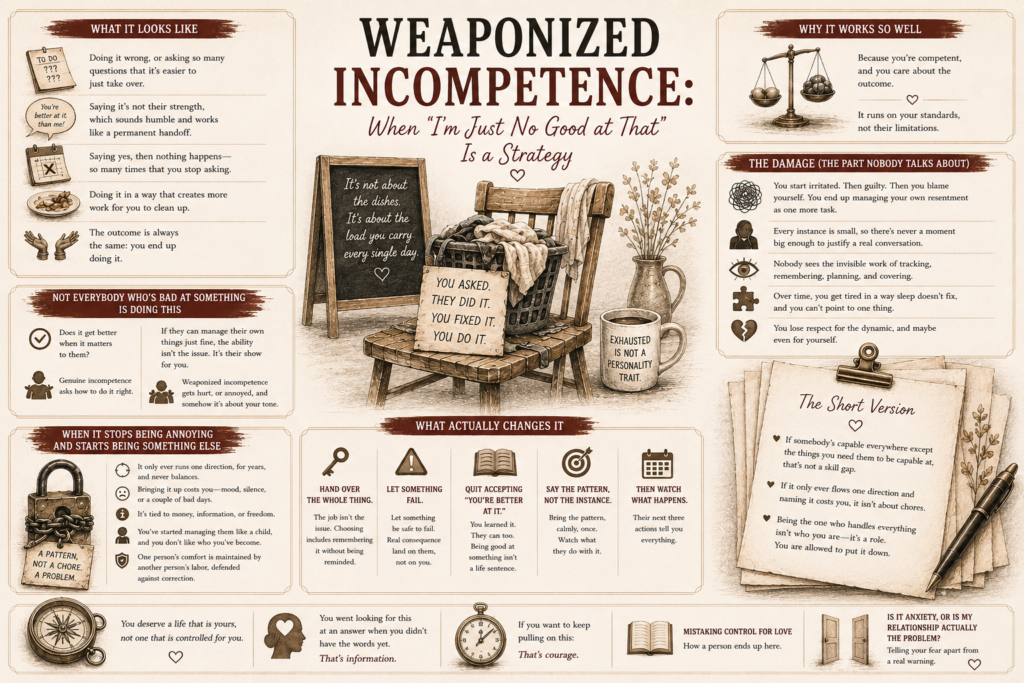
You asked them to handle one thing. They did it so badly, or asked so many questions about it, that by the end you’d have been better off doing it yourself. Which you did. Which is how it’s gone for years now.
There’s a name for that going around: weaponized incompetence. Doing something poorly on purpose, or claiming you can’t, so somebody else takes it over permanently.
Most of what’s written about it is a fight about chores. That’s the smallest version. The part worth understanding is what it does to the person who keeps picking things up, because that runs a lot deeper than a sink full of dishes.
It is never a flat refusal
It’s rarely a refusal. A refusal would be easy to see.
It’s the job done just wrong enough that you take it back. It’s twenty questions about a task they’ve watched you do a hundred times. It’s “you’re better at it than me,” which sounds like a compliment and works like a transfer. It’s saying yes and then nothing happening, so many times that you quit asking. It’s handling it in a way that creates a mess you then clean up, and after two rounds of that it’s easier to skip the middle step.
You’ll know it by the outcome, not the moment. Every road leads to the same place, which is you doing it.
Not everybody who’s bad at something is doing this
This matters, because the term has gotten thrown around fast, and some people genuinely are worse at certain things or were never taught them.
Here’s the test I’d use. Does it get better when it matters to them?
Somebody who truly can’t manage the calendar can’t manage it for their own stuff either. Somebody who can plan a fishing trip down to the hour, run a fantasy league, or handle a complicated thing at work, but goes helpless the second it’s a school form, isn’t incapable. The skill exists. It just doesn’t come out for this.
The other tell is what happens when you point at it. Genuine incompetence tends to be a little embarrassed and asks how to do it right. The other thing gets hurt, or annoyed, and somehow the conversation ends up being about your tone.
It only works on capable people
Because you’re competent, and you care about the outcome.
That’s the whole engine. It only works on somebody who won’t let the thing fail. If you were willing to let the bill go unpaid or the kid show up without the form, it’d collapse in a week. It runs on your standards, not their limitations.
Which is why the people carrying the most of it are usually the reliable ones. The organized one, the one who remembers, the one everybody calls. Being good at things quietly became a job nobody assigned you and nobody’s going to thank you for.
The part nobody talks about
The dishes aren’t the damage. The damage is what it does to your read on yourself.
You start out irritated. Then you feel guilty for being irritated, because it’s just chores and they’re not a bad person. Then you tell yourself you’re controlling, or you’re a perfectionist, or you should’ve explained better. You end up managing your own resentment as one more task on the list.
And because every individual instance is small, there’s never a moment big enough to justify a real conversation. What are you going to do, have it out over a dishwasher. So it accumulates instead. Five years in you’re tired in a way sleep doesn’t fix, and you can’t point at a single thing that would explain it to anybody.
Then there’s the invisible part. Nobody sees the work of tracking everything. They see the ten minutes of doing, not the constant background hum of remembering, planning, anticipating, and covering. When somebody says “you should have just asked me,” that’s the tell. Having to ask is the work.
Where it stops being annoying and starts being something else
Most of the time this is a bad habit, not a strategy. People fall into it, it works, and they never examine it. That version can change if you name it plainly and they actually want to be a decent partner.
It’s a different thing when it’s part of a pattern. Watch for these:
It only ever runs one direction, for years, and never balances no matter how many conversations you have.
Bringing it up costs you. Not a defensive moment, which is normal, but a punishment. A mood, a silence, a couple of bad days, so that raising it becomes more expensive than doing the task.
It’s tied to money, information, or freedom. Not knowing how the accounts work is a much bigger deal than not knowing how the dishwasher loads.
You’ve started managing them the way you’d manage a child, and you feel yourself becoming somebody you don’t like.
When those show up together, you’re not looking at a chore problem anymore. You’re looking at one person’s comfort being maintained by another person’s labor, defended against correction. That’s a control pattern wearing an apron. I’ve written about the larger version of it in Mistaking Control for Love.
How to hand it back
Hand over the whole thing, not the task. The job isn’t “do the dishes tonight.” The job is “the kitchen is yours.” Ownership includes remembering it without being reminded. If you’re still the one tracking whether it happened, you never handed anything over.
Let something fail that’s safe to fail. This is the hardest one for capable people and it’s the one that works. Not the mortgage. Something small with real, visible consequences that land on them and not on you. You can’t fix a thing you keep preventing.
Quit accepting “you’re better at it.” The answer is that you learned it, and they can too. Being good at something isn’t a life sentence.
Say the pattern, not the instance. “You didn’t do the trash” is arguable. “Every time I ask you to take something on, it comes back to me within two weeks, and I want to talk about why” is not. Bring the pattern, calmly, once, and watch what they do with it.
Then watch what happens. This is the whole ballgame. A partner who didn’t realize will be uncomfortable and then adjust, imperfectly, over months. A partner who’s getting something out of it will agree with everything you said and change nothing, and you’ll be back here in a year. The words tell you very little. The next three months tell you everything.
There’s one more thing worth saying to whoever’s been carrying it, and it has nothing to do with dishes.
Somewhere along the way you probably decided this is just who you are. The responsible one. The one who notices. You might even be a little proud of it, because it’s what people compliment you for, and because a house does run better with somebody like you in it. That part is true, and it’s exactly what makes the whole arrangement so hard to see. A role you’re good at stops looking like a role.
When the same pattern reaches the money, it looks like Financial Abuse: When You Have to Ask for Your Own Money. When it reaches your phone and your car, it looks like Is My Partner Tracking My Phone?.
But being the one who handles everything isn’t a character trait you were born with. It’s a role, you got put in it, and you’re allowed to put it down.
This reflects personal experience and research. It isn’t therapy, and it isn’t a diagnosis of anyone. If a pattern in your relationship has moved past chores into control, the National Domestic Violence Hotline offers free, confidential support 24 hours a day to people of all genders. Call 800-799-SAFE (7233), text START to 88788, or chat at TheHotline.org.