What Are Dark Personalities?
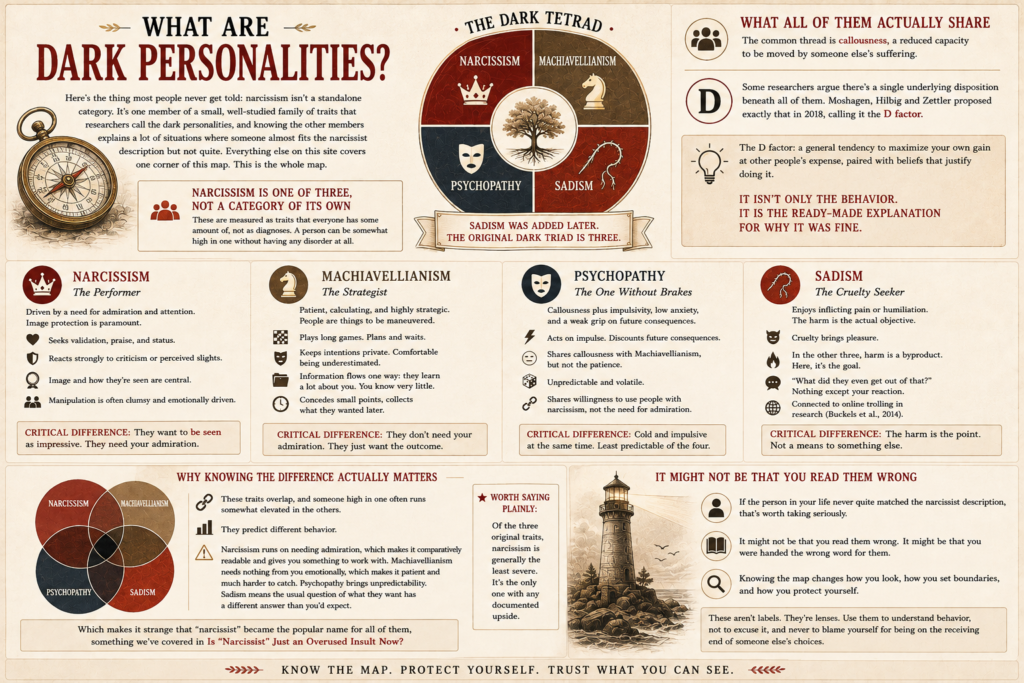
Here’s the thing most people never get told: narcissism isn’t a standalone category. It’s one member of a small, well-studied family of traits that researchers call the dark personalities, and knowing the other members explains a lot of situations where someone almost fits the narcissist description but not quite. Everything else on this site covers one corner of this map. This is the whole map.
Narcissism Is One of Three, Not a Category of Its Own
In 2002, researchers Delroy Paulhus and Kevin Williams grouped three traits together and named them the Dark Triad: narcissism, Machiavellianism, and psychopathy. Their point wasn’t that these are the same thing. It was that they’re related, they overlap, and they’d been studied in isolation for too long.
One thing to be clear about up front, because it changes how you should read all of this: these are measured as traits that everyone has some amount of, not as diagnoses. A person can be somewhat high in one without having any disorder at all. That’s a genuinely different framework from the clinical one, and it’s closer to how these things actually show up in ordinary life.
The practical consequence of narcissism being a member rather than a category is this: the traits travel together. Someone high in one is often somewhat elevated in the others, which is why a person can look like a textbook narcissist in most situations and then do something cold and calculated that doesn’t fit the description at all. That isn’t you misreading them. It’s what the overlap actually looks like from inside a relationship.
Machiavellianism: The Strategist
Named after Machiavelli’s The Prince, and studied since Richard Christie and Florence Geis built the first scale for it in 1970. This is the patient, calculating one. Someone high in Machiavellianism manipulates deliberately, plays long games, keeps their real intentions private, and holds a broadly cynical view of other people as things to be maneuvered.
The critical difference from narcissism: they don’t need your admiration. That’s the whole distinction in one line. A narcissist wants to be seen as impressive. A Machiavellian just wants the outcome, and will happily let you think whatever keeps you useful. That makes them much harder to spot, because the tell most people watch for, the visible ego, isn’t there.
In practice it tends to look like this. They rarely lose their temper, because losing it costs them control. They’re comfortable being underestimated, sometimes deliberately so. They don’t argue to win in the moment, they concede small points and collect what they wanted later. Information flows one direction: they learn a great deal about you, and you find you know surprisingly little about them that they didn’t choose to tell you. Where a narcissist’s manipulation is often clumsy and emotionally driven, this version is quiet enough that many people never identify it as manipulation at all, only that things somehow kept going one person’s way for years.
This is the one most often mistaken for narcissism, and it’s the reason to know the map exists. If your person was cold rather than grandiose, patient rather than reactive, and never seemed to need anyone’s approval, the narcissist framework was probably never going to fit them properly.
Psychopathy: The One Without Brakes
Callousness plus impulsivity, low anxiety, and a weak grip on future consequences. If Machiavellianism is a long game, psychopathy is the opposite: acting on the impulse now and discounting whatever it costs later. We’ve covered how this compares to narcissism directly in Narcissist vs Psychopath, and the recognized subtypes in Different Types of Psychopaths.
Worth noting where it sits relative to the other two, since that’s the part the map makes clear. Psychopathy shares the callousness with Machiavellianism but not the patience, and shares the willingness to use people with narcissism but not the need to be admired for it. That combination, cold and impulsive at the same time, is what makes it the least predictable of the three.
Sadism: The Fourth One, Added Later
Researchers led by Erin Buckels demonstrated in 2013 that everyday sadism, genuinely enjoying cruelty, exists as a measurable trait in ordinary people, and it’s since been added to the group, which is now often called the Dark Tetrad. Their later work also connected it to online trolling specifically.
Sadism is the real outlier of the four, and the distinction is worth holding onto. In the other three, harm is a byproduct. The narcissist hurts you protecting an image, the Machiavellian hurts you getting an outcome, the psychopath hurts you not caring about consequences. In sadism, the harm is the actual objective. If you’ve ever asked “what did they even get out of that,” and the honest answer seems to be nothing except your reaction, that’s the difference.
What All of Them Actually Share
The common thread is callousness, a reduced capacity to be moved by someone else’s suffering. Some researchers argue there’s a single underlying disposition beneath all of them. Moshagen, Hilbig and Zettler proposed exactly that in 2018, calling it the D factor: a general tendency to maximize your own gain at other people’s expense, paired with beliefs that justify doing it.
That second half is the part worth noticing. It isn’t only the behavior. It’s the ready-made explanation for why the behavior was fine, which is why the excuses tend to sound so similar across very different people.
Why Knowing the Difference Actually Matters
These traits overlap, and someone high in one often runs somewhat elevated in the others, so this isn’t about sorting a person into exactly one bucket. It’s about knowing what you’re dealing with, because they predict different behavior. Narcissism runs on needing admiration, which makes it comparatively readable and gives you something to work with. Machiavellianism needs nothing from you emotionally, which makes it patient and much harder to catch. Psychopathy brings unpredictability. Sadism means the usual question of what they want has a different answer than you’d expect.
Of the three original traits, narcissism is generally the least severe. It’s the only one with any documented upside, and the other two are more consistently linked to real exploitation. Which makes it strange that narcissist became the popular name for all of them, something we’ve covered in Is “Narcissist” Just an Overused Insult Now? If the person in your life never quite matched the narcissist description, that’s worth taking seriously. It might not be that you read them wrong. It might be that you were handed the wrong word for them.