Why a Narcissist Smears You Before You Even Leave
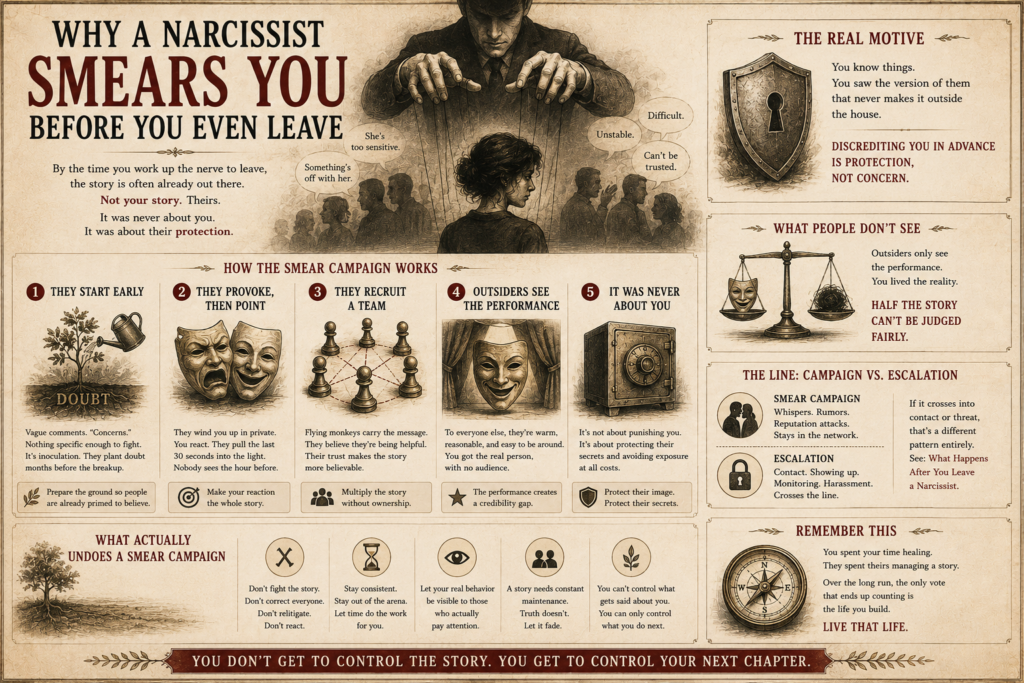
By the time you work up the nerve to leave, the story is often already out there. Not your story, theirs. A narcissist builds a reputation-management operation into the relationship long before any breakup, and every piece of it serves one purpose: making sure that when you finally describe what actually happened, nobody believes you. They provoke reactions they can point to later. They recruit people to carry the message. They save their best behavior for everyone who isn’t you. None of it is random, and none of it is really about you. Here’s how the campaign works, roughly in the order it runs.
They Start Smearing You Before It’s Even Over
This is the part people miss, because it doesn’t look like an attack. While things still look fine from the outside, and often while they still look mostly fine to you too, a narcissist is already planting doubt. Vague comments to friends and family about you “going through something.” A concerned tone about how “difficult” you’ve seemed lately. Nothing specific enough to argue with, just enough to make you sound unstable months before anyone would have a reason to think so.
The point isn’t to convince anyone of anything yet. It’s inoculation. By the time the relationship actually ends and you start describing the control, the rage, the cold-shoulder punishments, that description lands on ground that’s already been prepared. People don’t hear a fresh account. They hear confirmation of something they were quietly warned about months ago.
If you can look back and remember people getting oddly gentle with you, or oddly guarded, while everything still seemed normal on your end, that wasn’t concern. That was the campaign starting before you even knew there’d be one.
They Provoke You, Then Point at the Reaction
The second move is reactive abuse: wind you up with enough small cruelty, repetition, and provocation that you eventually snap, then treat the snap as the whole story. We’ve covered the mechanics of this in full in How Narcissists Make You the Problem, so we won’t repeat it here. What matters for a smear campaign specifically is timing and audience. The provocation happens in private, or where it won’t be noticed. The reaction gets pulled out in front of people, or timed so a witness catches only the last thirty seconds. Nobody sees the hour that led up to it. Everybody remembers the thirty seconds.
They Recruit a Team to Carry It For Them
Somewhere in this process, other people start showing up with opinions they didn’t have before. A mutual friend gets strangely distant. A family member starts relaying “concerns” that trace back to one source. Someone who was never especially close to either of you suddenly has a lot to say. These are flying monkeys, and their job is to multiply the story without the narcissist ever having to deliver it personally.
It’s a more effective version of the same tactic covered in a workplace context in Signs Your Boss Is a Narcissist. In a breakup, the recruits usually believe they’re being genuinely helpful, checking in, showing support, staying neutral. Few of them realize they’re functioning as a delivery system for a story they never verified themselves. A rumor delivered by a “concerned, neutral” third party lands with more credibility than the same words coming straight from the narcissist’s own mouth.
Outsiders Get a Version of Them You Never Did
Here’s the part that makes the whole thing work: to people outside the relationship, the narcissist is often genuinely warm, reasonable, and easy to be around. That’s not a coincidence and it’s not extra effort spent being nice. Outsiders are an audience, and eventually they may be called on to be a jury, so they get the performance. You got the person underneath it, every day, with no audience and nothing to perform for.
This split is exactly why the smear lands. How could someone so reasonable about the breakup, so calm describing it to mutual friends, possibly be the person you’re describing? It’s a fair question if you only have half the information. If you want a useful test, don’t argue with someone’s good impression of them. Ask them to imagine living with that version full time, every disagreement, every bad day, with nobody else in the room, ever. Most people have never had to picture it, and once they do, the certainty usually softens.
It Was Never About You, It Was About Their Secrets
Strip away the justifications and the motive is simple: you know things. You saw the version of them that never made it outside the house, and that version is the actual liability. Discrediting you in advance is cheaper and safer than ever having to answer for what you’d say if people believed you. It was never concern for you, and it was never really even about damaging you specifically. It’s protection, aimed at their own exposure.
Notice where the energy goes while this is happening. They spend real time and effort managing a story. You spend yours actually healing, actually rebuilding, actually moving on with a life. If things escalate past reputation into contact, showing up, or monitoring you, that’s a different and more serious pattern, covered in What Happens After You Leave a Narcissist. Most smear campaigns stay at the whisper-network level. It’s still worth knowing where the line is.
What Actually Undoes a Smear Campaign
Not a counter-campaign. Matching their energy, correcting every person, relitigating every rumor, gives them exactly the reaction they used against you the first time, and hands them new material to work with. A campaign fought in public rarely gets won by the person who has to keep proving a negative.
What actually works is slower and less satisfying: staying consistent, staying out of the arena, and letting your actual behavior, visible over time to whoever bothers to pay attention, outlast a story that has to be maintained and re-told to stay alive. You don’t get to control what gets said about you. You only get to control what you do next, and over a long enough stretch of time, that’s the only vote that ends up counting.