Why Narcissists Move On So Fast
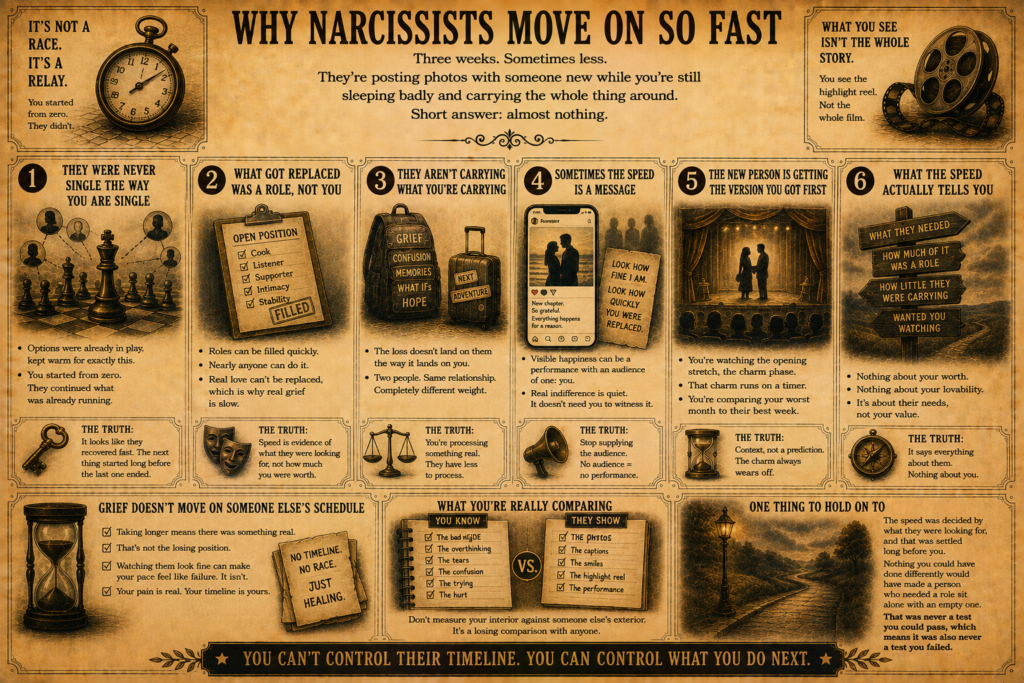
Three weeks. Sometimes less. They’re posting photos with someone new while you’re still sleeping badly and carrying the whole thing around. The mechanics of what they do after you leave are covered in What Happens After You Leave a Narcissist. This is the other question, the one that actually keeps people up: what does the speed mean about you? Short answer, and it’s worth saying before anything else: almost nothing.
They Were Never Single the Way You Are Single
You started from zero on the day it ended. They usually didn’t. There were often options already in play, kept warm for exactly this, which is part of the compartment structure covered in Why Narcissists Live a Double Life.
So the comparison you’re making is not a fair one, and it isn’t even the same race. You’re grieving from a standing stop. They’re continuing something that was already running. It looks like they recovered in three weeks. What actually happened is the next thing started well before the last one finished.
What Got Replaced Was a Role, Not You
A role can be filled quickly. A person can’t. We’ve covered in full what those roles actually are, and how to tell whether you were valued for one, in What You Really Are to a Narcissist.
The part worth adding here is what that means for how fast this happens. When someone needs a function filled, the search is easy, because nearly anyone can do it. When someone loves a specific person, there’s no replacement to find, which is exactly why real grief is slow. The speed you’re watching is evidence about what they were looking for, not evidence about how much you were worth.
They Aren’t Carrying What You’re Carrying
Part of it is simply that the loss doesn’t land on them the way it lands on you, and whether they even register the damage is its own question, covered in Do Narcissists Know They’re Hurting You?.
What matters for the speed is the practical consequence. You’re moving slowly because you’re processing something real. They’re moving fast because, for them, there’s less to process. Two people can walk out of the same relationship carrying completely different weights, and the one carrying less will always get down the road faster. That difference says something about them. It says nothing about the size of what you had.
Sometimes the Speed Is a Message
Here’s the part people miss. Some of that visible, hurried happiness is aimed directly at you. The timing of the posts, the places chosen, the mutual friends who’ll definitely report back. It functions as an announcement: look how fine I am, look how quickly you were replaced, look how little you mattered.
That’s a performance with an audience of one, and you’re the audience. Which is worth sitting with, because if they genuinely didn’t care, there would be no reason to stage it where you can see it. Real indifference is quiet. It doesn’t need you to witness it.
You can usually tell the difference by where the display lives. Someone genuinely moving on shares things with the people actually in their life. A display built for you tends to surface in the places you’re most likely to see it: the account you still follow, the friend who always relays news, the spot the two of you used to go. The choice of stage is the part that gives it away.
The practical move here is unglamorous and it works. Stop supplying the audience. Mute, unfollow, ask the friend who keeps updating you to stop. Not as a dramatic gesture, and not because you’re pretending it doesn’t hurt, but because a performance with nobody watching stops being worth staging, and because you cannot heal on a schedule while checking someone else’s highlight reel every night.
The New Person Is Getting the Version You Got First
What you’re watching from outside is the opening stretch, the same one you had at the beginning, and the charm that runs it operates on a timer, which we’ve covered in Why a Narcissist’s Charm Always Wears Off.
This isn’t a reason to wish anyone harm, and it isn’t a prediction you should be waiting around to see confirmed. It’s context for what you’re looking at. You’re comparing your worst month to their best week, and the two aren’t the same stage of anything.
What the Speed Actually Tells You
Nothing about your worth. Nothing about whether you were lovable, or enough, or replaceable as a person. It tells you what they needed, how much of it was a role, how little they were carrying, and in some cases how much they wanted you watching.
The hardest part is that grief doesn’t move on someone else’s schedule, and watching them look fine can make your own pace feel like failure. It isn’t. Taking longer means there was something real on your side of it. That’s not the losing position, even though it’s the one that hurts more right now.
It helps to be specific about what you’re actually comparing. You know your own insides, every bad night and every hour you spent trying to make sense of it. Of them, you know only what’s visible from outside, which is the part built to be seen. Measuring your interior against someone else’s exterior is a losing comparison with anyone, and it’s a badly rigged one here.
If you need something concrete to hold onto while the feeling catches up: the speed was decided by what they were looking for, and that was settled long before you. Nothing you could have done differently would have made a person who needed a role sit alone with an empty one. That was never a test you had any way to pass, which means it was also never a test you failed.