How Abuse Kills: The Two Endings Nobody Counts
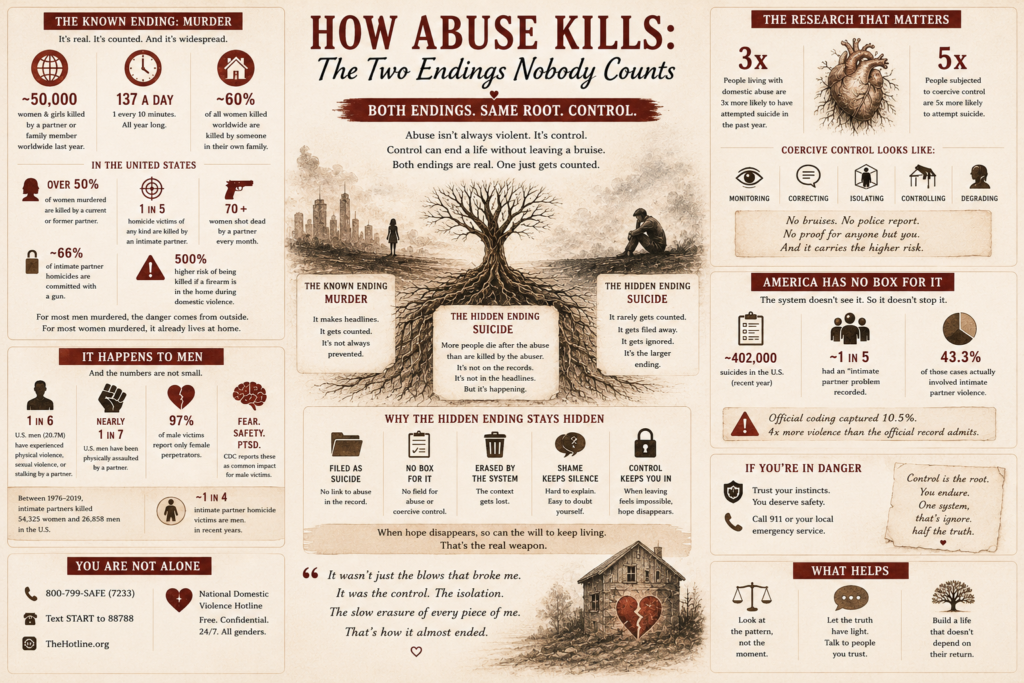
There are two ways this ends when it ends badly, and almost everything written about abuse only covers one of them.
Everybody knows abuse can end in murder. It’s the version in every headline and every drama, and it’s real. In 2024, roughly 50,000 women and girls worldwide were killed by a partner or a family member, which works out to 137 a day, one every ten minutes, all year long. That accounts for about 60% of all women murdered anywhere, by anyone, for any reason. Far fewer people know about the other ending, and where anybody has bothered to count it properly, it turns out to be the bigger one. Both endings have the same thing standing behind them, and it isn’t a temper and isn’t necessarily violence. It’s control.
What this looks like in America
In the United States, about half of all women murdered are killed by a current or former partner, and about one in five homicide victims of any kind die at the hands of an intimate partner. More than seventy women a month are shot dead by a partner. Around two thirds of intimate partner homicides here are committed with a gun, and a gun in the house makes a woman in an abusive relationship five times more likely to be killed.
Put it next to the rest of American murder and the shape gets stranger. Most people killed in this country are men, and for most of them the danger came from outside the house. Intimate partners account for around 10% of male homicide victims and about half of female ones. For most men who are murdered, the threat walked in from somewhere else. For most women who are murdered, it already lived there.
This happens to men, and the numbers are not small
More than one in six American men, about 20.7 million of them, have experienced physical violence, sexual violence, or stalking from an intimate partner. Nearly one in seven has been physically assaulted by a partner. Of the men who report that kind of treatment, all but a small fraction name a female partner as the only perpetrator. The CDC’s own summary of what male victims describe is fear, concern for their safety, and symptoms of post-traumatic stress.
On the fatal end, the most recent American count found 3,991 women killed by an intimate partner between 2018 and 2021 alone, roughly a thousand a year, and the rate has not budged. Men are counted less carefully. The only national tally that separates the sexes runs from 1976 to 2019, and across that span intimate partners killed 54,325 women and 26,858 men, putting men at one in three over the period and one in four in recent years. That is not a footnote and it is not an asterisk on somebody else’s problem. If you’re a man reading this and wondering whether you’re allowed to think of yourself as somebody this happened to, that question gets its own answer in Narcissism Is Not a Male-Only Problem. And if you have landed on the opposite worry, that you might be the one doing the damage, that gets a straight answer in Am I the Narcissist?.
Victim Killed by a partner or relative
Women and girls murdered
60%
Men and boys murdered
11%
Region Women and girls killed in 2024
Africa
22,600
Asia
17,400
The Americas
7,700
Europe
2,100
Oceania
300
Victim Killed by an intimate partner
Women murdered
50%
Men murdered
7.9%
Victim Deaths, 1976 to 2019
Women
54,325
Men
26,858
What investigators found Share of the killers
Had a known history of abusing her
20.3%
Had nothing on record at all
79.7%
How the death was counted Share showing partner violence
What the official coding recorded
10.5%
What was actually in the case files
43.3%
Situation How much more likely
Living with domestic abuse (suicide attempt)
3×
Subjected to coercive control (suicide attempt)
5×
Choked by a partner before (being murdered)
7.5×
The ending nobody counts
Now the other one, and this is where American record-keeping stops being able to help you.
Only one country tracks this properly, so the only hard number available comes from Britain, where police recorded 98 suspected suicides following domestic abuse in a single year, against 80 intimate partner homicides. Second year running the suicides came in higher. More people died after the abuse than were killed by the abuser, and controlling behavior was a driving factor in a large share of them. Unlike the killings, almost none of those deaths were recorded as having anything to do with abuse. They went down as suicides, full stop, the way suicides do.
That number exists because somebody decided to look for it. There is no American equivalent, and the reason for that is worth understanding.
Five times
Here’s the finding that ought to reorganize how everybody thinks about this. Women living with domestic abuse are around three times more likely to have attempted suicide in the past year than women who aren’t. Already a hard number. But people subjected to coercive control specifically are five times more likely to attempt suicide.
Put the emphasis where it belongs. Not people who were beaten. People who were managed. Monitored, corrected, isolated, kept explaining themselves, kept apologizing for things they hadn’t done. The kind of relationship that leaves no bruise, generates no police report, and gives a friend nothing to point at. That’s the kind carrying the higher number.
Anybody who’s tried to describe a relationship like that has hit the same wall. Well, did he hit you. Did she ever actually do anything. The honest answer is no, and the honest answer sounds like nothing, so you stop telling people, and then you’re alone with it, which was the point all along. The research says the part you couldn’t prove is the part most likely to kill you. If you’re still working out whether what you’re living in counts, that question has its own answer in Is It Abuse If They Never Hit You?
America has no box for it
The United States runs a national system recording the circumstances behind violent deaths, and it’s serious public health infrastructure. Out of roughly 402,000 suicides in it, about one in five had an “intimate partner problem” recorded as a contributing factor. That’s around 80,000 people, and the number can’t be used the way you’d want to use it, because “intimate partner problem” is one box covering a breakup, a divorce, an argument, jealousy, an affair, and fifteen years of coercive control, with nothing separating them. Nobody records whether the relationship was abusive. There’s no field for it.
So no researcher can tell you how many Americans die this way, but somebody went and checked anyway. A team read the investigators’ written accounts behind those deaths rather than the checkboxes, and found intimate partner violence in 43.3% of the cases the system had filed as a relationship problem. The coding had captured 10.5%. Four times as much violence in those deaths as the official record admits, and their conclusion was blunt: there’s a great deal of underlying and outright violence in these relationships, and it’s driving the risk of suicide. That was published, and the form didn’t change.
The American number isn’t missing because the deaths aren’t happening. It’s missing because nobody added a box, so the people who die that way get filed under something that reads like an ordinary bad breakup.
And for men it’s worse than missing
There’s a figure in the American data that looks made for a man writing about this. Intimate partner abuse was recorded as playing a role in 2,031 male suicides against 439 female ones. More than four to one.
It doesn’t mean what it appears to mean, and it’s worth understanding why, because the reason is the whole problem. Those records note that partner abuse was involved without noting which side of it the dead person was on. When researchers went through one state’s cases in detail, nearly three quarters of those deaths were cases where the man who died had been the abuser, not the abused. So that number is mostly counting men who abused someone and then killed themselves.
Which leaves the actual question unanswerable. How many American men are driven to suicide by a partner who spent years dismantling them? Nobody knows. Not because it’s rare, but because the form that records these deaths can’t tell an abuser from the person they abused, and nobody has built one that can.
These don’t all look the same
There’s a version of this most people picture. Somebody worn down across years, isolated and exhausted, who runs out of road on their own. That version is real and it’s common.
Mine had a voice on it.
I was on the bathroom floor, and it was as close as a person can get and still be here writing about it. She was on the phone. Not calling for help, not asleep at the other end of the house with no idea. On the phone with me, and every sentence she said pointed the same direction, and the direction was down.
I’d like to say I saw it for what it was, but I didn’t. By then I’d spent years being told what I was, and it had stopped sounding like an opinion and started sounding like information. When somebody has been correcting your read on your own life for long enough, and then they tell you what you’re worth, you don’t hear an attack. You hear a fact you’d been avoiding.
That’s what all of it had been for, the years of small management nobody would have called abuse. It was never about the schedule or the money or where I was at four in the afternoon. It was about making sure that when she finally told me what I was, there’d be nobody left inside me to argue.
I don’t know what got me off that floor. I’ve had years to work it out and I still can’t tell you. Something in me didn’t go along with it, and I don’t take credit for that, because plenty of people every bit as strong as me didn’t get that moment and aren’t here. That’s the part I want understood. I’m not proof that people survive this. I’m one example of what it looks like when somebody isn’t just worn down by an abuser but talked toward the edge by one, and lived anyway. The ones it worked on aren’t writing articles, which is exactly why the number looks small.
97%
The most thorough look anybody has taken at what precedes these killings ran twenty-two years of intimate partner homicides through a state death review team in Australia, examining what had been happening in each relationship before it turned fatal. In 97% of them, the perpetrator had been using coercive control against the victim first. Ninety-seven percent. Not a majority, not a strong correlation, very nearly all of them.
Which means the monitoring, the isolation, the money kept on a leash, the accounting for forty minutes at the feed store, all the behavior that no law recognized and no friend could see, wasn’t a milder thing that sometimes precedes the dangerous thing. It was the dangerous thing, earlier.
How a person gets trained to read that as devotion rather than as a warning is in Mistaking Control for Love. And if you are stuck on why it felt so right at the very beginning, that has its own mechanism, in Why Were They So Good at First?.
American records make the same point from the other side. Of the women killed by a partner between 2018 and 2021, only one in five of the killers had any known history of abusing her. Four out of five had nothing on record at all. Not because nothing had been happening, but because what had been happening was the kind nobody writes down.
Set the two findings next to each other and the shape of this is hard to miss. Coercive control came first in 97% of the murders, and coercive control multiplies suicide risk by five. It’s the common factor in both endings, and for most of its duration it’s perfectly legal in most of this country and invisible to everyone outside the house.
What actually predicts the worst outcome
Researchers have spent decades working out which cases turn fatal. The answers are specific, and most people have never heard them.
Non-fatal strangulation. This is the one that should be common knowledge and isn’t. A partner who has choked you before, even once, even briefly, even with no marks left, is associated with more than seven times the odds of going on to kill you, and nearly seven times the odds of an attempt. It showed up in 10% of abused women generally and in 43% of the murders. If this has happened to you, that single fact belongs in front of a doctor and an advocate, and it belongs there now.
Forced sex. A partner who has raped you sits on that same predictor list, alongside the gun and the hands, and it holds even after accounting for the other violence in the relationship. Most people file it as the most private thing that ever happened to them rather than as a warning. It has its own piece, in Is It Coercion If You Said Yes?.
Separation. The most dangerous stretch isn’t while you’re in it, it’s when you go. The strongest work on this went into eleven cities and compared women who had been killed by a partner against women in abusive relationships who survived, and it found estrangement to be one of the most powerful predictors of all, sharpest of any when the partner had been a controlling one. Estimates of how many of these killings cluster around a separation vary with who is counting and how, running from about half up to three quarters. That isn’t a reason to stay, and nobody who does this work will tell you it is. It’s the reason leaving gets planned with an advocate rather than announced in an argument.
A firearm in the house. Access changes the odds more than almost anything else on this list, and in this country that matters more than it does anywhere comparable.
Stalking. Following, showing up, tracking, monitoring. It isn’t devotion running hot and it isn’t a nuisance, it’s a documented predictor. If part of it is running through your phone or your car, that’s laid out in Is My Partner Tracking My Phone?
Escalating frequency or severity, past threats with a weapon, and explicit threats to kill sit on the same list. When somebody says they’ll kill you, the research is unanimous and unromantic. Believe them.
One of these is a crime. The other mostly isn’t.
Kill your partner and every state in this country prosecutes it. Spend a decade making sure they believe they’re worthless, and when they die by suicide the picture changes completely.
Five states have written coercive control into law: Hawaii, California, Connecticut, Washington, and Colorado. In four of them it operates inside family court and the protective order system, meaning a judge can recognize the pattern and act on it. Hawaii is the only state where controlling somebody can actually get you criminally charged. Charging somebody for a death that followed years of it is a different matter again, and it almost never happens. American prosecutions for pushing a person toward suicide have generally involved teenagers and text messages, not a marriage and a decade of erosion. Abroad it is only marginally better: British courts have accepted that driving a person to suicide can amount to a crime, and have managed to convict on it about once.
So one ending is a murder charge and the other, nearly everywhere, is nothing at all. Same perpetrator, same years of conduct, same funeral, different paperwork.
If you’re close to any of this
Reach a person tonight, not a plan. The 988 Suicide and Crisis Lifeline takes calls and texts around the clock. The National Domestic Violence Hotline is 800-799-7233, and it handles both sides of this at once, because they already know these arrive together. Both are free and confidential, and neither requires you to be leaving or to be certain of anything.
Say the abuse part out loud. If you call a crisis line, mention the relationship. If you tell a doctor you’re struggling, tell them why. It changes what help you’re offered, and it’s the only way any of this ever gets counted.
If you’ve ever been choked, tell somebody with training. That one fact moves your case into a different risk category, and most people carrying it have no idea.
Plan the leaving, don’t announce it. Separation is the sharp end. Advocates do safety planning all day long, for free, and it’s the difference between the most dangerous month of your life and a managed one.
If you’re a man, call anyway. The hotline serves men, and one in six of us has been through some version of this. The belief that these services aren’t for you is doing the abuser’s work.
Get a second read from outside. When one person has been the sole narrator of your life for years, their voice stops sounding like theirs and starts sounding like yours. That’s what makes it lethal, and it’s why an outside opinion is worth more here than nearly anywhere else.
Don’t decide anything about your own worth inside the relationship. Not the decision about leaving, and not the other one. Nothing you conclude about yourself while somebody is actively managing what you believe belongs to you.
And if you’re the friend reading this about somebody else: ask directly, ask more than once, and don’t wait for a bruise to justify the question. If you wait for the thing everybody recognizes as abuse, you may be waiting past the part where you could have helped.
What the counting is for
Fifty thousand women a year worldwide, killed by the people closest to them. About half of American women who are murdered, killed by a partner. Twenty-six thousand American men killed the same way since the seventies. And in 97% of the cases anybody examined closely, the control came first.
Then there’s the other column, the one with no total at the bottom. American records have no box for whether a suicide followed years of abuse, and where men are concerned the records can’t even tell you which one of them was doing the abusing. That gap isn’t clerical. The abuser attends the funeral, everyone agrees it’s a tragedy, and nothing gets examined, because on paper nothing happened.
Nobody is coming
That’s what all the missing paperwork adds up to, and it’s worth saying flatly, because it’s the part that affects you tonight rather than somebody’s budget next year. Nothing opens a file when a person is slowly taken apart. No case gets started when somebody stops arguing back. No alert goes off when the explaining begins, or when the apologizing turns automatic, or when a grown adult starts drafting an account of forty minutes at a store before anybody has asked for one. The doctor didn’t ask. The friend was never told. And if it ends either of the two ways this article is about, the form that records it will not say why.
Which leaves exactly one person in a position to do anything, and you already know who it is.
I waited years, and I want to be exact about what the waiting actually was, because it wasn’t cowardice and it wasn’t stupidity. It was a decision I made over and over again, that this wasn’t bad enough yet. Not bad enough to call anybody. Not bad enough to say out loud where somebody could act on it. Then it got worse, and I moved the line, and it still wasn’t bad enough. The night on that floor didn’t come out of nowhere. It came at the end of a long run of me deciding it hadn’t gotten there yet.
So don’t wait until you can prove it, because you can’t prove it. That’s the nature of this particular thing, and it’s why the control was already running long before anybody died, and why the ones who went the other way got written down as a private decision. Proof shows up late here, if it shows up at all.
And what to do with all of that, if leaving is the thing you are weighing, is in The Most Dangerous Month of Your Life.
I’m here by an accident I still can’t account for, and the only thing it bought me is the ability to describe what was happening, which is the one thing the people it finished can’t do. So take the part that’s useful. Call tomorrow. The numbers are at the bottom of this page, you don’t have to be leaving, you don’t have to be certain, and you don’t need a version of it that sounds like anything to anybody. Say the flattest, most boring account of it out loud to somebody trained to hear that for a living. People do exactly that every day of the week, and then go on to have the rest of their lives.
This reflects personal experience and research, not medical or legal advice. If you’re having thoughts of suicide, help is available right now: call or text 988 for the Suicide and Crisis Lifeline. If you’re worried about control or abuse in a relationship, the National Domestic Violence Hotline offers free, confidential support 24 hours a day to people of all genders: call 800-799-SAFE (7233), text START to 88788, or chat at TheHotline.org. Use a device you believe is safe. If you’re in immediate danger, call 911.
Where these numbers come from
Every figure above is drawn from published research or official records. They are listed here so you can read them yourself, or hand them to somebody who doesn’t believe you.
Global deaths. Femicides in 2024: Global Estimates of Intimate Partner and Family Member Femicides, UN Office on Drugs and Crime and UN Women.
American prevalence, including male victims. The National Intimate Partner and Sexual Violence Survey and the CDC’s summary of intimate partner violence.
The suicide undercount. “Intimate partner problems and suicide: are we missing the violence?”, Journal of Injury and Violence Research. The study that read the case narratives and found violence in 43.3% of deaths filed as a relationship problem.
Male suicides and the perpetrator problem. “Intimate Partner Violence: A Pathway to Suicide,” FBI Law Enforcement Bulletin, drawing on the National Violent Death Reporting System, alongside published analysis of North Carolina death records.
Strangulation. Glass and colleagues, “Non-fatal Strangulation is an Important Risk Factor for Homicide of Women,” Journal of Emergency Medicine, 2008.
Firearms and separation. Campbell and colleagues, “Risk Factors for Femicide in Abusive Relationships: Results From a Multisite Case Control Study,” American Journal of Public Health, 2003.
The 97%. The New South Wales Domestic Violence Death Review Team, covering intimate partner homicides from 2000 to 2022.
Suicides following abuse. The Domestic Homicide Project, run through the National Police Chiefs’ Council. The five-times coercive control figure is Munro and Aitken, 2018.