You Don’t Need Them to Lie to You Anymore
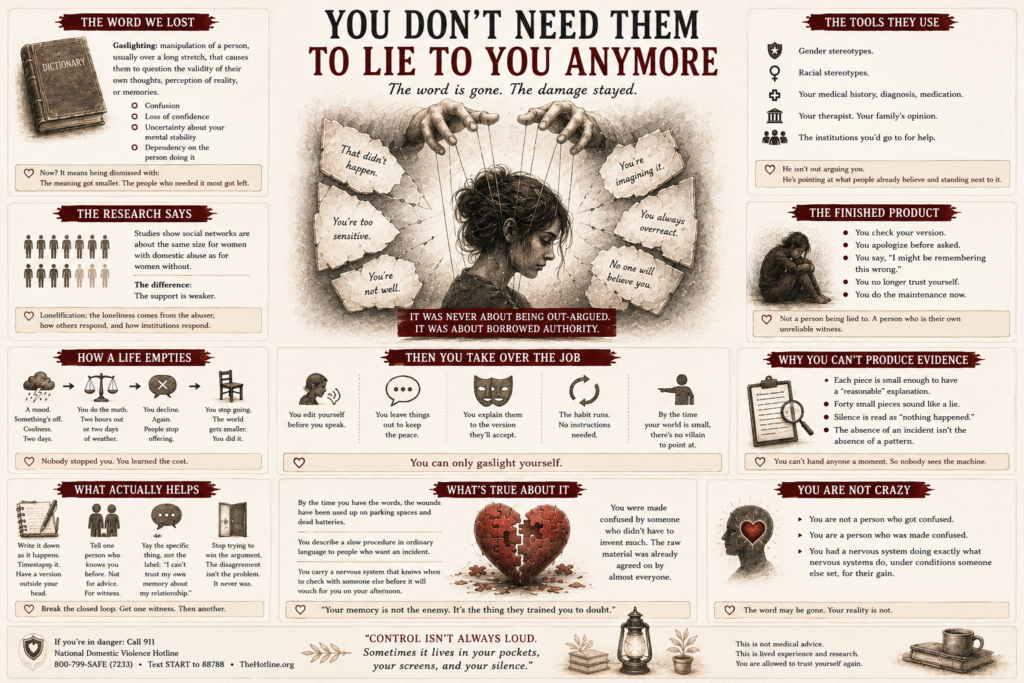
There’s a word for what happened to you, and you can’t use it anymore.
The word is gaslighting. Say it at a dinner table and watch what happens. Somebody’s eyes go flat. Somebody else makes a joke about their boss gaslighting them over a parking space. It’s been worn so smooth that it slides off whatever you were trying to describe, and you end up saying no, I mean the actual thing, which is a sentence nobody has to say about a word that still works.
That’s not a small annoyance, and it isn’t a complaint about language. It’s a second injury. The first one took your account of your own life. The second took the only word that would have let you describe it, and almost nobody writes about that part from the inside.
What the word used to hold
Merriam-Webster made it word of the year in 2022. Lookups were up 1,740% on the year before. That’s not a word entering the language. That’s a word being taken up by everybody at once, which is usually the beginning of the end of it meaning anything.
Its actual definition is narrow and specific. Manipulation of a person, usually over a long stretch, that causes them to question the validity of their own thoughts, their perception of reality, or their memories. The dictionary goes on to name what it produces: confusion, loss of confidence, uncertainty about your own mental stability, and dependency on the person doing it.
Read that last part again, because it’s the part the dinner-table version loses. Not an argument you lost. Not somebody being dismissive. A slow procedure with an outcome, and the outcome is that you can no longer stand up your own account of your own life without help from the person who took it apart.
Now it means being disagreed with. And because it means that, somebody in the middle of the real thing has no way left to name it that gets taken seriously. The vocabulary that was supposed to help them arrived, got popular, and left.
There’s a particular unfairness in that. A word gets coined for a thing so specific that most people never encounter it, and then it turns out to be useful shorthand for ordinary friction, and the ordinary friction wins, because there is far more of it. The people who needed the word most are the smallest group who ever reached for it.
It was never really about being out-argued
Here’s where most explanations stop, and where the interesting research starts.
The standard account treats it as a technique. He denies. He rewrites. He tells you it didn’t happen until you can’t be sure it did. All true, and all incomplete, because it doesn’t explain why the same sentences would bounce off a stranger and land on you.
A sociologist named Paige Sweet published a study in 2019 arguing that this isn’t fundamentally psychological at all. It’s social. Her point is that the manipulation works by borrowing, and what gets borrowed is authority the abuser didn’t have to earn. Gender stereotypes. Racial stereotypes. Your medical history, your diagnosis, your medication, your therapist. The institutions you’d have to go to if you ever tried to get help.
Which reframes the whole thing. He isn’t out-arguing you. He’s pointing at what people already believe and standing next to it.
You’re emotional. You’re dramatic. You’re not well, remember. You were on medication for this. Your family already thinks you’re difficult. Who exactly is going to believe you, and while we’re at it, what would you even tell them.
None of that requires him to be clever. It requires the world to have decided in advance whose account holds up, and the world mostly has. If you’re a man saying a woman is doing this to you, the same borrowing happens with different material. The stereotype recruited is that you are large enough to leave, so nothing much can be happening. That has its own piece, in Narcissism Is Not a Male-Only Problem.
Then the work changes hands
Everything above still describes something being done to you, which means somebody is still doing it. That stage doesn’t last.
What comes next is quieter and much worse. You start checking your version before you offer it. You go back over the conversation looking for where you might have got it wrong. You find yourself saying I might be remembering this wrong, out loud, about something you remember perfectly well, because leading with the concession is cheaper than having it extracted from you later.
By the end I wasn’t being told what I was. I was checking. Years of small corrections had done something I didn’t notice while it was happening: their read on me had stopped sounding like an opinion and started sounding like information. Not a claim I could weigh. A fact about the world that I happened to be inconveniently attached to.
That’s the finished product. Not a person being lied to. A person who has become their own unreliable witness, and who now does the maintenance without being asked, and who cannot point to a single recent incident to explain any of it, because there hasn’t been one in months. There doesn’t need to be.
Why you can’t produce evidence
People who haven’t lived in it always ask for an example, and the example never survives daylight.
He said he never told me about the dinner. She said I always do this. It came out fine when I described it to myself at two in the morning, and then falls apart the second it has to stand on its own in a kitchen at eleven on a Sunday, because each piece is small enough to have a reasonable explanation, and offering forty small pieces makes you sound like somebody keeping a file.
So you don’t offer any of them. And that silence gets read as nothing much having happened, which is the outcome the whole arrangement was pointed at.
This is the same wall described in Is It Abuse If They Never Hit You?. The absence of an incident isn’t the absence of a pattern. It’s just the absence of something you could hand to somebody.
What actually helps
Not the advice that starts with trusting your instincts, because that assumes you still trust yourself enough to act on your own judgment, and that is the thing that was taken.
What does work is external and unglamorous. Write things down as they happen, not afterward, in something with a timestamp. Not to build a case against anybody. To have a version of events that exists outside your head and outside their reach, because the argument you keep losing is about what happened, and a note written at the time doesn’t get relitigated at midnight.
Then tell one person, in the flattest language you can manage, and pick somebody who knew you before. Not for advice, and not so they can adjudicate. What you need is one other memory of who you were, held by somebody with no stake in the answer.
And if you go looking for professional help, say the specific thing rather than the label. “I can’t trust my own memory about my relationship anymore” describes something specific enough to work with. The word, by now, invites a definition argument you did not come for.
The last thing is a decision rather than a tactic. Stop trying to win the argument about what happened. You will not win it. The disagreement is not the problem and it never was, it’s the machinery, and every hour you spend inside it is an hour of confirming that the question is genuinely open. It isn’t. You were there.
What’s true about it
The cruelty of this one is in the timing. By the time you have the words for what happened, the words have been used up on parking spaces and bad managers, and the people you most need to explain it to have already learned to hear the term as an exaggeration.
That leaves you describing a slow procedure in ordinary language, to people who want an incident, about a person who was mostly pleasant in public, while carrying a nervous system that now checks with somebody else before it will vouch for your own afternoon.
The same borrowing runs outside the house as well, on everybody you might have told, and that is in They Told Everyone First.
You are not a person who got confused. You’re a person who was made confused, by somebody who mostly didn’t have to invent anything, because the raw material was lying around and everybody had already agreed to it.
This reflects personal experience and research, not medical or legal advice. If you’re worried about control or abuse in a relationship, the National Domestic Violence Hotline offers free, confidential support 24 hours a day to people of all genders: call 800-799-SAFE (7233), text START to 88788, or chat at TheHotline.org. Use a device you believe is safe. If you’re in immediate danger, call 911.