They Told Everyone First
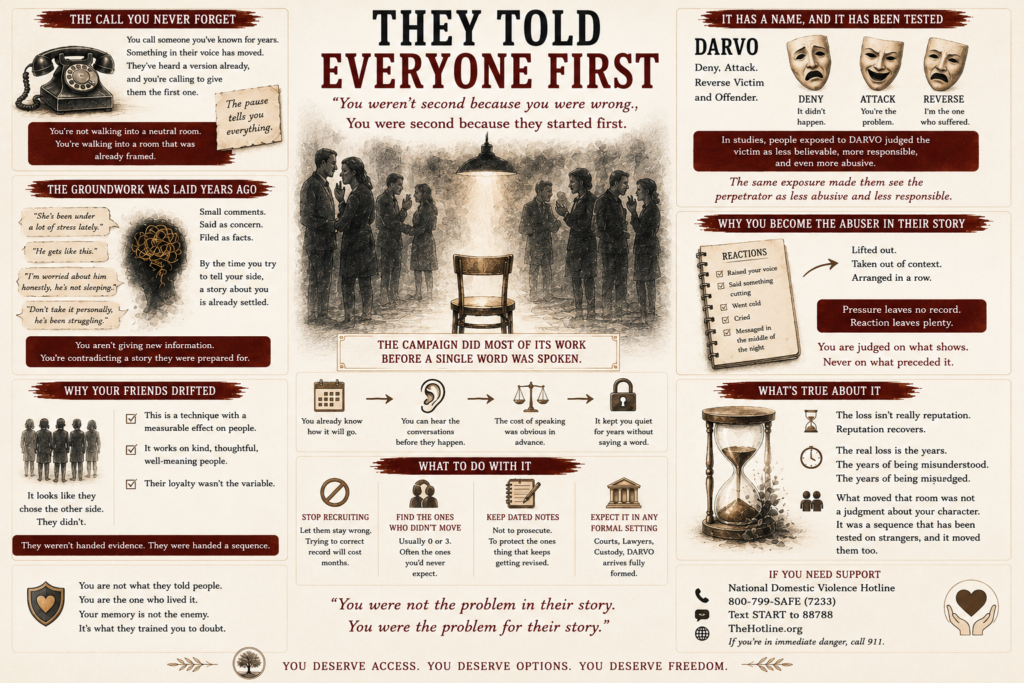
There’s a particular phone call you don’t forget. You ring somebody who has known you fifteen years, and something in their voice has moved. Not hostile. Careful. They’ve heard a version already, and you’re calling to give them the first one, except you’re not, and you can hear in the pause that you’re second.
Most writing about this treats it as revenge. You left, so they went around telling people things. That’s real, and it’s the smaller half of it.
The bigger half is that a lot of it happened before you ever opened your mouth.
The groundwork was laid years ago
Think back and you’ll find it, scattered through ordinary conversations you didn’t file at the time.
She’s been under a lot of stress lately. He gets like this. Don’t take it personally, she’s been struggling since her dad. I’m worried about him honestly, he’s not sleeping. It was never presented as a complaint. It arrived as concern, from somebody who looked tired and loyal, and every person who received it filed away a small idea about your stability without ever noticing they’d been handed it.
That’s why the phone call goes the way it does. You’re not walking into a neutral room and making your case. You’re walking into a room where a frame was installed over several years, and everything you say has to be understood through it. You aren’t giving people new information. You’re confirming a story they were prepared for.
Researchers who study what happens around a separation describe exactly this. The reputational side of it is a recognized part of post-separation abuse, and its function is to get ahead of the account you might one day give. Not to answer your version. To make sure yours arrives late.
It has a name, and it has been tested
Here’s the part that changes how this feels, and almost nobody in the survivor world gets told.
A psychologist named Jennifer Freyd gave the pattern a name in the 1990s: DARVO. Deny, Attack, and Reverse Victim and Offender. Deny it happened. Attack the credibility of the person saying it. Then swap the roles, so the person who did the harm is now the one who was wronged.
You will recognize the whole sequence. It didn’t happen. And frankly you’ve got a memory problem. And after everything I’ve put up with, I’m the one who’s been suffering here.
What makes this worth knowing is that it hasn’t just been described. It has been put in front of people and measured. In the experiments, participants exposed to DARVO rated the victim as less believable, as more responsible for the violence, and, remarkably, as more abusive. The same exposure made them judge the perpetrator as less abusive and less responsible. The effect showed up even in observers who had some knowledge of the subject.
Sit with what that means for a second, because it’s the opposite of what you have probably been telling yourself.
Your friends were not weak
The story most people carry afterward is that the people who drifted were fair weather. That they were fooled because they wanted an easy life, or because he was charming and they were shallow.
I have been on the receiving end of one of these. I am not going to set it out here, because my particular version helps nobody and this is not about me. What I will say is that it worked on people who knew me, and that is the part I could not make sense of for a long time.
The research says something less personal and much harder. This is a technique with a measurable effect on ordinary people, including thoughtful ones, including people who care about you. Run it on a room and the room moves. Their loyalty wasn’t the variable.
That is genuinely worse in one way, because it means there was nothing you could have said. And it is better in another, because the thing you have been carrying, that everyone who mattered looked at the evidence and chose him, is not what happened. They were not handed evidence. They were handed a sequence that has been shown to do this to people.
Why you become the abuser in their version
The reversal is the part that isolates people most, and it follows from the mechanism rather than from anybody’s imagination.
By the end you had reactions. You raised your voice at some point. You said something cutting after the fourth hour of an argument you didn’t start. You went cold, or you cried in front of somebody, or you sent messages at two in the morning that read badly out of context, and out of context is the only way they will ever be read.
All of that is real, and none of it is disputed. It gets lifted out, arranged in a row, and handed to people who never saw what preceded any of it. The reaction survives the story. The years of pressure that produced it don’t, because pressure leaves nothing to show anybody. It’s the same problem that makes the whole pattern so hard to name, described in Is It Abuse If They Never Hit You?
The part that kept you there
This is the piece I’d want somebody to have told me earlier.
Long before you ever thought about leaving, you already knew how it would go. You could hear the conversation before you had it. You knew which relatives would ring each other afterward, what would be said about you being difficult, whose family would take it hardest, that somebody would want to know why you never mentioned any of this at Christmas.
So the campaign did most of its work without a single word being spoken to anybody. It kept you quiet for years by making the cost of speaking obvious in advance. By the time you finally said something, you were not just breaking bad news. You were contradicting a settled understanding of yourself that you had watched being built and had never been able to interrupt.
That’s not cowardice, and it wasn’t a failure of nerve. You were doing accurate arithmetic about a situation somebody else had arranged.
What to do with it
Almost nothing works on the room, and it saves years to accept that early. Rebutting each item makes you look like a person with a list. Explaining the pattern requires an hour nobody has. The tools available to you are not the tools that would win.
What does work is narrow. Stop recruiting. The urge to get people back, to correct the record with somebody who has gone quiet, will cost you months and it very rarely succeeds, because the person you are correcting would have to admit they got you wrong and they were unkind about it. Most people cannot. Let them stay wrong.
Then look for the ones who didn’t move. There are usually two or three, and they are frequently not the ones you’d have predicted. Somebody peripheral. A cousin. A colleague. People closest to the situation are often the most thoroughly prepared, and somebody with a bit of distance sometimes just saw a person they liked getting smaller every year and never needed the explanation.
Keep your records dull and dated. Not to prosecute anybody. Because the version of events you carry in your head is the one thing that keeps getting revised, and a note made at the time does not argue back.
And expect the reversal in any formal setting, because that is where it does the most damage. If there are lawyers, courts, or anything involving children, the deny-attack-reverse sequence tends to arrive fully formed, and the person who knows the name for it is much harder to knock off balance with it.
What’s true about it
The loss here is not really reputation. Reputation recovers, slowly, and mostly by living long enough near people who watch you.
The real loss is the years. The years of not saying anything because you could already hear how it would sound. The years of being pleasant to people who had quietly been told to worry about you. The years of being the difficult one in a story you were never shown and never got to answer.
What the actual leaving takes, and why it is the most dangerous stretch, is in The Most Dangerous Month of Your Life.
And the thing to hold on to is this. What moved that room was not a judgment about your character. It was a sequence that has been tested on strangers who had no reason to be unkind, and it moved them too.
This reflects personal experience and research, not legal or medical advice. If you’re worried about control or abuse in a relationship, the National Domestic Violence Hotline offers free, confidential support 24 hours a day to people of all genders: call 800-799-SAFE (7233), text START to 88788, or chat at TheHotline.org. Use a device you believe is safe. If you’re in immediate danger, call 911.