Financial Abuse: When You Have to Ask for Your Own Money
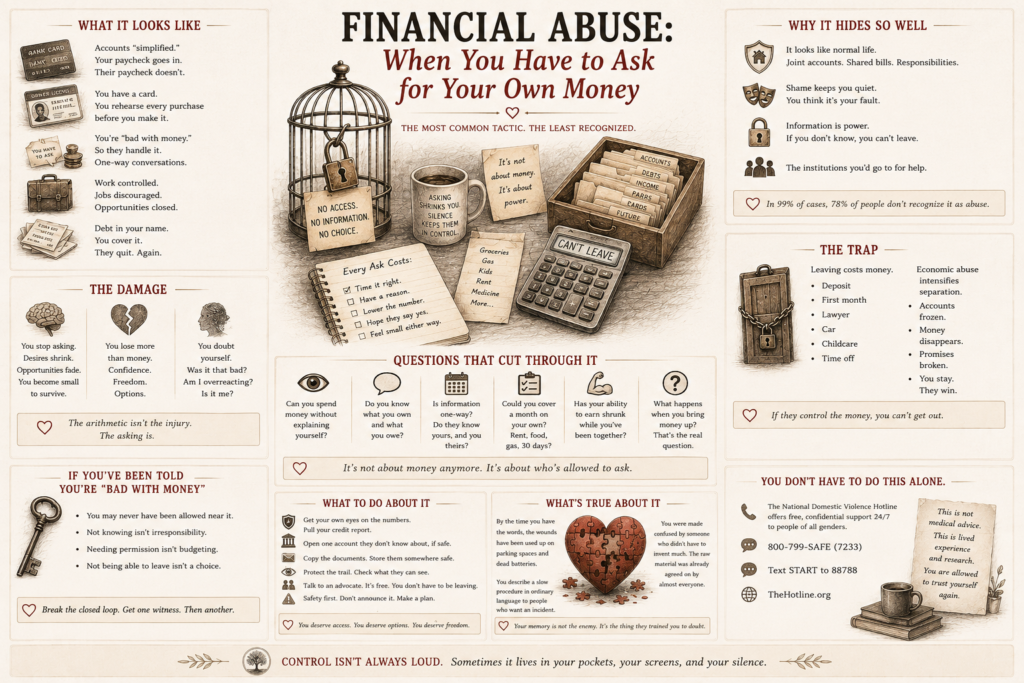
Financial abuse shows up in an estimated 99% of domestic violence cases. Nearly all of them. And roughly 78% of Americans don’t recognize it as abuse at all.
So the most common tactic there is happens to be the one almost nobody can name. That’s not a coincidence. It’s most of the reason it works.
What it looks like from the inside
It’s rarely a man handing his wife an allowance and calling it that. It’s quieter, and it usually arrives disguised as competence or care.
The accounts get consolidated because it’s simpler. Your paycheck goes into the joint one, theirs stays where it is, and nobody planned that, it just happened that way. You’re the one who’s bad with money, which may even have been true once, so they handle it. Big purchases need a conversation, which sounds reasonable, except the conversation only runs one direction. You have a card, but you find yourself mentally rehearsing an explanation for a $12 charge before you swipe it.
Or it runs the other way. They spend and you cover it. Debt shows up in your name that you didn’t agree to. They quit a job, then another one, and the reasons are always about somebody else. You start working more to stay level, which leaves less of you for noticing anything.
Or it’s about work itself. There’s a reason you shouldn’t take that job, and it’s a caring reason. The hours are bad for the kids. The commute is dangerous. That boss sounds like a problem. Each one is arguable on its own and the sum is that you haven’t earned your own money in nine years.
The word advocates use for this is economic abuse, and the definition is plain enough: controlling someone’s ability to get money, use money, or keep money. What makes it coercive control rather than a bad habit is what it produces, which is a person who can’t leave.
What it looked like in my own house
Two marriages, and I couldn’t have told you at the time that either one was happening.
In the second, all of it ran through her. The accounts, the bills, the paperwork. The house was in her name. And here’s the part worth sitting with, because it’s the whole problem in one line: I didn’t think it was a big deal. It never crossed my mind to think about it. We were married, married people share things, and who the deed said owned the house was not a question I was asking.
In the third, I had cards. I had access. I could walk up to any machine in Oregon and take money out. What I couldn’t do was spend anything without it coming up later. Never forbidden. Just noticed, every single time, until I quit doing it on my own.
And I could never work out why we were broke. I was making six figures. She was earning too. We weren’t living above our means, no boat, no second house, nothing anybody could point at. The arithmetic never came together, and I never got a straight answer about where it went.
Years after, I learned there had been an account I didn’t know about. It had a name in the house. The Disneyland account. We never went to Disneyland.
I’m not going to sit here and tell you what was in anybody’s head, because I don’t know, and hunting for intent is a hole with no bottom in it. What I can tell you is what it cost. For most of those years nothing was taken from me, every number I was shown added up fine, and I still went the better part of two decades with no real say over money I earned.
And I’ll tell you where I am with it today, which is not settled.
I still can’t fully explain how it happened. There was no day it started. Nobody sat me down and proposed an arrangement. I signed things because signing them made sense in the moment. I went along because going along is what I did. At no point did any of it feel like anything at all.
That’s the part that still gets me, and it isn’t that it happened. It’s how completely normal it felt the entire time it was happening. Not tolerable. Not something I was putting up with. Normal. The way the weather is normal. I was years into it before the word for it ever came up in a room, and when it finally did, my first reaction wasn’t recognition. It was that the word seemed too big for what I was describing.
All these years later I still turn it over. Some of it I understand now. Some of it I don’t think I’m ever going to.
I’m telling you that on purpose. If you’re reading this and thinking you’d have noticed, that you’re too smart for it, or that you’d never have signed, understand that I thought all of that too, and I was already in it when I thought it.
That’s what this is. Control isn’t theft. It never had to be theft to take your life apart.
Somebody has to handle the money
Before this goes any further, I want to take something off the table, because I’ve watched people read an article like this and go straight to panic about an arrangement that’s perfectly fine.
In most houses, one person handles the money. Somebody’s better at it, or doesn’t mind doing it, or has the patience for a spreadsheet on a Sunday. That is not control. That’s two people dividing up a job, the same as one of them always driving or always cooking.
I’ll be honest that I still can’t call it cleanly on my own second marriage. Everything ran through her, the house was in her name, and I never gave it a thought. Maybe that was control. Maybe it was just how we split the work and I was happy not to deal with it. I’ve turned it over plenty and I’m not certain, and I’d rather say that than pretend I’ve got it sorted.
The third one I have no doubt about, and the difference is worth more than any list of warning signs.
It isn’t who holds the money. It’s whether the other person can get to it.
So the questions are these. If you needed money and didn’t want to explain why, could you get it? If you disagreed about a purchase, would it cost you anything beyond the purchase? Do you know what you own, or only what you’ve been shown? And could you get through next month on your own if you had to?
A person managing the money keeps you informed. A person controlling it keeps you dependent. Those can look identical from the outside and from the kitchen table, and they feel nothing alike at the moment you need to act.
One more thing. None of this cares who’s who. The research on financial abuse mostly documents men doing it to women, and that reflects domestic violence generally. But I sat on the other side of it, and I’m not rare. Wife or husband, the mechanism is the same and so is the test.
Why it hides so well
Three reasons, and they stack.
The first is that money is genuinely complicated, so incompetence and control look identical from outside. Somebody who won’t explain the accounts might be hiding something or might just find it tedious. You can’t tell from one conversation, and neither can anybody you’d ask.
The second is that couples are supposed to merge finances. That’s the normal, healthy, expected thing. Nobody looks at a joint account and thinks cage. So the exact arrangement that makes a marriage work is the one that makes this invisible, and you can’t point at any single step and call it wrong.
The third is the one that does the most damage. Money problems come with their own built-in shame. If you can’t buy your kid shoes without asking, some part of you decides that’s a failure of yours. You’re not earning enough. You’re bad with money. You should have paid more attention. That shame keeps people quiet in a way that other tactics don’t manage, because the story you’ve told yourself is that you’re the one who fell short.
What asking does to a person
The arithmetic isn’t the injury. The asking is.
The first time, it’s nothing. You mention you need new work boots and there’s a conversation about it, and the conversation is reasonable, and you get the boots. Fine.
The fortieth time is a different thing. By then you’ve learned to time it. You raise it when they’re in a decent mood. You have the justification ready before you open your mouth, and you’ve already trimmed the number, because you know the smaller figure goes down easier. You’ve become somebody who prepares a case to buy boots.
Then something quieter happens. You stop wanting things.
Not out of discipline. Because wanting has a cost now. Every want turns into a negotiation, and negotiations can be lost, and losing one in front of somebody who already thinks you’re careless with money is worse than just going without. So the wanting gets smaller. You don’t browse. You don’t mention the trip. You develop opinions about how you never really needed much anyway, and you half believe them.
That’s what makes this one so hard to describe to anybody afterward. There was no incident. Nobody stopped you. You just slowly became a person who doesn’t ask for things, in a life where you’d have to.
The part that turns it into a trap
Every other form of control damages you while you’re in it. This one also decides whether you can get out.
Leaving costs money. A deposit, a first month, a lawyer, a car that runs, time off work, childcare while you sort it. Somebody who controls the money controls all of that, and they don’t have to threaten you with anything. They just have to make sure the arithmetic never works.
That’s why advocates take it so seriously. Somebody can know exactly what’s happening to them, have decided to go, have somewhere to sleep, and still be sitting at the same kitchen table two years later, because the numbers won’t move. From outside that looks like a person who won’t leave. It’s a person who can’t.
The research also finds that economic abuse tends to intensify around separation, exactly when the person needs resources most. Accounts get emptied or frozen. Cards stop working. Support gets promised and doesn’t arrive, and every month it doesn’t arrive is another month they know where you are.
Questions that cut through it
Forget whether it’s fair. Ask what you can actually do.
Can you spend money without explaining yourself? Not a mortgage payment. $40.
Do you know what you own and what you owe? If you had to list every account, card, loan and policy right now, could you? If the answer is no, ask yourself who arranged that.
Is the information one-way? Do you know their income, their accounts, their debts, as well as they know yours?
Could you cover a month on your own? Rent, food, gas, thirty days. Whatever your answer is, notice how fast it came, because most people in this already know.
Has your ability to earn shrunk while you’ve been together? Not your choices. Your ability. Skills gone stale, gaps on the resume, licences lapsed, a career that quietly became a hobby.
What happens when you bring money up? That’s the real one. If asking a normal question about a shared account reliably produces anger, contempt, a lecture, or a mood that lasts two days, the question isn’t about money anymore. It’s about who’s allowed to ask.
What to do about it
Get your own eyes on the numbers. Pull your credit report. In the United States you can get it free, and you’re entitled to it. It will tell you what’s in your name whether or not anyone told you. Do this even if you’re staying, and do it from a device they don’t have access to.
Get one account they don’t know about, if it’s safe to. A small one, at a different institution, with statements that don’t come to the house. Advocates suggest this routinely and it isn’t dishonesty. It’s the same reason you keep a spare key.
Copy the documents. Tax returns, pay stubs, account numbers, the mortgage, insurance policies, titles. Photograph them and store them somewhere that isn’t the house and isn’t a shared cloud account. People who leave without paperwork spend years trying to reconstruct it.
Protect the trail. Check whether your location, your logins, or your card alerts are visible to them. Financial control and digital monitoring travel together more often than not, and what to check, in what order, is in Is My Partner Tracking My Phone?
Talk to somebody who does this for a living. Domestic violence advocates handle exactly this, they do it free, and you do not have to be leaving to call one. Many can connect you with legal help and with programs built specifically for people whose credit was wrecked by somebody else.
And on safety, since this is the one that raises the temperature fastest. Money is the lever, and people who rely on a lever react when they feel it moving. Do not announce that you’re getting your own account or pulling your credit. Do it quietly, and make a safety plan before you make a speech.
If you’ve been told you’re bad with money
99% of cases. 78% of people can’t name it.
If you’ve been told you’re bad with money for long enough that you believe it, consider the possibility that you were never bad with money. You were just never allowed near it.
Not being able to buy something without permission isn’t a budgeting problem. Not knowing what you own isn’t forgetfulness. And not being able to afford to leave isn’t a choice you made.
If this is running alongside other things, the wider pattern is in Is It Abuse If They Never Hit You? and Mistaking Control for Love.
Here’s the one thing I’d have you do tonight. Work out what it would cost you to walk out the door tomorrow morning and keep a roof over your head for thirty days. Just the number.
If the same hand is on the phone and the car, that is Is My Partner Tracking My Phone?. And if any of it comes wrapped in scripture, Spiritual Abuse: You Can’t Win an Argument With God.
If you can’t get to that number, or you can and you don’t have it, that isn’t a budgeting problem. That’s a lock. And somebody else is holding the key to it.
This reflects personal experience and research, not financial or legal advice. If you’re worried about control or abuse in a relationship, the National Domestic Violence Hotline offers free, confidential support 24 hours a day to people of all genders, and can connect you with advocates who specialize in economic abuse. Call 800-799-SAFE (7233), text START to 88788, or chat at TheHotline.org. If you’re in immediate danger, call 911 or your local emergency service.