It Was Never Love. It Was Relief.
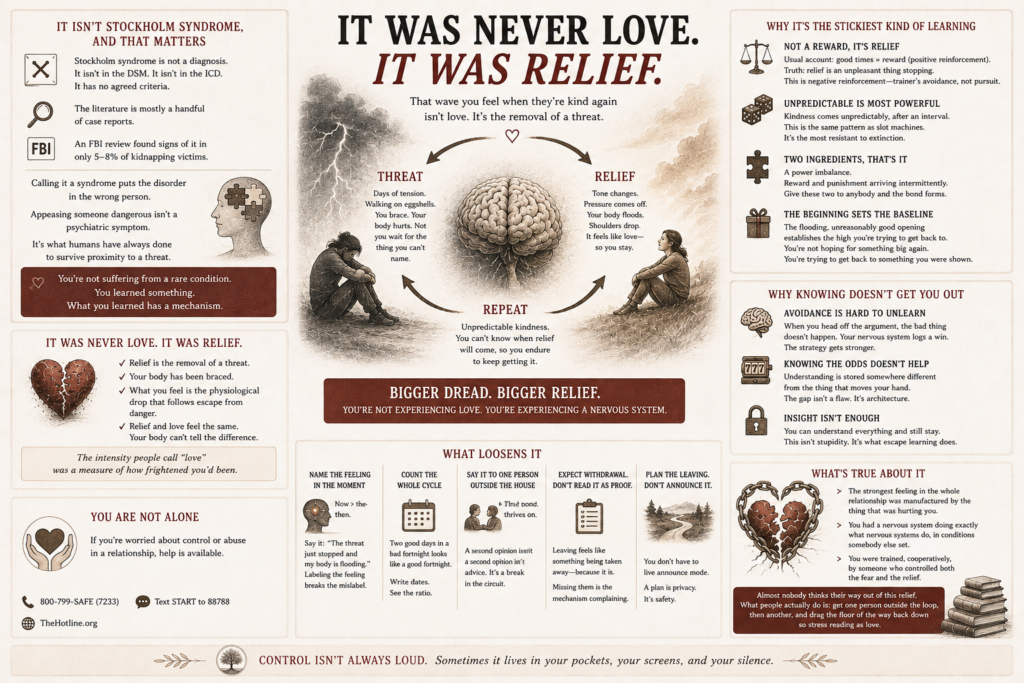
Everybody who has lived in one of these knows the moment. Something has been wrong for two days, the air in the house has weight to it, and you’ve been carrying it around in your chest while you make dinner and answer emails and act normal. Then they say something ordinary in an ordinary voice. A joke, maybe. A hand on your back on the way past.
And what happens in your body is enormous. Your shoulders drop three inches. You could cry. You feel a wave of something so strong and so warm that you’d call it love if anybody asked, and for years you did call it that, and it’s the single most confusing thing about the whole experience.
That feeling is what keeps you there. Working out what it actually was took me years.
It has a name. Researchers call it traumatic bonding; most people know it as a trauma bond. Learning the phrase matters, because it is what you have to type into a search box, say to a therapist, or use to find other people who have been through it. What almost nobody tells you is that the explanation you will meet almost everywhere is missing the part that does the most work.
It isn’t Stockholm syndrome, and that matters
Every article written about this reaches for the same comparison, so start by throwing it out.
Stockholm syndrome is not a diagnosis. It isn’t in the DSM. It isn’t in the ICD. It has no agreed criteria, the literature behind it is mostly a handful of case reports, and an FBI review found apparent signs of it in roughly eight percent of hostages, and fewer on a stricter reading. It’s a phrase that got its authority from a news story in the 1970s and has been coasting on it since.
There’s a harder objection than the evidence, though. Calling it a syndrome puts the disorder in the wrong person. It says the strange thing needing explanation is you, the one who was frightened and adapted, rather than the person who arranged the fear. Appeasing somebody dangerous isn’t a psychiatric symptom. It’s what humans have always done to survive proximity to a threat, and it works, which is why you learned it.
So you’re not suffering from a rare condition named after a bank robbery. You learned something, the way anything gets learned, and what you learned has a mechanism.
It was never love. It was relief.
Here’s the reframe that took the ground out from under me.
What arrives when the tone changes back may not be affection, or not only affection. A large part of it is the removal of a threat. Your body has been braced for two days, running hot, waiting for the thing you couldn’t name, and then the pressure comes off. What you feel in that instant is the physiological drop that follows any escape from danger, and it is enormous.
The problem is telling them apart from inside. Relief can feel warm, close, and physically settling enough to be read as love. Both say the danger’s gone, you’re safe, stay here. So the moment gets filed as evidence of the relationship’s depth, when a good part of what it registered was the fear that came before it.
Which leads somewhere uncomfortable. The intensity people point to as proof that a relationship was real, the highs nothing since has matched, was at least partly measuring the distance between the dread and the relief rather than the depth of what was between you. Bigger dread, bigger drop. That does not mean nothing was there. It means the size of the feeling was never the proof you took it for.
Why a trauma bond is the stickiest learning there is
This is where the popular version of the mechanism tends to go wrong, and the correction matters because it explains everything that follows.
The usual account says the good times are the reward, and you keep going back for them. That’s positive reinforcement, the mechanism behind chasing something pleasant. But relief isn’t a pleasant thing arriving. It’s an unpleasant thing stopping. When the apologizing, the appeasing, or the getting ahead of it appears to be what made the tension lift, behavioral science has a name for what happens to those behaviors: negative reinforcement. It trains avoidance rather than pursuit, and avoidance is the harder of the two to give up.
Then add the timing. The kindness never came on a schedule. It arrived unpredictably, after an interval you couldn’t guess, and unpredictable reward is unusually hard to shake off. It’s the family of schedules slot machines run on, and reinforcement delivered that way tends to produce behavior that outlasts the reward. A relationship isn’t a laboratory and the fit isn’t exact. But the reason is the same either way: you can never be certain the next attempt won’t pay.
The foundational research on traumatic bonding named two ingredients, and only two. A power imbalance, and reward and punishment arriving intermittently. There’s nothing in that account about being weak, or having bad taste in partners, or secretly wanting it. Those two conditions are what the research points at. Not a flaw in you. Researchers are still arguing about why it grips some people harder than others, and nobody has yet found the version where it happens because somebody deserved it.
The beginning matters here too, because that’s where the pattern was set. The flooding, unreasonably good opening described in Why Were They So Good at First? establishes the baseline the relief is measured against. You aren’t hoping for something you imagined. You’re trying to get back to something you were shown.
Why knowing doesn’t get you out
Here’s the part almost nobody writes down, and it’s the honest one.
You can understand every word above and still not leave. People read the articles, recognize themselves completely, close the laptop and go make dinner for the person the article was about. That isn’t stupidity and it isn’t a failure of insight. It’s what escape learning does.
Avoidance is uniquely hard to unlearn, because it never gets tested. When you head off the argument, when you apologize before anybody’s accused you, when you get ahead of it on a Tuesday, the bad thing doesn’t happen. So your nervous system logs a win and the strategy gets stronger. You never find out whether the threat was as big as it felt, because you’ve spent years making sure you never have to.
And knowing the odds has never once cured a gambler. You can hold the entire explanation in your head and still find your hand reaching for the phone. That gap isn’t a character flaw.
So if you’ve read this sort of thing before and stayed, nothing is wrong with you. You were never going to be argued out of it. It comes off in a different way and usually more slowly, and pretending otherwise is how people end up ashamed of themselves on top of everything else.
What actually loosens it
Given everything above, a numbered list would be dishonest. Nobody gets out by working through five steps in the right order. But a few things do turn out to matter, and they are smaller and stranger than advice usually is.
The first is a labeling problem, and it has the advantage of working from inside, with no help and nowhere to go. When the flood arrives, the accurate sentence is not “I love him.” It is “the threat just stopped and my body is reacting.” That sounds like a semantic trick and it is not, because the mislabeling was doing work. Naming it while it is happening puts an inch of space between you and the feeling. An inch is not freedom. It is enough to notice you are inside something, which is where the rest of it starts. If it dissolves nothing, that is expected. It was never going to be the cure.
The second is arithmetic. A few intense reconciliations can end up dominating the memory of a much longer stretch of dread, because relief tends to be the louder of the two. Written down with dates, the ratio stops being deniable, and the record often looks nothing like the memory of it.
The third is one other person. The bond runs on a closed loop in which the same individual is the only source of both the fear and the calm, so a second opinion matters less for being wise than for breaking the circuit. It does not have to be a professional. It has to be somebody who is not them.
Two things are worth knowing in advance. Leaving often feels like something being taken away rather than escaped, and missing them afterward is not evidence that going was a mistake. And the leaving itself gets planned rather than announced, with an advocate, because separation can be the most dangerous stretch, particularly where there has been stalking, threats, weapons, or a partner who was controlling. That is documented, specific, and laid out in How Abuse Kills.
What’s true about it
The cruelty of this one is that the strongest feeling in the whole relationship, the one people hold up afterward as the reason they can’t let go, took much of its force from the thing that was hurting them. Not faked. Not imagined. Genuinely felt, and pointed at the wrong cause.
You had a nervous system doing exactly what nervous systems do, in conditions somebody else set. If that’s still running, it isn’t because you’re weak or because some part of you enjoyed it. It’s because your responses were shaped by somebody who controlled both the fear and the relief, whether or not they could have explained what they were doing.
None of this works without an empty room around it, and how the room empties is in Nobody Took Your Friends.
And the reason you stopped trusting your own account of the good stretches is a mechanism of its own, in You Don’t Need Them to Lie to You Anymore.
And if the plan is to actually go, the danger window and how to plan around it is in The Most Dangerous Month of Your Life.
And if you’re still in it after understanding all of that, you’re in the ordinary position, not the shameful one. Knowing this costs you nothing. Leaving costs you everything you have arranged your life around, which is why the first one never automatically produces the second. What people actually do is get one person outside the loop, then another, and find one day that the flood on the way back down has stopped reading as love.
This reflects personal experience and research, not medical advice. If you’re worried about control or abuse in a relationship, the National Domestic Violence Hotline offers free, confidential support 24 hours a day to people of all genders: call 800-799-SAFE (7233), text START to 88788, or chat at TheHotline.org. Use a device you believe is safe. If you’re in immediate danger, call 911.
Where this comes from
The mechanism in this piece is not folk psychology. It is listed here so you can read it yourself, or hand it to somebody who thinks you are making excuses.
Stockholm syndrome as a diagnosis. Namnyak and colleagues, “Stockholm syndrome”: psychiatric diagnosis or urban myth?, Acta Psychiatrica Scandinavica. The review that found no agreed criteria and a literature made mostly of case reports.
Traumatic bonding, the original model. Dutton and Painter, who identified the two conditions understood to promote the bond: a power imbalance, and reward and punishment arriving intermittently. Their model proposes conditions that foster it, not a rule that it forms in everyone exposed to them.
Why intermittently rewarded behavior persists. Resistance to Extinction following Variable-Interval Reinforcement. Slot machines are the variable-ratio case rather than this one; the shared finding is that reward delivered unpredictably produces behavior that outlasts it.
Why avoidance outlives the threat. Negative reinforcement rate and persistent avoidance following response-prevention extinction. This is the research behind the section on why understanding it does not release you from it.