You Could Say No. You Just Couldn’t Afford To.
There’s a question underneath a lot of relationships that almost nobody asks out loud, because the answer feels like it would make them the villain. If you said yes, was it consent?
Most people were taught the line sits in one place. Force on one side, agreement on the other. Nobody made you. You opened your mouth and the word that came out was yes. So whatever that was, it counts as something you chose, and the discomfort afterward is yours to carry quietly.
Before anything else, understand where that idea came from, because it wasn’t an accident.
It was legal here until 1993
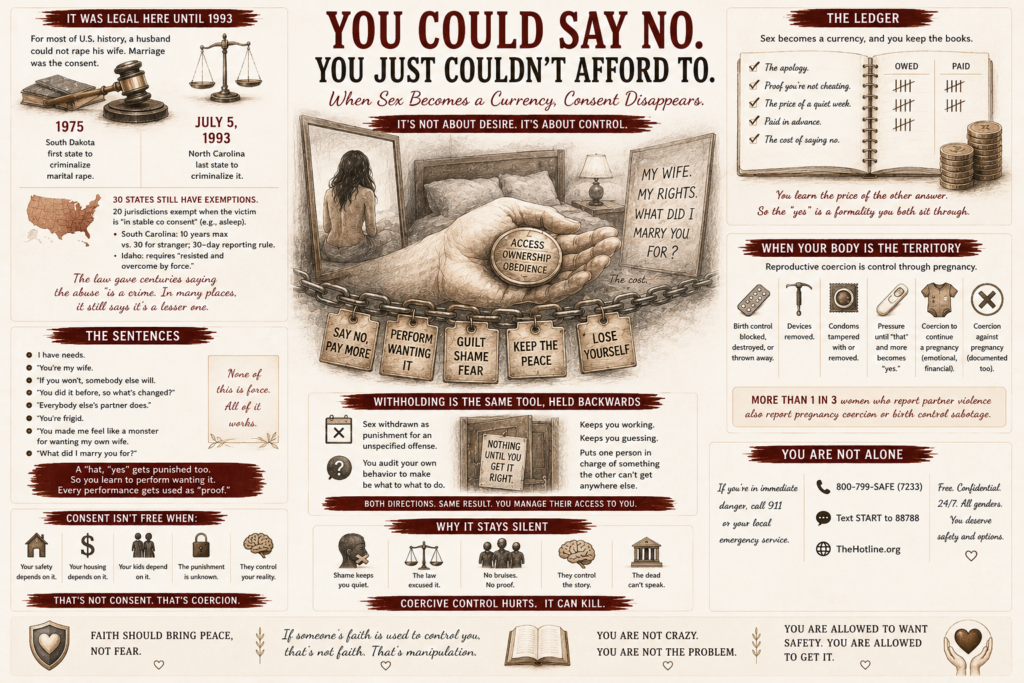
For most of American history a husband could not rape his wife, not because it didn’t happen but because the law said the act did not exist. Marriage was the consent. It was given once and it covered everything afterward.
South Dakota was the first state to make it a crime, in 1975. The last was North Carolina, on July 5, 1993. If you’re an adult reading this, you were alive on the day that finished.
And it didn’t really finish. Thirty states still carry exemptions that treat the same act differently when the people are married. As of 2019, twenty jurisdictions had exemptions covering offenses where the victim was unable to consent, which in plain language means being asleep counts for less if you’re married to them. South Carolina caps spousal sexual battery by aggravated force at ten years, against thirty for the identical act by a stranger, and won’t let a prosecution proceed at all unless it was reported inside thirty days. Idaho requires that a spouse resisted and was overcome by force.
Read that again as a survivor rather than a citizen. The law spent centuries telling you this wasn’t a category of harm, and in thirty states it still says it’s a lesser one. Then people wonder why victims don’t come forward, or why they can’t find the words. The words were removed on purpose.
The ledger
Here’s what it looks like from inside, and it has almost nothing to do with any particular night.
Sex stops being something two people do and turns into currency. It becomes the apology when you’ve done nothing wrong, because it’s the only apology that gets accepted. It becomes the proof you’re not cheating, offered on demand and never quite sufficient. It becomes the price of a quiet week, paid in advance, because you’ve learned exactly what the alternative week costs.
Once it’s currency you’re keeping accounts. You know roughly how long it’s been. You can feel the balance running down. You do arithmetic on a Tuesday about whether tonight buys enough peace to survive the weekend, and you make yourself available before anybody asks, because being asked and refusing costs more than getting ahead of it.
That’s the part with no name. Not assault. Not even really an argument. A running debt in a currency that happens to be your body, and the interest is your own dread. It’s the same machine described in Is It Abuse If They Never Hit You?, operating in the one room nobody wants to look into.
The sentences, and the acting
You’ll know these if they were used on you. I have needs. We’re married. If you won’t, somebody else will. You did it before, so what’s changed. Everybody else’s partner does. You’re frigid. You’ve made me feel like a monster for wanting my own husband. What did I marry you for. And the one saved for men: most guys would be grateful.
None of that is force. All of it works. The reason it works isn’t that the argument is persuasive, it’s that you already know the price of the other answer, so the argument is a formality you both sit through.
What almost nobody writes down is the next part, and it’s the one that keeps people silent for decades. Compliance wasn’t enough. A flat, obedient yes gets punished too, because it exposes the thing as what it is. So you learned to perform wanting it. You made the sounds. You initiated sometimes, partly so you could pick the moment rather than have it picked for you.
And every one of those performances got filed by them as evidence. You wanted it. Look how you were. You started it that time. Which is exactly why, years later, you can’t tell your own story without it sounding like a lie, and why the first person you tell might be the last.
Withholding is the same tool, held backwards
Run it the other direction and nothing about the machine changes.
Sex withdrawn as punishment for an offense that’s never specified is the same instrument. Weeks of nothing, no explanation, no argument you can locate and settle. You’re left auditing your own behavior for whatever you must have done, which is the entire point. It keeps you working. It keeps you guessing. It puts one person in charge of something the other can’t get anywhere else without ending the marriage.
Both directions produce the same result. You spend your life managing another person’s access to you, and the managing is the job.
When your body is the territory
Underneath all of that sits a layer with a clinical name and doctors trained to screen for it.
Reproductive coercion is control exercised through pregnancy. Contraceptives destroyed, hidden, or thrown away. Devices removed. Holes in condoms, or removal during sex without telling you. Pressure and threats aimed at wearing down a no until it stops being a no.
More than a third of women who report partner violence also report pregnancy coercion or birth control sabotage. It runs in both directions: the peer-reviewed evidence says coercion into continuing a pregnancy is the more common one, but coercion the other way is documented too, through guilt, money, sabotaged appointments, and threats of harm.
And it does something nothing else here can. It installs a permanent tie. A child isn’t something you can go no contact from. Somebody who cannot keep you any other way can keep you for eighteen years, and the family courts will help them do it.
Men are in this, and the counting hides them
About one in ten men have been sexually coerced in their lifetime, meaning worn down, lied to, pressured, or threatened with the end of the relationship until they gave in. Of the men who report it, roughly seven in ten name an intimate partner, and about 84% name a female perpetrator and no other.
There’s also a category most people have never heard of, and it exists because of how the counting works. The CDC’s definition of rape requires being penetrated, so a man forced to penetrate somebody is filed somewhere else entirely. About one in fourteen men have been made to penetrate someone, and around 79% of them name a female perpetrator. Because those cases sit in a different box, not one of those men appears in the rape figure anybody quotes. Same result the law produced, reached by a different route.
A man in this position carries the ordinary problem of not being believed, and then one that’s specific to him: the belief that he can’t have been coerced because his body responded. Arousal isn’t consent. It’s a reflex, and it fires under fear about as readily as under wanting. Plenty of men have spent twenty years treating their own physiology as a confession. The wider version of that argument is Narcissism Is Not a Male-Only Problem.
When being known is the leverage
It happens in same-sex relationships too, and by the numbers it happens more. Lifetime intimate partner violence runs at 43.8% for lesbian women and 61.1% for bisexual women, against 35% for heterosexual women, which makes bisexual women the most-affected group in the entire survey. Among men it’s 37.3% for bisexual men and 26% for gay men, against 29% for heterosexual men.
What gets added is a form of leverage with no equivalent in a straight relationship, and researchers have a name for it. Identity abuse. Stay, or I tell your family. Stay, or I tell your work. Stay, or your church finds out. For somebody whose job, housing, or family still depends on not being known, that one sentence does the work a raised hand does elsewhere, and it leaves nothing behind to point at.
It goes past the threat of exposure. Partners weaponize the question itself, telling a bisexual person they aren’t really bisexual, or that they’re only here until they go back to the other thing. Somebody’s HIV status becomes a thing held over them. And then the trap closes, because reporting any of it can mean outing yourself to a police officer, a shelter intake worker, or a courtroom, before you were ready and with no guarantee of help at the other end. The ledger runs the same. The currency just includes who gets to know who you are.
The far end of the same road
This is where people stop believing it happens in ordinary relationships. Partners lend each other out. Partners sell each other.
It starts as a suggestion dressed as adventure, or generosity, or a favor that solves a money problem, and it gets reframed afterward as something you already agreed to. Once it’s happening regularly the leash changes. It’s no longer the original threat. It’s that they’ll tell people what you’ve been doing, and by then there are photographs.
The research here should change how you read your own history. People trafficked by a romantic partner describe recruitment that didn’t look like recruitment. It looked like being loved. One 2024 study found 68% said their trafficker’s grooming tactic was love-bombing.
The flooding, too-good beginning described in Why Were They So Good at First? is the documented opening move of somebody who will eventually sell you. Not a different playbook. The same one, further along, which means that for a while the two are indistinguishable from the inside.
It’s on the list with the gun
Now the fact that makes this more than a chapter about dignity.
Decades of work on which abusive relationships turn fatal produced a short, specific list of predictors. Access to a firearm. Prior non-fatal strangulation. A previous threat with a weapon. And prior rape of the victim by her partner.
It isn’t a separate, more private category of harm sitting alongside the dangerous things. It’s on the list with the gun. Women who’d been sexually assaulted by their partners scored higher for homicide risk even after accounting for all the other violence they’d survived. That work was done on women, because women are who the fatality studies followed, which means nobody can tell you the equivalent number for men.
So if this happened to you, you aren’t carrying a shameful private thing. You’re carrying a risk factor, and it belongs in front of an advocate for the same reason a hand on your throat does. The rest of that list is in How Abuse Kills.
What it costs after
Nobody warns you about this part.
Years of using your body as payment teaches your body that sex is a transaction with consequences attached, and that doesn’t switch off because the relationship ended. It shows up later, with somebody kind, when you can’t tell the difference between wanting and bracing. When you go somewhere else in your head out of habit. When your body won’t cooperate with a person who hasn’t done anything wrong, and you have to decide whether to explain or apologize.
Some people go numb for years. Some can’t be touched from behind, or in the dark, or while half asleep. Some find they only know how to initiate, because being asked still lands like a bill arriving.
That’s not damage you caused. It’s a skill you were forced to learn, and it outlasted the person who made you learn it.
What to do with it
Say it to somebody trained, in plain words. The National Domestic Violence Hotline is 800-799-7233. You don’t need a story that sounds like a crime. “I have sex I don’t want because it’s easier” tells them everything.
If there was force, say the word. It moves you into a different risk category, the same as strangulation does. That’s not an opinion, it’s what the research says.
Tell a doctor about the birth control. Sabotaged pills, removed devices, holes in condoms. They’re trained for it, there are methods that can’t be tampered with, and it can be done without anybody else knowing.
Check your own state’s law before you assume there’s no case. The exemptions are real, some carry reporting deadlines as short as thirty days, and an advocate will know your state’s rules better than a search engine will.
Stop grading yourself on whether you resisted hard enough. The question was never whether you fought. It’s whether refusing was actually available, and you already know the answer.
What’s true about it
The reason this stays buried isn’t that it’s rare. It’s that the story a person has to tell about it makes them sound like a participant, because in the literal sense they were. They said yes. They kept the ledger. They performed. They got ahead of it on a Tuesday so the weekend would be survivable, and got good enough at it that from outside it looked like a marriage.
That arithmetic is not consent. It’s a person managing a threat with the only currency they were allowed to keep, and being good at it is evidence of what they were living in, not evidence that they chose it.
There’s no box on any form for a decade of yes that meant no. For most of this country’s history there wasn’t even a law, and in thirty states there still isn’t a whole one. So it stays inside the person it happened to, who eventually concludes it must not have counted, because nothing anywhere ever said it did.
Why the good stretches afterward felt like proof of something is a mechanism in its own right, in It Was Never Love. It Was Relief..
It counted.
This reflects personal experience and research, not medical or legal advice. Laws vary by state and change. If you’re worried about coercion, control, or abuse in a relationship, the National Domestic Violence Hotline offers free, confidential support 24 hours a day to people of all genders: call 800-799-SAFE (7233), text START to 88788, or chat at TheHotline.org. For sexual assault specifically, RAINN is 800-656-4673. Use a device you believe is safe. If you’re in immediate danger, call 911.
Where these numbers come from
Every figure above is drawn from published research or from state statute. They are listed here so you can read them yourself, or hand them to somebody who does not believe you.
The legal history and the surviving exemptions. The United States Still Says “I Do” to Marital Rape: An Examination of Modern Marital Rape Exemptions, and the National Criminal Justice Reference Service summary Marital Rape: History, Research, and Practice. South Dakota 1975, North Carolina 5 July 1993.
Sexual assault inside abusive relationships. Campbell and Soeken, “Forced Sex and Intimate Partner Violence,” Violence Against Women, 1999.
Sexual violence as a predictor of being killed. Intimate Partner Sexual Violence Poses Risk Factor for Homicide, alongside the wider risk-factor literature in How Abuse Kills.
Reproductive coercion. The American College of Obstetricians and Gynecologists, Reproductive and Sexual Coercion, and Reproductive Coercion and Intimate Partner Violence Victimization Among a Racially and Ethnically Diverse Young Adult Sample.
Trafficking by a romantic partner. An Analysis of Romantic Partnership Dynamics in Domestic Minor Sex Trafficking Case Files. The love-bombing figure is Kenney and Raghavan, 2024.
Men, sexual coercion, and made to penetrate. CDC, Intimate Partner Violence, Sexual Violence, and Stalking Among Men, from the National Intimate Partner and Sexual Violence Survey.
Same-sex relationships and identity abuse. CDC National Intimate Partner and Sexual Violence Survey findings by sexual orientation, summarized by the Human Rights Campaign, and the Williams Institute review of intimate partner violence and sexual abuse among LGBT people.