Nobody Took Your Friends
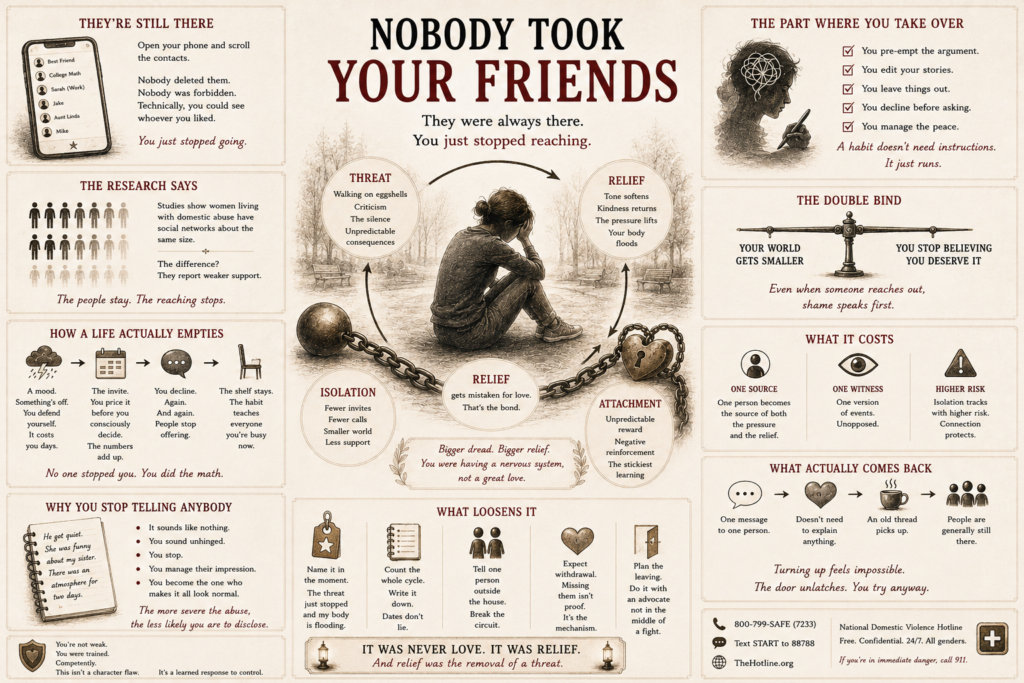
Open your phone and scroll the contacts. They’re nearly all still there. The friend from the old job. The cousin you used to talk to every Sunday. The two people who were at your wedding and would still take your call at two in the morning if you made it.
Nobody deleted them. Nobody was forbidden. If you asked, and you probably did ask at some point, you’d have been told you could see whoever you liked, and it would have been technically true.
That’s the part that makes isolation so hard to describe afterward. There was no moment anybody cut you off. You just noticed one day that a whole life had emptied out, and that you appeared to have done it.
The friends never actually left
This is where the research says something almost nobody repeats.
Studies comparing women living with domestic abuse against women who aren’t have found their social networks are about the same size. The same number of people. What differs is that women in abusive relationships report the support they receive as weaker.
Read that carefully, because it turns the standard story inside out. The usual account has the abuser removing people from your life, one by one, like a man taking books off a shelf. Mostly that isn’t what happens. The people stay on the shelf. What stops is your reaching for them.
A 2026 study of how this works gave the process a name: lonelification. And it found something worth sitting with. The loneliness doesn’t come only from the abuser. It comes from the abuser, and from how the people around you respond, and from the institutions you eventually go to. Three sources, and only one of them is the person you’re living with.
How a life actually empties
It goes in an order, and none of the steps look like anything at the time.
It starts with a mood. You come home from a night out and something is off. Not an accusation, nothing you could write down. Just a coolness that lasts into the next day and a conversation about how much you’d had to drink, or how you were with somebody’s husband, or how you seem different around those people. You defend yourself. You win the argument, or you think you do. It costs you two days.
The next invitation arrives about three weeks later, and something happens that nobody warns you about. Before you’ve consciously decided anything, you’ve priced it. Two hours with your friends against two days of weather in the house. And you find yourself typing that you can’t make it this time, work is mad, next month for sure.
Nobody stopped you. You did a calculation and the numbers were bad.
Then it compounds, because declining is a habit that teaches other people things. Cancel three times and the fourth invitation doesn’t come, not out of spite but because people stop offering where they keep being refused. Your friend isn’t punishing you. She’s just learned you’re busy now.
And here’s the piece of it that does the most damage: by the time your world is small, there’s no villain to point at. You can’t say he stopped me seeing my friends, because he never did. He was quite reasonable about it. All you can say is that you stopped going, which sounds like a description of your own personality.
Then you take over the job
Somewhere in there the work changes hands.
You start pre-emptively editing your life so it doesn’t produce weather. You don’t mention the colleague you got on with. You leave a name out of a story. You keep the lunch that went well to yourself, because enthusiasm about anybody else has a way of being expensive later. When somebody suggests a weekend away you say no before you’ve even checked, because you already know how the asking would go and you’d rather not spend the evening on it.
None of that requires an instruction. It’s what anybody does after enough repetitions, and it is far more effective than a prohibition, because a prohibition can be resented and argued with. A habit just quietly runs.
I’d started drafting explanations in my head before anybody asked for them, over things as small as forty minutes at a feed store. That reflex doesn’t stay in one place. Once you’re composing accounts of your own afternoon, you’ve already begun trimming the afternoon down to something easier to account for.
Why you stopped telling anybody
There’s a second isolation running under the first one, and it’s the one that lasts longer.
Try to describe it to somebody. Nothing you can say sounds like anything. He got quiet. She was funny about my sister. There was an atmosphere for two days. Said out loud, in daylight, to a reasonable friend, it sounds like you’re describing a person in a bad mood and calling it a crime. You can hear yourself sounding unhinged while you’re still speaking.
So you stop. Not because you were forbidden, but because you tried twice and the response was a slightly puzzled face and the sense that you’d used up some credit.
After that you go the other way and start managing their impression instead. You explain why he couldn’t come. You laugh about how he is with parties. You become, without ever agreeing to it, the person whose job is making the situation sound normal to everybody outside it. That work is exhausting and completely invisible, and it’s why the family asking how did nobody see this are asking the wrong person. They didn’t see it because you spent years making sure of it.
The research has a blunt version of this. The more severe the abuse gets, the less likely people are to disclose it or seek help. It works backwards from how anybody would expect. The worse it is, the quieter you get.
The part where you stop feeling worth calling
Then the two halves meet.
While your world has been narrowing, something else has been happening to your estimate of yourself. Years of small corrections, of being told how you come across, of having your read on things adjusted, and you arrive at a place where you don’t just lack people to call. You’ve stopped believing you’re somebody worth a friend’s Tuesday evening.
Researchers describe it as a double bind, and that’s exactly what it is. The network has thinned at the same time as your sense of deserving it. So even on the day somebody does reach out, the honest reaction isn’t relief. It’s a flicker of shame, and a quick calculation about how much of your actual life you’d have to hide to get through the coffee.
If that self-estimate feels like your own settled opinion rather than something installed, the mechanism behind it is in Mistaking Control for Love.
What it costs, and what actually comes back
Isolation isn’t only lonely. It’s the condition every other part of this depends on.
With nobody else in the room, one person becomes the sole source of both the pressure and the relief, which is the exact arrangement that produces the attachment described in It Was Never Love. It Was Relief. One person becomes the only witness, so their version of events is unopposed. And the research is consistent that social and geographic isolation both track with higher risk, while people with somebody available seem measurably better protected.
The way back is smaller than it sounds and worse than it sounds, in that order. It’s one message to one person, and the message doesn’t have to explain anything. Most people who do this send something that has nothing to do with abuse at all. A photo. A joke that’s four years out of date. Something that lets an old thread pick up without requiring a confession first.
What the same process does to your grip on your own memory, rather than your address book, is in You Don’t Need Them to Lie to You Anymore.
And the reason the people who did stay had already been prepared for a version of you is in They Told Everyone First.
What makes it hard isn’t the typing. It’s that you’ll be certain you’ve left it too long, that they’ve moved on, that turning up now with your particular mess would be an imposition. That certainty is the most reliable symptom of the thing itself, and it’s wrong roughly as often as it’s felt. People are generally still there. They were the whole time.
This reflects personal experience and research, not medical or legal advice. If you’re worried about control or abuse in a relationship, the National Domestic Violence Hotline offers free, confidential support 24 hours a day to people of all genders: call 800-799-SAFE (7233), text START to 88788, or chat at TheHotline.org. Use a device you believe is safe. If you’re in immediate danger, call 911.